How Much Does HR Software Cost Per Employee in 2026?
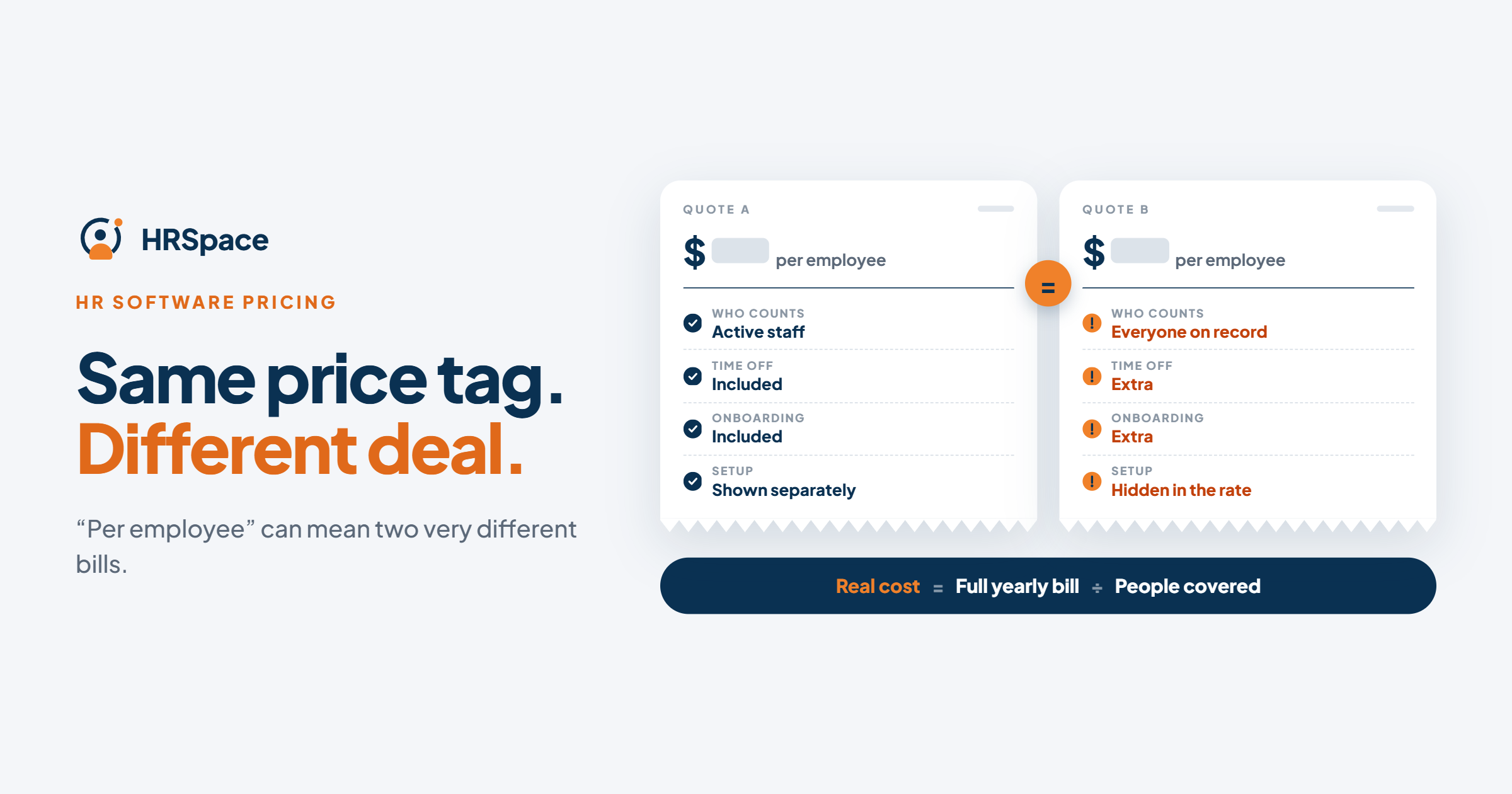
The short answer: most HR software for small and mid-size companies lands between roughly $8 and $25 per employee per month, according to 2026 pricing roundups. Entry-level options can be lower, and mid-market platforms sit higher. The number you pay depends on four things: what the vendor counts as an employee, which modules are included, what fees sit on top, and how the contract works.
This guide gives you the ranges, explains why quotes can’t be compared by rate alone, and shows how to work out your real cost per employee. It also shows HRSpace’s published prices as a worked example.
What popular platforms charge
These figures come from vendor pages and third-party summaries. Several vendors don’t publish prices, so treat estimates as indicative.
| Platform | Reported pricing | Notes |
|---|---|---|
| BambooHR | Core about $10, Pro about $17, Elite about $25 per US employee per month above 25 employees | Smaller teams from about $250 per month; payroll, benefits administration and time tracking are add-ons |
| Gusto | Simple $49 + $6 per person, Plus $80 + $12, Premium $180 + $22 per month | Payroll-first, aimed at US small businesses |
| Rippling | From around $8 per employee per month, by quote | Modular; each added product adds cost |
| HiBob | Quote-based; estimates around $16 to $25 | No public pricing |
| Personio | Quote-based; estimates range from about $3 to $8 | Pricing varies by modules and contract |
| Zoho People | Low entry pricing in some reviews | Payroll and recruiting are separate products |
Roundups put entry-level platforms such as Gusto and BambooHR at up to about $25 per employee, and mid-market platforms such as Rippling and HiBob at about $16 to $29.
The four pricing models
- Per employee per month. Headcount multiplied by a rate.
- Base fee plus per employee. A platform fee plus a per-person rate.
- Modular per employee. Each module priced separately, so the total depends on how many you add.
- Flat fee. One price per workspace, regardless of headcount.
A low rate on a modular plan can be misleading if the module you need costs extra.
Costs that don’t show in the rate
- Minimums. Some plans have a flat floor for small teams, so a five-person company can pay a much higher effective rate than the headline.
- Add-ons. Payroll, time tracking, recruiting and performance are often extra.
- Implementation and migration. Some vendors charge for set-up, data migration or training.
- Support and services. Check what’s included.
- Contract terms. Annual commitments, minimum terms and rules for changing headcount.
- Who counts as an employee. Active staff, contractors, people on leave and leavers can be treated differently.
How to calculate your real cost
- Confirm who counts as a billable employee, in writing.
- List the work you need software for now, and what can wait.
- Add all recurring charges for that scope, including any platform fee and add-ons.
- Divide by the employees covered for the same billing period. That is your effective cost per employee.
- Keep one-off costs separate. Implementation belongs in your first-year budget, not your ongoing one.
- Ask how the bill changes when headcount grows or shrinks, and when adjustments take effect.
Send every vendor the same brief, so a narrower proposal doesn’t look cheaper only because it leaves work out.
A worked example: HRSpace’s published prices
HRSpace publishes its pricing, so the maths is simple. There’s a $1 per employee per month base layer (employee records, documents, time off and timesheets), and you add modules as needed:
- Onboarding: $0.50
- Service Me (internal service desk): $0.50
- Goals & Performance: $1
- Recognition & Feedback: $0.66
- AI Recruitment: $1
Here’s what that comes to:
| Team size | Core (base + Onboarding + Service Me) | Base plus all five modules above |
|---|---|---|
| 20 employees | $40/month | $93.20/month |
| 50 employees | $100/month | $233/month |
| 100 employees | $200/month | $466/month |
That is about $2.00 per employee per month for the core set and $4.66 with all five modules, billed monthly, with no setup fee and a 14-day free trial.
Compare like with like
HRSpace doesn’t process payroll, so a fair comparison with a payroll-inclusive platform has to add a payroll provider’s cost to HRSpace’s. And a higher-priced platform may include things you won’t use. The point is to compare complete quotes for the same scope, not rates.
What to ask every vendor
- Who counts as a billable employee?
- Which modules does the quote include, and what costs extra?
- Is there a platform fee or a minimum?
- What are the implementation, migration and training charges?
- What support is included?
- What happens to the bill if headcount changes?
- What are the term and renewal conditions?
Frequently asked questions
How much does HR software cost per employee?
Most platforms fall between about $8 and $25 per employee per month, depending on the vendor, modules and contract. Some are lower, and some higher.
Is the cheapest rate the cheapest option?
Not necessarily. Compare the full recurring bill, one-off costs and what’s included.
Is modular HR software cheaper?
Not automatically. Compare a full quote for the same workflows.
Should I budget implementation separately?
Yes, so your first-year and ongoing budgets stay clear.
What does HRSpace cost?
HRSpace has a $1 per employee per month base and modules from $0.50 to $1, billed monthly with no setup fee.
Can I try HRSpace before buying?
Yes, with a 14-day free trial and no credit card.
One last thing
Keep two records: a cost comparison and a checklist showing whether the quote covers the work. A clear quote without a demonstrated process is an incomplete decision, and so is a good demo with unclear terms.
Where to go from here
To see what you’d pay for your own team, start a free 14-day HRSpace trial or check the pricing page. If you’re comparing platforms, see how HRSpace stacks up against BambooHR, Personio and Rippling.
Ready to make HR the easy part?
Explore modular pricing and start a free 14-day trial.