Employee Recognition Software for Sales Teams: A 2026 Guide
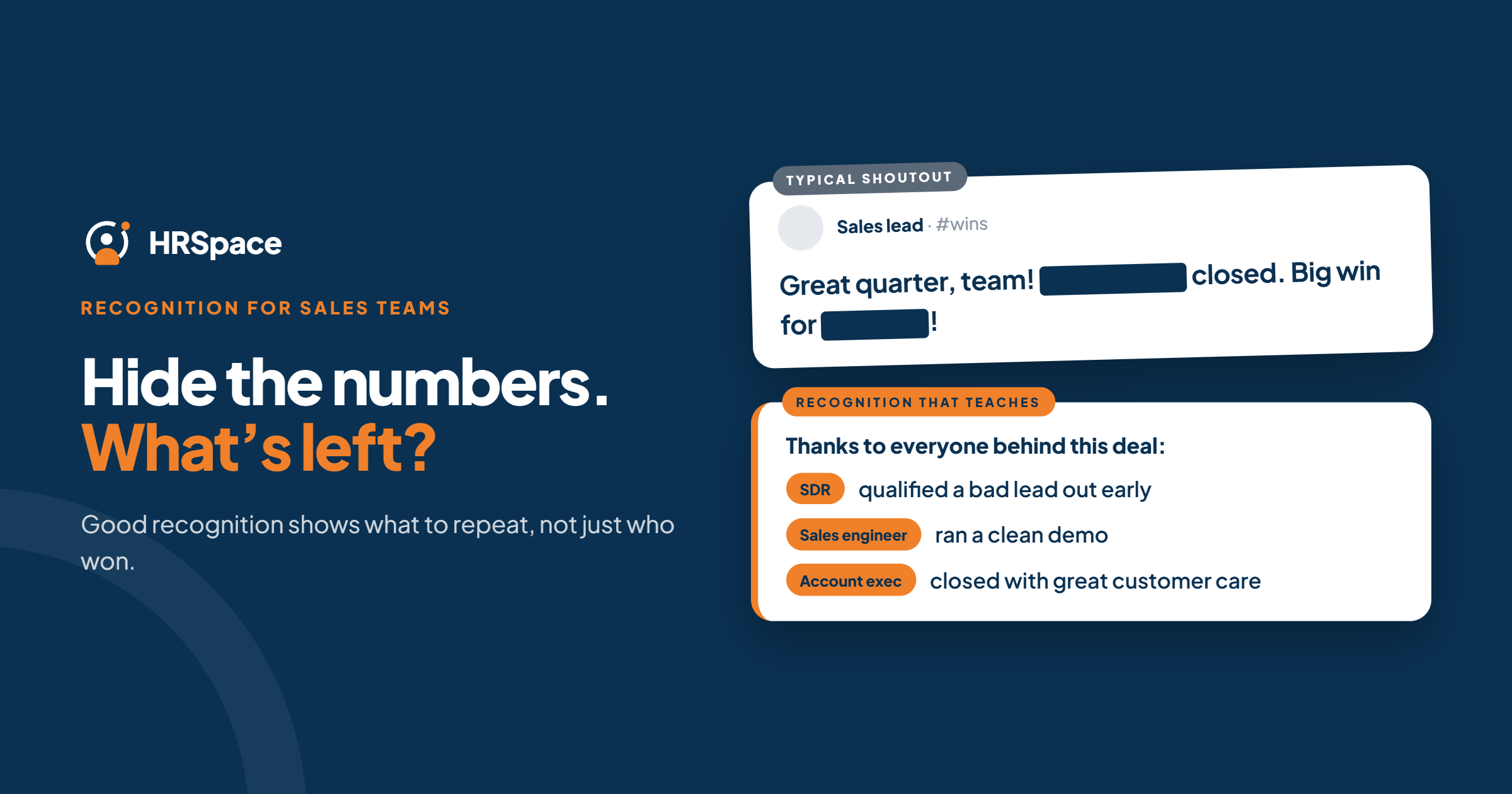
Sales teams already have a scoreboard. Revenue is visible, ranked and updated daily. What usually goes unseen is everything around it: the rep who qualified out a bad-fit deal, the sales engineer who saved a demo, the account executive who handed over a clean customer.
Recognition software can fix that, but "recognition software for sales" means two different things, and picking the wrong one is the most common mistake.
Two kinds of tool
Sales gamification platforms such as SalesScreen, Spinify, Hoopla, Ambition and LevelEleven connect to your CRM and sales activity. They run leaderboards, contests and targets, and celebrate results as they happen. Roundups describe them as tying recognition to defined sales activities, outcomes and competitions.
HR recognition tools let colleagues and managers acknowledge specific contributions, usually across the whole company. They are about appreciation and behaviours, not live sales numbers.
Neither is better. They answer different questions. Gamification asks "who is winning?" Recognition asks "what did good work look like here, and does everyone see it?"
If you want live leaderboards and contests driven by CRM data, you need a sales gamification tool. If you want a consistent way to acknowledge the work that never reaches the leaderboard, and to keep it alongside goals and reviews, an HR platform's recognition module is the better fit. HRSpace is the second kind.
What to recognize besides closed deals
A revenue ranking recognises outcomes. Write down the behaviours you want repeated:
- Pipeline quality: accurate qualification, useful opportunity notes, and the discipline to drop a poor-fit deal early.
- Team contribution: help with demos, proposals and handovers.
- Customer care: honest expectation-setting and clear follow-through.
- Role-specific craft: research and prospecting for development reps, technical discovery for sales engineers, negotiation and handoff quality for account executives.
Roles are not interchangeable. Judging a sales engineer by closed revenue means their work is never seen.
Set it up so people trust it
Publish the criteria. If reps have to guess what earns recognition, it becomes popularity.
Keep it separate from commission and ratings. A thank-you shouldn't quietly become a bonus decision or a performance score. Decide whether recognition has any link to rewards, and say so.
Ask for a reason with every acknowledgement. "Great work!" teaches nothing. "Dropped the deal after the discovery call showed no budget, which saved two weeks" does.
Watch for gaps. Count how many different people are recognised, and which roles are never mentioned. High volume from the same few contributors isn't coverage.
Be careful with leaderboards. They can energise competitive reps, but some vendors themselves note that constant ranking can demotivate people who are always near the bottom. Pair individual rankings with team-level recognition.
How HRSpace makes this easier
Most sales managers recognise good work informally, in a Slack message or a team call. That works until the message scrolls away, the quiet contributors are missed, and recognition never connects to goals or reviews.
HRSpace's Recognition & Feedback module ($0.66 per employee per month) gives that recognition a permanent home. It sits with Goals & Performance ($1) in one workspace, so when a manager writes a review, the examples of good work are already there. You can run it with the base layer ($1) for records and time off, and add only what you use.
Where it doesn't fit
HRSpace doesn't connect to your CRM, run sales contests or show live leaderboards, and it isn't a rewards catalogue. If that's what you need, use a sales gamification tool and keep HRSpace for the people side. The two work well together.
What it costs
For a 50-person sales organisation:
- Base layer (records, documents, time off, timesheets): $50/month
- Recognition & Feedback: $33/month
- Total: $83/month, or $133/month with Goals & Performance
Billing is monthly with no setup fee. A 14-day free trial needs no credit card.
Run a short pilot
Choose one sales group that includes different roles. Give everyone the same written criteria and an owner for the programme. After a few weeks, ask:
- Who has been recognised, and who hasn't?
- Do entries explain what good work looks like?
- How much admin did the programme add?
- Does anyone think it's become a popularity contest?
Participation and coverage tell you whether people use the process. They don't prove that recognition changed revenue, so don't claim they did.
Frequently asked questions
What is employee recognition software for sales teams?
It's a tool for acknowledging sales contributions. Some, like sales gamification platforms, connect to CRM data and run leaderboards. Others, like HR recognition modules, focus on acknowledging specific behaviours alongside goals and reviews.
What should sales teams recognise besides closed deals?
Qualification quality, collaboration, technical support, customer care and clean handoffs. Define examples for each role.
Should recognition affect commission?
Keep them separate unless your compensation policy says otherwise. Employees should know whether an acknowledgement is appreciation, a reward or performance evidence.
Does HRSpace have sales leaderboards?
No. HRSpace's recognition module is for acknowledging contributions, not live CRM-driven leaderboards or contests. Pair it with a sales gamification tool if you need those.
Can I start without software?
Yes. Written criteria, a shared log and an owner are enough to begin.
Can I try HRSpace before buying?
Yes, with a 14-day free trial and no credit card.
Where to go from here
To see recognition alongside goals and reviews, start a free 14-day HRSpace trial. You may also like our guide to performance review software for creative agencies, or our comparisons with BambooHR and Rippling.
Ready to make HR the easy part?
Explore modular pricing and start a free 14-day trial.