Workload Planning When the Same People Support Several Projects
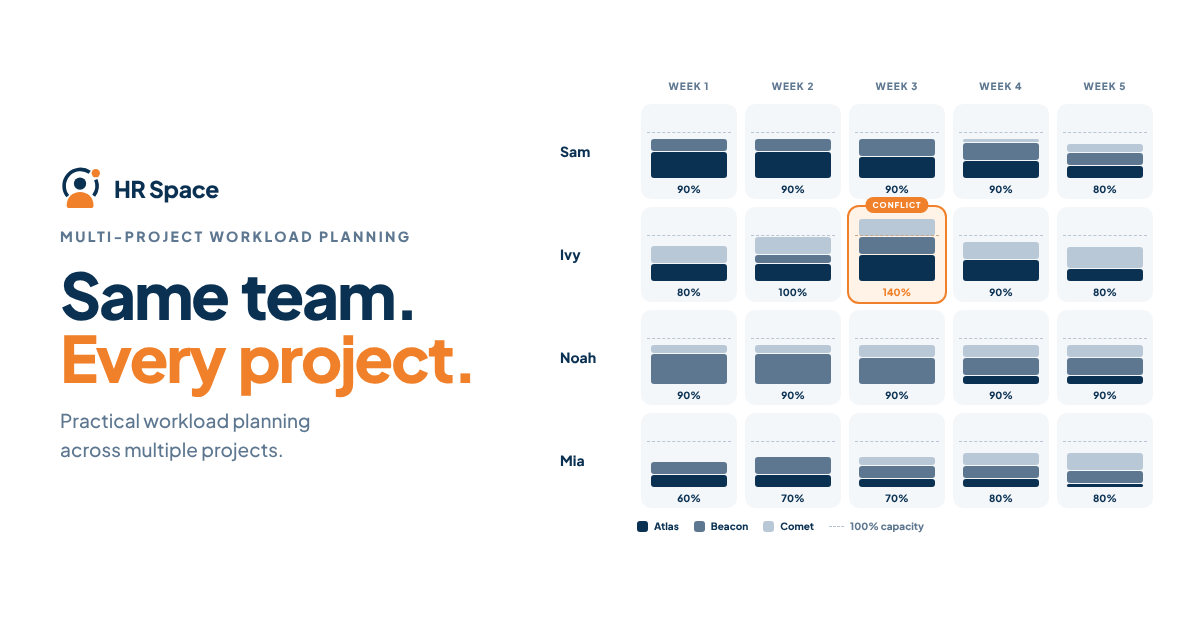
Bring the commitments into one conversation
List the person's active assignments across the relevant projects. Include review work, recurring support, meetings, and known absence where they affect the plan.
Ask project owners to name the actual next commitment and its expected effort. A deadline attached to a large, undefined task gives the team little basis for deciding what can fit.
Asana's workload guidance discusses viewing commitments across projects and using consistent effort information when assessing capacity. You can apply that planning principle without treating a task count as a complete measure of demand.
Use the shared view to identify collisions early. The employee should not need to negotiate separately with every project owner to explain that the same hours have been promised several times.
Distinguish effort from elapsed time
A task may span a week while requiring only a few focused hours. Another may have a short deadline and need most of a person's available time. Capture the distinction where it affects allocation.
Label estimates as estimates and discuss the uncertainty. New work, unclear requirements, and unresolved dependencies may need a range or an explicit review point rather than a confident single value.
Include the time needed for handovers and review when reallocating work. Moving a task to another person may be sensible, but it can require context and coordination before that person can deliver.
Keep the units consistent within the view. If one project uses hours and another uses an unexplained points scale, resolve how the team will interpret them before making a capacity decision.
Compare demands against the same period
|
Planning item |
What to establish |
Decision it enables |
|
Committed work |
Deliverable and expected effort |
Identify conflicts across projects |
|
Available capacity |
Working time after relevant commitments |
Set a realistic amount of new work |
|
Dependencies |
Information, review, or decisions required |
Resolve waiting before allocation |
|
Priority |
Business consequence and decision owner |
Agree what moves first |
|
Reallocation |
New owner and handover effort |
Change the plan without losing context |
The purpose is a practical allocation discussion. Keep any missing information visible rather than treating a blank field as evidence that the person is available.
Give priority conflicts an owner
Identify who can resolve a disagreement between projects. The person coordinating capacity may gather the information while a business or portfolio owner decides which commitment changes.
Describe the tradeoff concretely. Completing the design review on Wednesday may mean moving the campaign revision to Friday. Ask the relevant owners to agree on the consequence rather than saying the employee should simply manage both.
Update the affected plans after the decision. A verbal agreement in one meeting is not enough if other managers continue to see the original date.
Tell the employee which priority is now agreed and who will handle any further conflict. Avoid leaving them responsible for defending a decision that belongs to management.
Make room for work that arrives unexpectedly
Review the kind of unplanned demand the person handles. Support questions, urgent corrections, and client requests can be part of the normal role even when the exact tasks are unknown in advance.
Use past records to estimate a reasonable planning allowance where possible, and review it against actual demand. Do not label an arbitrary percentage as a universal rule for every team.
Agree on a route for new urgent work. Someone needs to decide what it displaces and communicate the change. Otherwise, unexpected work becomes an invisible addition to an already full plan.
If the same interruption recurs, examine its cause. A missing instruction, repeated approval problem, or unclear service route may need a process change rather than a larger permanent allowance.
Review the allocation with the people doing the work
Ask whether the estimate reflects the actual task and whether a dependency is missing. Invite the employee to explain a concern before the date becomes impossible.
Look at upcoming periods as well as the current week. A quiet day now does not establish availability for a deadline-heavy week later. Confirm start and finish assumptions when moving work.
After the work completes, review one meaningful difference between the allocation and reality. Update the estimate or coordination rule that would make the next plan more realistic.
If you are evaluating software, test this discussion with a person assigned to several fictional projects. The useful output is an agreed change that every affected owner can understand.
FAQs
Is task count enough to plan workload
Tasks vary in effort, difficulty, and timing. Review the work expected in the same period and the capacity available after other commitments. Use a consistent way to estimate effort and keep uncertainty visible.
Who should resolve conflicting project priorities
Name an owner with authority over the competing commitments. Give them the consequences of each option, record the decision, and update the affected plans. Employees should receive a clear priority rather than conflicting instructions.
How much time should be reserved for unplanned work
Use the role's actual responsibilities and available evidence to make an estimate. Review the allowance against demand. A recurring interruption may need a process improvement instead of an increasingly large buffer.
What should we test in a software demonstration
Assign one person to several projects with overlapping dates and include leave or support responsibilities. Ask how the team identifies the conflict, agrees on a change, and keeps the revised commitments visible.
Check one person across all active projects
Find the first deadline collision and name who can resolve it. Explore HRSpace with that scenario and ask how your proposed project records would support the allocation discussion.
Further reading
Ready to make HR the easy part?
Explore modular pricing and start a free 14-day trial.