Take Home Assignments Candidates Can Reasonably Complete
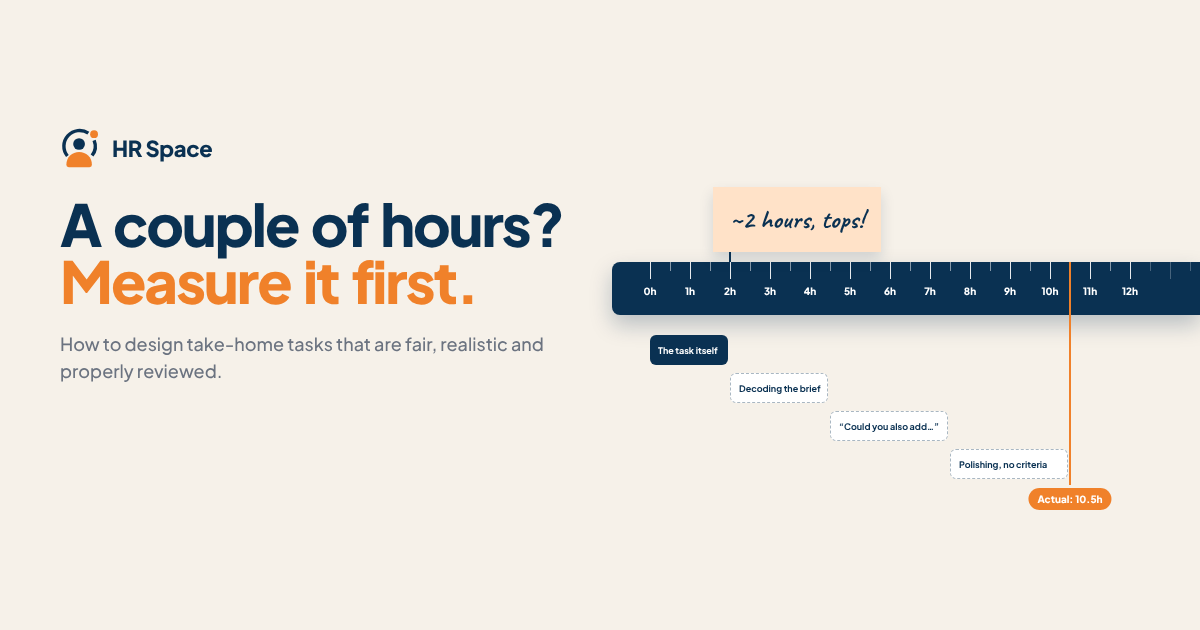
“It should only take a couple of hours.”
The candidate opens the assignment and finds a research brief, a presentation, and several questions that need information they do not have. They could spend an evening on it and still be unsure what the team expects.
A useful take-home assignment gives the candidate a reasonable opportunity to demonstrate something relevant to the role. Start by deciding what you need to learn, then design the smallest task that can provide that evidence.
Name the skill before designing the task
Choose a responsibility the person will actually perform. A support role might need a clear response to an unfamiliar customer problem. A developer might need to reason about a small code change. A project coordinator might need to prioritize competing requests.
Write down what the reviewer should look for. Keep the criteria focused on the purpose of the exercise. If the task tests reasoning, a highly polished slide deck should not quietly become the deciding factor.
Greenhouse's official take-home-test guidance describes assignments as a way to examine relevant skills and aspects of the work. The practical design question is which part of the role your exercise will reveal.
If the existing interview or work sample already provides that information, reconsider whether another assignment is necessary.
Make the instructions complete enough to work from
Explain the context, expected output, suggested effort, and submission route. Identify what the candidate may assume and what they can ask you to clarify.
State the rules for external resources and AI tools clearly. A candidate should not have to guess whether a tool commonly used in the job is acceptable in the exercise. Apply the stated rules consistently and explain how you will discuss the person's work afterward.
Use fictional, public, or suitably prepared material. Avoid asking applicants to solve an active client problem simply because it is convenient for the business. Decide the policy for compensation, ownership, and use of submissions before sending the task, and make the relevant terms clear.
Give the assignment a brief candidates can understand
|
Brief element |
What to explain |
Why the reviewer needs it too |
|
Purpose |
The role skill being explored |
Keeps assessment focused |
|
Output |
Format scope and necessary sections |
Prevents extra polish becoming a hidden requirement |
|
Effort |
Expected working time and deadline |
Helps judge whether the task is proportionate |
|
Resources |
Permitted tools and assumptions |
Creates a consistent basis for review |
|
Follow-up |
Review steps and contact for questions |
Connects the submission to a decision |
Keep these details in the actual invitation. Information shared only during an internal planning meeting does not help the candidate complete the task.
Test the assignment before sending it
Ask someone with relevant skills who did not write the instructions to attempt it. Give them the same material a candidate would receive and ask them to note missing information.
Compare the effort required with the estimate in the brief. If the task expands, reduce its scope or revise the expectation before inviting applicants. An internal expert who already knows the context may complete it much faster than someone seeing the scenario for the first time.
Also have a reviewer assess the sample output. If they cannot apply the criteria without inventing additional expectations, improve the guide. Test the assessment as well as the task.
Allow a workable route for questions
Name a contact and explain how candidates can raise a problem with the format or deadline. Be ready to discuss a suitable alternative where appropriate to the role and process.
When someone asks for clarification, check whether the answer changes the instructions for everyone. If it does, update the relevant candidates rather than leaving one person with information the others never received.
Do not interpret every question as a lack of independence. Clarifying an ambiguous request can be a normal part of good work. Look at what the question reveals about the instructions before judging the person who asks it.
Plan the review before collecting submissions
Assign a reviewer and an expected turnaround. Ask them to record the evidence against the criteria, including any point that needs discussion with the candidate.
A short follow-up can explore choices and tradeoffs in the submitted work. Explain its purpose in advance. Avoid adding an entirely new exercise after someone has completed the original request.
Close the loop with a decision or a realistic update. Candidates should not invest effort in a task whose review has no owner. If the vacancy is paused, explain that promptly and tell people what happens to work already submitted.
FAQs
How long should a take-home assignment take
Choose an effort level justified by the evidence you need and test it with someone unfamiliar with the brief. Keep the scope proportionate. Explain the expected working time separately from the submission deadline.
Should AI tools be allowed
Define the rules according to the purpose of the assessment and explain them before the task. State what resources are permitted and how the candidate will discuss their work. Do not change the standard after submission.
Can we use a real business problem
Consider whether a fictional or prepared scenario can test the same skill. Agree on compensation, ownership, confidentiality, and use of submissions through the appropriate internal process. Make the relevant terms clear before participation.
What should happen after submission
A named reviewer should assess the relevant evidence and record the outcome or a specific question for clarification. Give the candidate the next step or a realistic update rather than leaving the work in an unowned queue.
Try the task yourself first
Give the brief to a colleague who has not seen it and compare their experience with the invitation. If you are exploring HRSpace Recruiting, ask how your team would organize the associated review and candidate updates.
Further reading
Ready to make HR the easy part?
Explore modular pricing and start a free 14-day trial.