Scope Changes That Keep Project Effort Visible
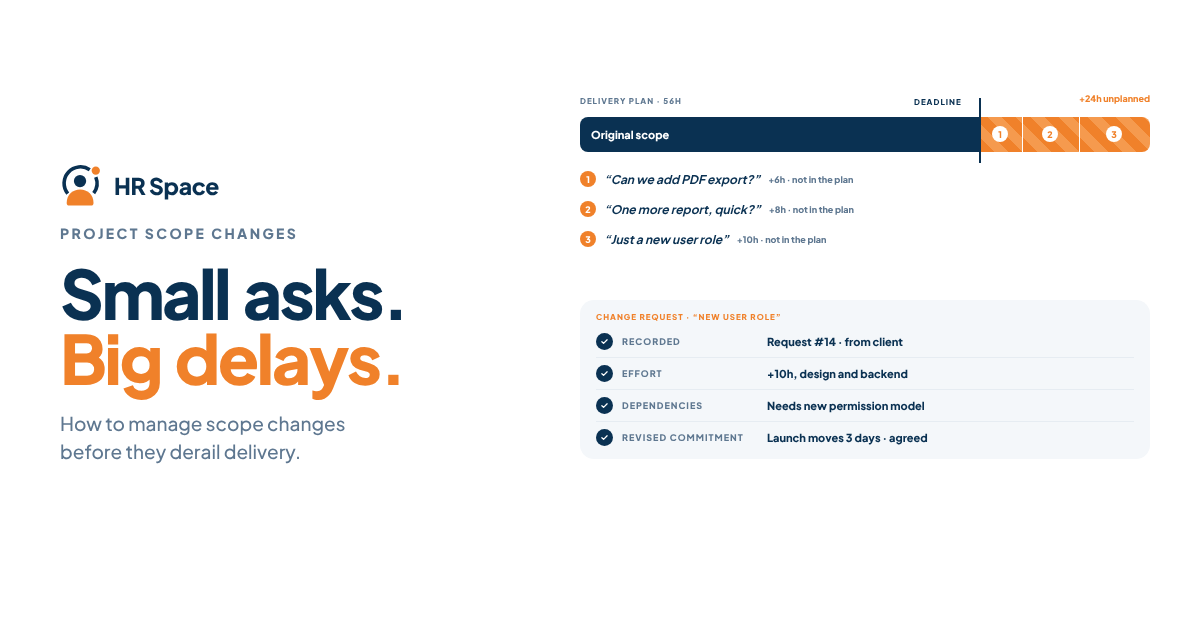
Make the original commitment easy to find
Before evaluating a change, establish what the team has agreed to deliver. Keep the expected outputs, boundaries, acceptance conditions, and major assumptions available to the people handling requests.
For a client portal project, an agreed screen may include a defined user journey and a specific set of interactions. A request that changes the journey could have a different effect from correcting a spelling error.
Avoid assuming that everyone shares the same definition of a “small change.” Discuss what the request affects. The person receiving it may see only the design task, while another team sees a dependency in development or testing.
Atlassian's scope creep guidance describes the problem of project scope expanding without corresponding adjustments to resources, time, or budget. For everyday delivery, the useful habit is to make the adjustment a visible decision.
Record the request before accepting the commitment
Capture what is being requested, why it matters, and when the requester needs it. Link the request to the relevant work rather than allowing it to disappear inside a general discussion.
An acknowledgement can be simple: the team understands the request and will assess its effect before confirming the delivery plan. This keeps the conversation moving without accidentally promising that every addition fits the current date.
Distinguish a correction to agreed work from a new requirement. If the delivered screen fails an agreed acceptance condition, the team needs to address that failure. If the client wants an additional capability, the discussion may involve a new commitment. Where the boundary is unclear, resolve it with the responsible owner.
Keep the language practical and cooperative. The purpose is to help both sides choose a workable plan, rather than turn every conversation into a dispute over labels.
Examine the effects across the delivery chain
|
Change detail |
Question to answer |
Decision information |
|
Requested outcome |
What does the requester need to achieve? |
Reason and priority |
|
Work affected |
Which deliverables and teams would change? |
Dependencies and review needs |
|
Effort |
What work would be added or repeated? |
Estimate with assumptions |
|
Timing |
What existing commitments would move? |
Revised dates or tradeoffs |
|
Approval |
Who can accept the revised commitment? |
Recorded decision and next action |
Ask the people responsible for the affected work to contribute. An estimate made by the person receiving the request may miss review, testing, coordination, or rework elsewhere.
Treat an early estimate as an estimate. If the request contains uncertainty, state the assumption or propose a bounded investigation before confirming delivery. False precision makes the decision harder to revisit honestly.
Offer a choice the requester can understand
Once the effect is clearer, present practical options. The team might replace a lower priority deliverable, move the delivery date, narrow the request, or schedule it for a later phase.
Explain the consequences in the terms that matter to the requester. “This affects three dependencies” is less helpful than explaining which agreed milestone would need to move and why.
Record the chosen option, who approved it, and any conditions. Update the working plan after the decision so the task board and the client agreement tell the same story.
If the request is declined or deferred, keep the reason and revisit date where appropriate. Otherwise, the same idea can return through another colleague and be accepted without the earlier context.
Compare planned and actual effort with care
After a change is delivered, review the effort and timing against the assumptions used for the decision. Time records can help when they distinguish the changed work from the original delivery.
Do not force people to recreate every minute of a project. Choose a recording approach that supports the planning question. A separate work item or a clear change category may be enough for the team to understand the effect.
Investigate differences before drawing conclusions. The team may have discovered a hidden dependency, received another revision, or spent time resolving an earlier defect. Those are different explanations and suggest different improvements.
Use repeated patterns to improve the next project. If stakeholder reviews regularly add a round of work, consider whether the original plan needs a clearer review process or more realistic allowance.
Review the last three additions
Choose three recent requests accepted after work began. Can the team find the original commitment, the change decision, and the updated plan? Can it explain the effect on other work?
Start by improving whichever link is missing. A lightweight record used consistently will be more useful than a detailed change form that arrives after the team has already delivered everything.
For an HRSpace walkthrough, use one of those real requests. Ask how the proposed project and time records would help your team understand the additional commitment and its effect on delivery.
FAQs
Is every scope change a problem
No. Changes can respond to useful learning or a genuine business need. The team needs to understand the effect and agree on a revised commitment so the addition does not remain invisible.
How can a team tell whether a request is additional work
Compare it with the agreed outputs and acceptance conditions. Involve the responsible delivery and account owners when the boundary is unclear. Record the conclusion so colleagues handle the request consistently.
Should small requests have a formal approval process
Use a proportionate route with clear authority. A team may agree on boundaries for routine decisions while escalating changes that affect timing, resources, or other commitments. Keep the decision visible either way.
How do timesheets help with scope changes
Relevant time entries can show the effort associated with changed work. They become more useful when linked to the request and its assumptions, rather than treated as a complete explanation of why effort increased.
Make the next addition a clear decision
Explore HRSpace with a recent scope request. Ask how your team would keep the request, delivery decision, and resulting work understandable in the proposed setup.
Further reading
Atlassian guidance on project scope creep.
69 Internal Requests
Ready to make HR the easy part?
Explore modular pricing and start a free 14-day trial.