Salary Alignment Before the Final Interview
Start with the approved framework
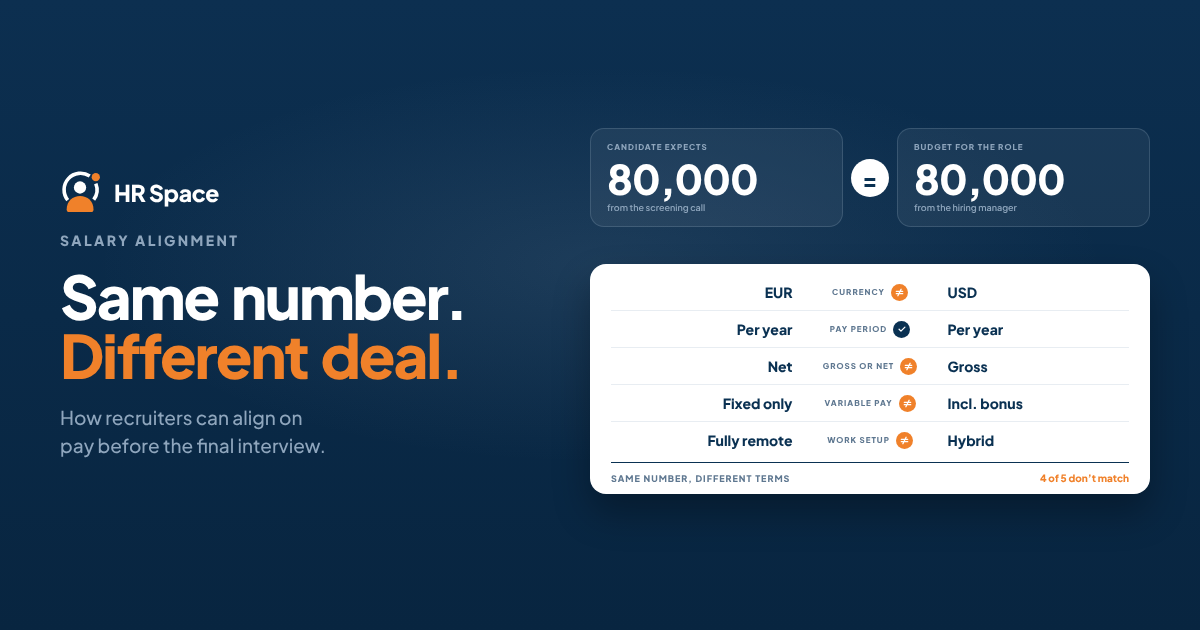
Before asking candidates about expectations, make sure the recruiter understands the company's position. Confirm the approved range or framework, the currency, the pay period, and which elements are fixed or variable.
Identify what is still awaiting approval. If a recruiter cannot confirm a figure, they should be able to say who can and when an answer is expected. An optimistic assumption should not become an informal promise.
Keep practical details connected to the role. Working hours, location, travel, and the type of engagement may influence whether the overall arrangement works. Explain the terms that the company is actually prepared to offer.
Workable's official guidance recommends recording salary expectations early in the hiring process. The useful principle is shared understanding before the team moves further into assessment.
Give the candidate something concrete to respond to
A conversation that begins with the company's approved framework is easier to interpret than an unexplained request for a number. Explain the role and the relevant terms, then ask whether the arrangement could work for the person.
For example: “For this role, the approved base range is [range] in [currency], paid [period]. The variable element works as follows: [description]. Based on the role we have discussed, is that broadly aligned with what you would consider?”
Use placeholders only in your internal template. Before sending it, verify the actual details. Avoid presenting an upper figure as available to everyone if a further decision is required.
Clarify the terms people can misunderstand
|
Detail |
Question to clarify |
Useful note |
|
Currency and period |
Which currency and pay period are we discussing |
Exact basis of the conversation |
|
Base and variable pay |
Which amount is fixed and which depends on conditions |
Separate components |
|
Hours and working pattern |
What arrangement does the figure relate to |
Agreed role terms |
|
Candidate expectations |
What would make continuing worthwhile |
Dated expectation and context |
|
Approval |
What remains to be confirmed |
Owner and expected answer date |
Follow your organization's approved approach to compensation and local requirements. The recruitment task here is to make the conversation accurate and understandable, rather than improvise terms outside your authority.
Record the context as well as the figure
An isolated number can mislead the next person who opens the record. Note when it was discussed, what it referred to, and any condition the candidate attached to it.
Someone may say they would consider a particular range for a role with limited travel, while a substantially different arrangement would need another discussion. Record that relationship rather than making the preference appear unconditional.
If expectations change, date the update. Avoid silently replacing an earlier note in a way that makes the team think the original conversation never happened. Keep access appropriate to the information and your internal policy.
The candidate should have room to clarify a misunderstanding. An early discussion helps the process; it should not be treated as permission to ignore material changes to the role later.
Revisit alignment when the role changes
A new location requirement, a broader area of responsibility, or a different working pattern may change how the person evaluates the opportunity. Revisit the relevant terms when those changes arise.
Explain the new information directly. Do not rely on the final offer document to reveal a difference that could have been discussed earlier. Give the candidate time to consider the updated arrangement and ask questions.
If the company cannot meet the person's expectations, say so respectfully. Continuing through extra interviews without a plausible route to agreement can create unnecessary work for everyone.
Keep negotiation ownership clear
Decide who can discuss the framework and who can authorize a change. The recruiter should know when to bring in the manager or the person responsible for compensation approval.
Avoid asking several colleagues to have separate conversations about the same request. Choose one communication owner, record the question accurately, and return with a coordinated answer.
Before the final stage, confirm that the team and candidate are still discussing the same role terms. This is a short check, not a substitute for the formal approval and offer process.
FAQs
When should salary alignment be discussed
Raise the framework early enough for both sides to judge whether continuing makes sense. Provide enough role context for a useful answer and revisit the conversation if the responsibilities or practical terms materially change.
What should the recruiter record
Record the currency, period, relevant components, date, and any conditions attached to the expectation. Identify unresolved questions and the person responsible for answering them. Avoid a bare number without context.
What if the candidate is unsure of an expectation
Explain the approved framework and role terms clearly. Let the person consider them and ask questions. Agree on a sensible time to revisit alignment rather than pushing for an immediate number without enough information.
Who should approve a change
Use the company's agreed approval process. The recruiter should know the decision owner and communicate confirmed information. Keep an unapproved possibility distinct from a commitment to the candidate.
Check the record before the next final interview
Could a colleague explain the basis of the pay conversation from the notes alone? If you are exploring HRSpace Recruiting, ask how your team would record the relevant context and manage the required approval steps.
Further reading
Ready to make HR the easy part?
Explore modular pricing and start a free 14-day trial.