Reference Checks That Answer Useful Questions About the Work
Agree on the process before approaching anyone
Explain the reference requirement to the candidate and confirm the appropriate contact arrangements. Be particularly careful about approaching a current employer; do not treat a name on a CV as permission to contact them.
Acas guidance for Great Britain recommends requesting references at the final recruitment stage and obtaining permission before contacting an applicant's current employer. It also notes that an employer's policy may limit who can provide a reference and what they can include. Use the relevant rules and internal guidance for your own location and situation.
Identify who is authorized to make contact and receive the information. Do not improvise outreach through a mutual acquaintance when the agreed process calls for a formal channel.
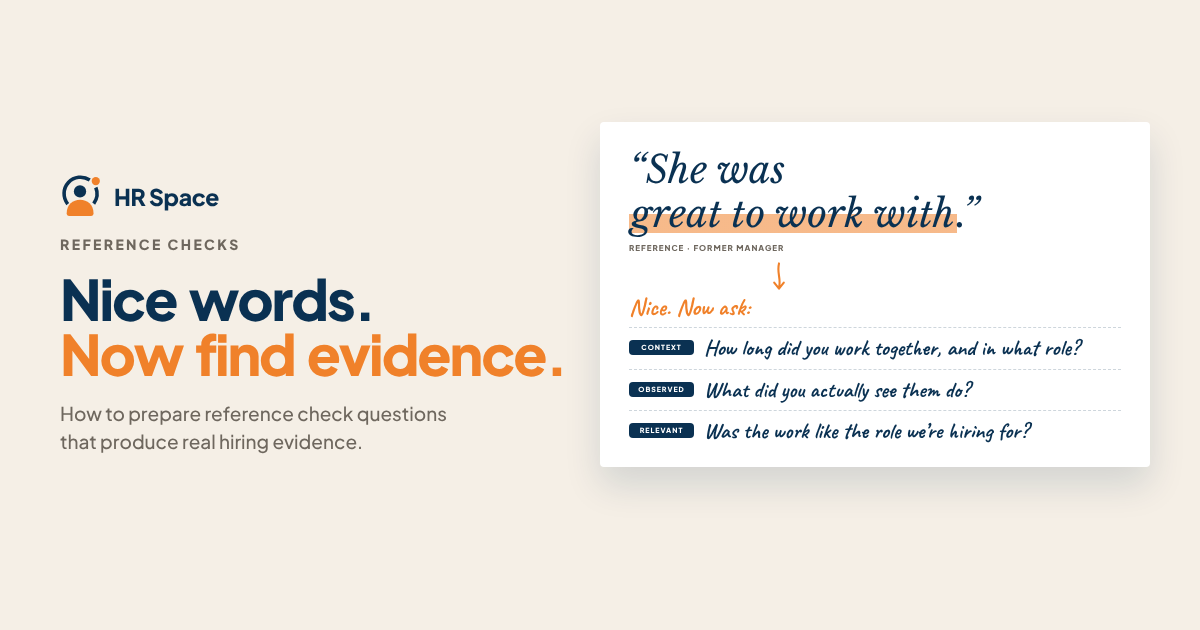
Ask what the referee actually observed
Begin with the working relationship, the period involved, and the responsibilities they saw directly. A colleague from an earlier project may provide useful context while having little knowledge of the person's recent work.
Connect the discussion to the role. If the job requires handling competing priorities, invite an example of how the person organized work in that setting. If collaboration matters, ask what the referee observed when responsibilities crossed teams.
Keep the questions neutral. “They were a great leader, weren't they?” suggests an answer. A request for an example gives the referee room to describe the work and the limits of their knowledge.
Avoid asking for personal information unrelated to the hiring purpose. Follow the organization's approved questions and requirements for the role.
Organize the conversation around relevant evidence
|
Question area |
Purpose |
Context to preserve |
|
Working relationship |
Understand what the referee could observe |
Role, period, and closeness of work |
|
Relevant responsibility |
Explore an area important to the new job |
Specific example and setting |
|
Collaboration |
Understand an observed way of working |
People and responsibilities involved |
|
Development |
Clarify support that helped in that setting |
Time period and conditions |
|
Limits of response |
Recognize unavailable information |
Policy restriction or lack of direct knowledge |
The matrix is a planning aid. Adapt the questions through your approved process rather than treating it as a complete reference or background-check policy.
Distinguish a policy limitation from a negative signal
Some employers will confirm only basic employment details. A short reply may reflect that policy rather than a judgment about the candidate.
Record what was provided and any stated limitation. Do not translate “we only confirm dates and title” into “would not recommend.” The distinction should remain clear to anyone who later reviews the application.
If required information is missing, ask the authorized owner how to proceed. The next step might involve another appropriate source or a clarification with the candidate. Avoid repeatedly pressing a referee to share information they are not authorized to provide.
Keep the status accurate while the question is unresolved. “Reference requested” and “reference reviewed” are different events and should not be treated as interchangeable.
Handle a concern with context
If the conversation raises an important concern, record the actual statement, relevant example, and time period. Identify whether it was a direct observation, an interpretation, or information the referee could not substantiate.
Route the issue through the appropriate hiring or HR process. Where clarification with the candidate is appropriate, use a specific question and give them an opportunity to respond under that process.
Avoid treating one phrase as a complete account of a person's ability. The role, manager, team, and conditions may differ from the opportunity under consideration. Equally, do not ignore relevant information simply because the interviews felt positive.
Bring the information together with the rest of the assessment and keep the decision owner's reasoning visible.
Close the check and explain the next step
Confirm who will review the result and whether any condition remains unresolved. Record enough context for that person to understand what was verified, what was discussed, and what could not be obtained.
Keep access and retention aligned with the organization's requirements. Reference notes should not become material shared casually across an interview group.
Tell the candidate the next process step through the appropriate communication owner. If the check is taking longer than expected, give a realistic update rather than allowing silence to suggest a decision has already been made.
FAQs
When should references be requested
Use the timing required by the applicable process and location. Explain the requirement early and obtain the appropriate permission before contact, especially with a current employer. Confirm case-specific questions with the authorized HR owner.
What makes a reference question useful
Connect it to a relevant responsibility and invite an example from work the referee observed. Establish the working relationship and time period. Neutral questions produce context that is easier to interpret than leading praise.
Is a brief factual reference a bad sign
Not necessarily. The employer may have a policy restricting the response. Record the stated limit and the information received. Ask the appropriate owner how to address any unmet requirement without inventing a negative interpretation.
What if the reference raises a concern
Preserve the statement and its context, distinguish observation from interpretation, and follow the relevant hiring or HR process. The decision should consider the evidence and any appropriate clarification rather than rely on an unexplained label.
Review the questions before the next call
Check that each one has a role-related purpose and an appropriate route for the answer. If you are exploring HRSpace Recruiting, ask how the check's status and authorized review would fit your proposed workflow.
Further reading
Ready to make HR the easy part?
Explore modular pricing and start a free 14-day trial.