Recruitment Pipeline Stages That Make the Next Action Clear
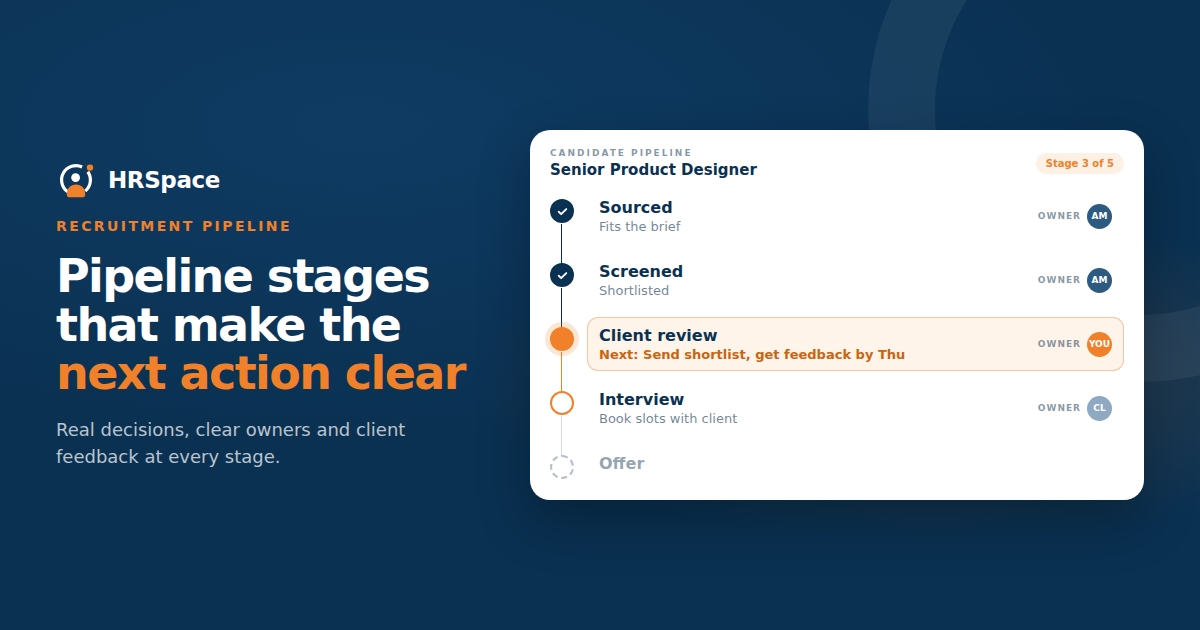
A client asks for an update on Friday. You open the pipeline and find the candidate under interviewed. The conversation happened on Tuesday, but there's no decision, no feedback date, and no obvious next step.
You remember agreeing that someone would follow up. Was that you, the other consultant, or the client? You end up opening the email thread to find out. The board has recorded progress without making the work any easier to continue.
That is where recruitment pipeline stages earn their place. For an independent recruiter or small agency, a useful stage should explain where an application stands and point you towards the next action. A label that needs a separate explanation every time is worth revisiting.
Define stages around decisions
A recruitment pipeline describes the progress of an application for a particular vacancy. The same candidate may have several applications, each with its own history and outcome.
Start by writing down the decisions that move a search forward. Someone checks the initial fit. The candidate confirms interest. The client reviews the submission. An interview produces evidence for the next decision. An offer is discussed and accepted or declined.
Those events provide a better structure than labels such as hot, promising, or follow up. Those labels may describe useful information, but they do not consistently tell another recruiter where an application stands.
Keep availability separate from application progress. A candidate who declines one assignment may remain open to another. Closing one application should not make their entire profile appear unsuitable.
A practical starting pipeline
There is no universal set of recruitment pipeline stages. A specialist agency may need a technical assessment; an executive search may require additional stakeholder conversations. The following model is a starting point to adapt to your actual work.
|
Stage |
Meaning |
Next responsibility |
|
Initial review |
Application or profile is being checked against the brief |
Recruiter records the initial assessment |
|
Recruiter conversation |
Interest and essential requirements need confirmation |
Recruiter speaks with the candidate |
|
Ready for submission |
Candidate has agreed to proceed and the profile is prepared |
Recruiter submits through the agreed channel |
|
Client review |
Client has received the profile and a decision is pending |
Named client contact returns feedback |
|
Interview process |
A client interview or assessment is underway |
Owner coordinates the next agreed event |
|
Offer discussion |
Offer terms are being considered |
Recruiter tracks questions and the decision date |
|
Accepted |
Candidate has accepted under your agreed definition |
Owner prepares the placement handover |
Treat withdrawn, declined, rejected, and vacancy paused as distinct outcomes or statuses where your system allows. They explain different situations and should not disappear into a single unsuccessful category.
Agree on the evidence needed to enter a stage
Two consultants can use the same board differently. One moves a candidate into client review when the profile is drafted. Another waits until the client receives it. Their reports will disagree even if both believe they are following the process.
Write down what has to happen before someone moves a candidate into each stage. For client review, you might require the submission date, the recipient, and the profile that was actually sent. For interview process, make it clear whether the interview has been requested, booked, or completed. Those are different moments in a search.
Keep those details readable. If entering a stage requires ten fields that nobody uses, people will work around the board. Ask which information a colleague needs to continue the search tomorrow, and begin there.
Give pending work an owner and a date
Some stages describe waiting. That is acceptable, provided waiting has a clear owner.
Suppose a client receives three profiles on Tuesday and agrees to respond on Thursday. The applications can stay in client review, with a Thursday feedback commitment and a recruiter responsible for checking it. If the client misses the date, the next action becomes visible without inventing another stage.
Avoid a column called waiting for everything. Waiting for the candidate to confirm salary expectations and waiting for a client interview decision involve different people and different follow-ups. Record the reason and commitment alongside the application.
Try opening the board as you would between two calls. Can you see what is due today? You should not have to open every candidate record to discover which client promised feedback yesterday. During a software demo, ask to see the view you would use on a busy morning.
Handle repeated interviews without creating a maze
A second interview does not always justify a permanent new column. If most roles have one conversation and a few have four, a stage for every possible round can make the board harder to scan.
Consider keeping interview process as the main stage and storing individual events inside the application. For roles that consistently require different decisions, such as technical assessment followed by final approval, separate stages may be useful.
The test is practical. Can you tell which event has happened, which assessment is missing, and who owns the next step? Choose the structure that answers those questions with the least ambiguity.
Review the age of pending applications
A weekly review should identify candidates whose next action is overdue. It should also distinguish active delays from planned waiting.
A candidate waiting for a scheduled interview next week is different from someone whose feedback was due five days ago. Simply sorting by time in stage can mix those cases together.
Use stage age as a prompt to investigate. Look at the promised date, the last meaningful activity, and the reason for the delay before deciding what to do. For specialist searches with long interview cycles, set review expectations that match the work rather than importing a generic target.
A small agency example
Imagine two consultants sharing a finance search. One screens a candidate on Monday. The other submits the profile on Tuesday, then takes leave. The client asks for an interview on Wednesday.
The handover works if the record shows the current brief, the candidate's interest, what was submitted, and the next commitment. It breaks if one consultant's personal notes hold the salary conversation and the board only says submitted.
Test your proposed stages with that scenario. A colleague who has not worked on the search should be able to explain the next action from the record. Their unanswered questions show where the structure needs improvement.
Testing the workflow in HRSpace
HRSpace includes a candidate pipeline within its recruitment offering. Bring your stage definitions to an HRSpace Recruitment demo and test the complete route for one vacancy.
Use a slightly awkward example: one candidate in two searches, a missed feedback date, and a consultant taking leave. Ask how ownership, history, and pending work would appear. If you recruit for several clients, make their separation part of the demonstration too.
Common mistakes
Adding a column whenever something goes wrong gradually creates a board that nobody understands. Investigate whether the problem needs a new decision stage, a clearer note, or a visible task.
Also avoid moving candidates forward to make a weekly report look healthier. A stage should describe an event that happened. If client feedback is missing, recording the delay is more useful than making the application appear closer to an offer.
FAQ
How many recruitment pipeline stages should an agency use
Use enough stages to distinguish the decisions that matter to your process. Begin with a small set, test it on live assignments, and add a stage only when it provides information that your team needs regularly.
Should every interview round have a separate stage
It can, if each round represents a consistent decision across your roles. Otherwise, keeping interview events inside a broader stage may make the pipeline easier to manage.
Can the same candidate be in different stages for different roles
Your process should allow this. Candidate information and role-specific applications need separate treatment so progress on one assignment does not overwrite another.
What should a weekly pipeline review focus on
Review overdue commitments, missing decisions, and applications whose status no longer matches the work. End each review with a named owner and a concrete next action for the cases that need attention.
A useful next step
Open one live search and cover the candidate names. Could another recruiter work out what each column means and which applications need attention? Use the confusing cases to improve your stages before changing the rest of the board.
Ready to make HR the easy part?
Explore modular pricing and start a free 14-day trial.