Recruitment Handover How to Keep a Search Moving Between Recruiters
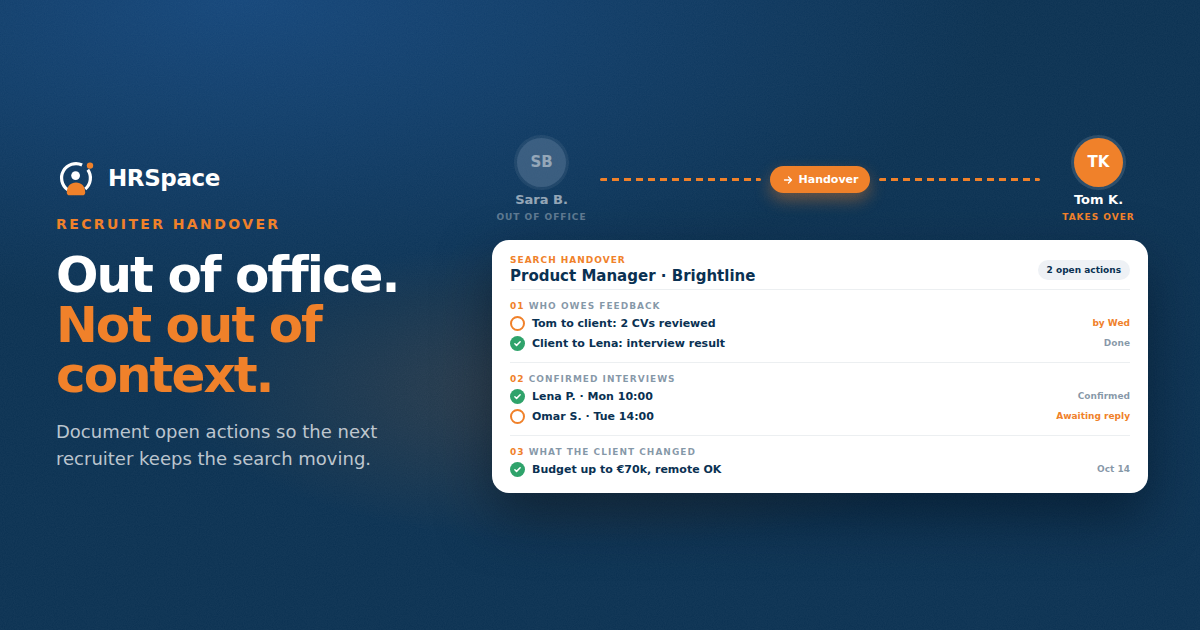
Your colleague is away next week, and you agree to cover a live search. The candidate list is easy to find. The difficult part is knowing which conversations are still open, what the client has changed, and whether someone already promised a candidate an update today.
A recruitment handover should let the next recruiter continue those conversations with confidence. A folder of CVs and a pipeline screenshot will rarely provide enough context on their own.
This matters even in a small agency where everyone sits close together. People take leave, assignments change, and urgent work gets shared. A practical handover keeps the current position of the search understandable without requiring a long conversation every time someone steps in.
Say what the covering recruiter is responsible for
Start with the scope of the cover. Are they managing the full assignment, answering urgent messages, or arranging interviews that have already been agreed?
Identify which decisions they can make and which need the account owner or client. Without that distinction, the covering recruiter may hesitate over routine work or accidentally make a commitment outside the agreed role.
Give them the dates that matter. A final interview tomorrow deserves more attention than an open sourcing task with no immediate deadline. Make the priorities clear enough that someone unfamiliar with the search can choose the first action sensibly.
Point to the current brief
Use one agreed place for the active role brief. Include the changes that affect sourcing or screening, and distinguish confirmed requirements from suggestions still under discussion.
For example, the original brief may have required experience in a particular sector. The client later agreed to consider adjacent experience. If that change lives only in the outgoing recruiter's inbox, the covering recruiter may restart the search against an obsolete requirement.
Summarize major changes in the handover and link or point to the current record. Keep the supporting decision history available where your team normally stores it. The cover note should guide the recruiter to the work, rather than becoming another competing version of the brief.
Explain open conversations at candidate level
For every candidate needing attention, record the current stage, last meaningful interaction, and next action. Add the detail that makes the action possible.
“Follow up with Sam” leaves too much unexplained. “Sam is waiting for confirmation of Thursday's interview time; the client has offered 10:00 or 14:00” tells the next recruiter what to resolve.
Include commitments already made to the candidate. If someone was told they would receive feedback by Friday, that belongs in the handover even if the client has not supplied it yet. The covering recruiter needs to manage the expectation rather than discover it from a frustrated reply.
|
Handover area |
Information to include |
What it enables |
|
Current role brief |
Confirmed requirements and recent changes |
Consistent sourcing and screening |
|
Client contacts |
Decision owner and backup contact |
Questions reach the right person |
|
Active candidates |
Stage, last contact, next action |
Conversations continue accurately |
|
Interviews |
Confirmed and provisional arrangements |
Scheduling without conflicting messages |
|
Open decisions |
Question, owner, and requested date |
Follow-up with a specific purpose |
|
Candidate commitments |
Promised updates and agreed arrangements |
Expectations are maintained |
|
Cover responsibilities |
Scope and escalation route |
Clear authority during the handover |
Separate a scheduled interview from a proposed one
Recruitment records often contain a mixture of confirmed arrangements and possibilities. Label them clearly.
If a manager has offered a time but the candidate has not accepted it, the interview is still provisional. If both have agreed but the joining link has not been sent, there is a remaining preparation task. A stage called interview does not explain either situation by itself.
Record who is attending, the format, the time zone, and any preparation already shared. Check the calendar invitation against the candidate record. A changed time in one place and an old time in another can create an avoidable missed meeting.
Give client decisions enough background
The next recruiter should understand what the client is deciding and why it matters. Include the question asked, the relevant options, and the last response.
If the client is reviewing a shortlist, note whether they have seen the profiles and whether clarification is outstanding. If they are reconsidering the range, show the current agreed position so the covering recruiter does not quote a number that was only discussed.
Identify the contact who can resolve urgent questions. A general company email address may not reach the person authorized to change the brief or approve an interview.
Keep the handover short enough to use
You do not need to retell every sourcing conversation. Focus on the information that affects the next action or prevents a misunderstanding.
Use the recruitment system for detailed history and the handover note for priorities and unresolved work. Long notes that copy everything from the record are difficult to maintain and can become outdated as soon as someone replies.
For a temporary cover, consider a short daily review of changes. For a permanent reassignment, have the incoming recruiter confirm that they can find the current information and understand the client relationship. Those are different needs and should not require identical paperwork.
Tell people who to contact when needed
If candidates or the client will deal with a different recruiter, introduce the change clearly. Say who is covering, how to reach them, and whether the arrangement is temporary.
Avoid making people repeat information unnecessarily. Before the new recruiter calls, they should read the relevant history. They can still confirm an important detail, but the conversation should show that the team has passed the context along.
Keep internal handover notes appropriate to their purpose. A message introducing a colleague does not need to include assessment notes or the full client discussion.
Test the handover before the outgoing recruiter leaves
Ask the covering recruiter to walk through the next few actions. Can they arrange the pending interview, answer the candidate's question, and reach the client decision owner?
If they need to ask several basic questions, fill those gaps while the outgoing recruiter is available. This is a practical check, not a test of whether the colleague read every note.
Also confirm that access works. Knowing where the record is stored is little help if the covering recruiter cannot open it. Use the team's normal permissions process so the person can do the assigned work without receiving unrelated information.
Check the workflow in your software demo
Use an HRSpace Recruitment demo to follow a sample reassignment. Ask how a colleague would find current stages, notes, next actions, and the history needed to continue the search.
Confirm the permissions and ownership behavior your agency needs. If temporary cover and permanent reassignment work differently in your process, test both rather than assuming that changing an owner field covers every situation.
FAQ
What should a recruitment handover include
Include the current brief, active conversations, open client decisions, interview arrangements, candidate commitments, and the covering recruiter's responsibilities. Point to the detailed records rather than copying the whole search history.
When should an agency prepare a handover
Prepare it before planned leave or reassignment, and keep daily records clear enough to support unexpected cover. A short review before the change helps uncover missing context.
Does a solo recruiter need a handover process
Yes, if another person may cover their work. Clear current records also help a solo recruiter resume an assignment after time away without reconstructing every conversation.
How detailed should candidate notes be
Give enough context for the next relevant action. Record confirmed arrangements, important preferences, and commitments accurately, using your organization's rules for candidate information.
Ask a colleague to continue one action
Choose an active search and ask another recruiter to identify its next action from the records. Notice what they need to ask you. Add the missing context where the team will use it, and keep that standard for the next handover.
Ready to make HR the easy part?
Explore modular pricing and start a free 14-day trial.