Portfolio Reviews That Reveal the Work Behind the Presentation
Define the evidence the role needs
Choose the capabilities that a work sample can reasonably demonstrate. For a designer, that might include explaining a decision under competing user and business constraints. For an engineer, it might involve discussing the structure and tradeoffs of a change.
Separate those capabilities from presentation preferences. A visually polished document may be relevant to a communication responsibility, while telling you little about another part of the role.
Indeed's employer guide to portfolios recommends starting with the skills required by the job before reviewing samples. Use that principle to write a short review guide, rather than allowing the first attractive example to set the standard for every candidate.
Tell applicants what kinds of work would be useful. An open request to “send your portfolio” can produce material that answers different questions for different reviewers.
Ask for a manageable sample
Invite the candidate to select a small amount of relevant work and explain why they chose it. State what the review involves, what preparation is expected, and how much time has been allowed for discussion.
Provide an appropriate route for someone whose work cannot be made public. They may be able to describe a project at an agreed level, use a redacted example, or complete another suitable assessment. Do not ask them to disclose confidential material to prove their experience.
Check any alternative against the same capability you intended to assess. A different format should still give the person an appropriate opportunity to demonstrate the relevant skill.
Avoid quietly turning a review into a request to rebuild a portfolio for your organization. Keep the work proportionate to the evidence you need.
Structure the conversation around the project
|
Review area |
Question to explore |
Evidence to record |
|
Context |
What problem was the project intended to address |
Goals and relevant constraints |
|
Contribution |
Which parts did you personally own |
Decisions, responsibilities, and collaboration |
|
Judgment |
Why did you choose this approach |
Alternatives and tradeoffs |
|
Outcome |
What changed and what could be verified |
Supported result and its limits |
|
Reflection |
What would you approach differently now |
Learning connected to the work |
These prompts guide a conversation. They should not require candidates to share business information they are unable or unauthorized to disclose.
Explore the decisions rather than retell the case study
Let the candidate establish the context, then ask about a decision relevant to your role. What options were available? Which constraint shaped the choice? What did they need from other people?
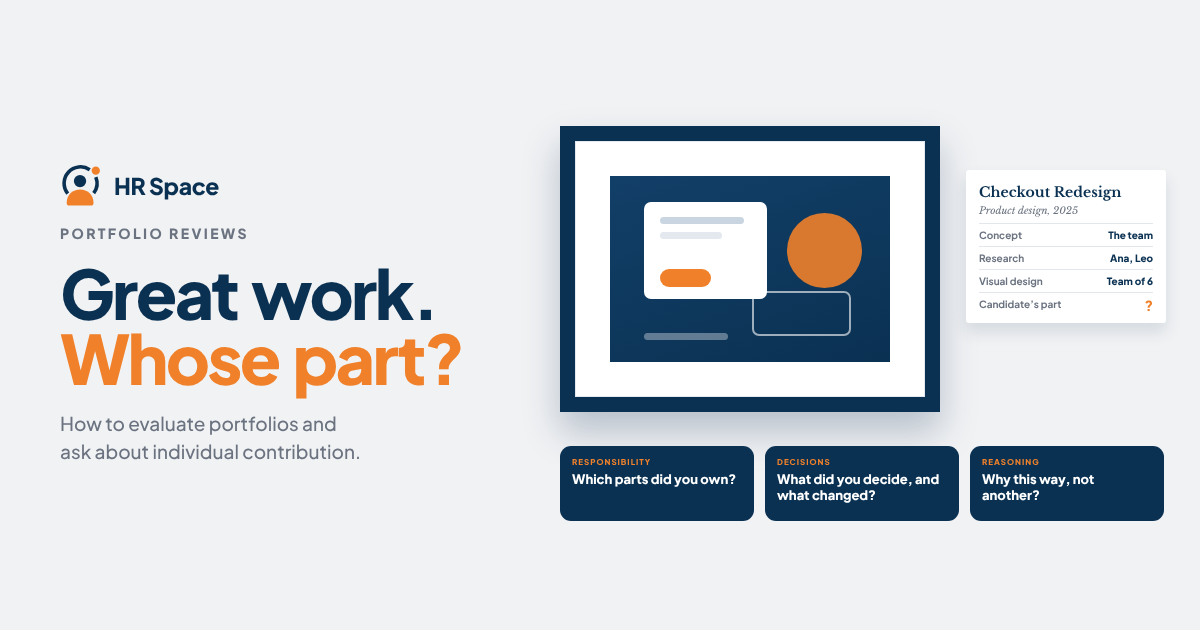
Look for the boundary of their own contribution. Someone can have played an important part in a team outcome without owning the whole project. Give them space to describe that accurately.
If the outcome is presented as a large improvement, ask what was measured and what other factors may have contributed. Record the explanation without converting an approximate or shared result into a personal achievement claim.
Ask a relevant reflection question. How would the approach change under a different constraint? Keep the discussion connected to the work rather than using unexpected questions purely to make the candidate uncomfortable.
Give reviewers a common basis for assessment
Ask each reviewer to connect observations to the agreed capability. “Impressive portfolio” does not explain what the hiring decision can rely on. A note about how the candidate handled a specific constraint is more useful.
Check whether a concern relates to the skill or the format. If the sample is unfamiliar, ask for context before concluding that the work lacks depth. If the person has limited public material, use the agreed alternative route.
Collect individual notes before discussing the overall recommendation where practical. Review disagreements by returning to the evidence and the purpose of the role.
Do not create new criteria halfway through the shortlist because one candidate showed an interesting extra capability. Decide whether it is relevant and handle any material change to the assessment consistently.
Decide what still needs to be learned
A portfolio may answer some questions while leaving others open. Identify those gaps and decide whether existing interviews already address them before arranging another task.
Use focused follow-up when new evidence is genuinely needed. Explain its purpose and avoid asking the person to repeat a project walkthrough simply because a different reviewer missed the first conversation.
Record the outcome, the relevant evidence, and the next owner. The person reviewing the application later should understand what the sample demonstrated and what the panel could not establish from it.
FAQs
Does a polished portfolio prove strong performance
It provides material to assess, but the team still needs to understand contribution, judgment, and the relevant result. Use role-specific criteria and a conversation about the decisions behind the presentation.
What if the candidate cannot share previous work
Offer an appropriate route under your assessment process, such as a suitably redacted example or another proportionate way to demonstrate the skill. Do not require disclosure of confidential material. Explain the alternative and its criteria.
Should every reviewer use the same criteria
Use shared role requirements and evidence standards while assigning reviewers the areas they can assess. This gives the panel a common basis for discussing different observations without requiring identical reactions to every sample.
When is another assignment necessary
Consider one when an important capability remains unassessed and the evidence is needed for the decision. Check existing material first, define the missing question, and keep any new work focused and explained.
Choose one question for the next portfolio review
Ask which decision the person owned and why they made it. If you are exploring HRSpace Recruiting, ask how your reviewers would keep that evidence connected to the application and the next hiring action.
Further reading
Ready to make HR the easy part?
Explore modular pricing and start a free 14-day trial.