Performance Reviews That Start Before the Review Meeting
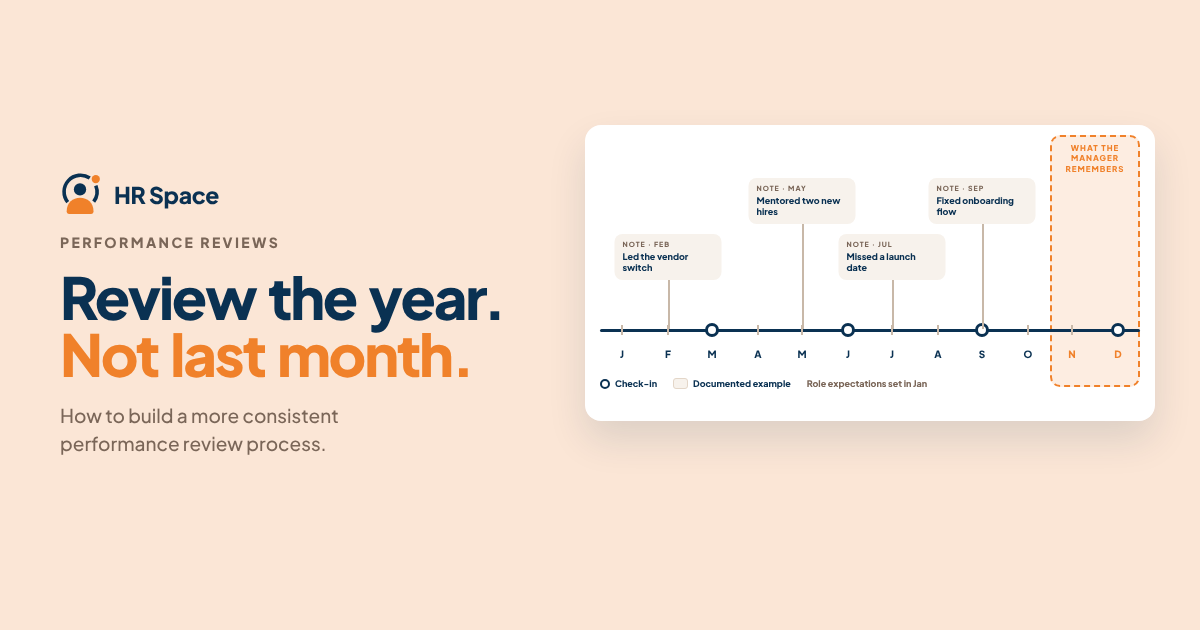
Agree on what good work means for the role
Consider an implementation specialist at a growing software company. Their work includes launching customer accounts, explaining unfamiliar workflows, and helping colleagues solve unusual setup problems. Counting completed launches captures one part of that contribution.
Before collecting examples, agree on the expectations. What should a successful launch include? Which responsibilities belong to this role? What support is available when a customer changes requirements?
The CIPD performance management factsheet describes performance management as an ongoing process involving objectives, feedback, and development. A practical starting point is to connect review criteria to the work people have actually agreed to do.
Write those criteria in plain language. “Communicates well” leaves room for interpretation. “Explains implementation risks early enough for the account team to respond” gives the employee a clearer expectation and the manager something specific to discuss.
Keep examples with their context
A useful note explains the situation, the person's contribution, and the outcome or current limitation. It also records the date. That takes more care than saving a compliment, but it produces stronger evidence.
For example, an employee identified a missing customer dependency before launch, documented the options, and coordinated a revised plan. Record what they did and what happened next. If the launch remained late because the customer could not provide access, preserve that context too.
Do the same for concerns. “Missed another deadline” is too thin. Which deadline was agreed? When did the risk become visible? Did the employee control the missing input? What did the manager do after learning about it?
Avoid turning everyday records into a running verdict. Their purpose is to support discussion. An employee should have a way to add relevant context or correct an inaccurate example while the event is still fresh.
Collect evidence that can support a conversation
|
Review area |
Useful evidence |
Question to discuss |
|
Delivery |
Agreed output and acceptance record |
What helped or prevented completion? |
|
Quality |
Review findings and resulting changes |
Which issues were within the person's control? |
|
Collaboration |
A specific contribution to another team |
What difference did the contribution make? |
|
Development |
A new responsibility attempted with support |
What improved and what needs more practice? |
|
Reliability |
Commitments and timely updates |
Were expectations clear and realistic? |
Use this as a starting point for the role, rather than a universal scorecard. A junior analyst and a team lead should not be assessed against identical responsibilities simply because the software uses one form.
Make check ins useful enough to continue
An ongoing process can still become an administrative burden. If every conversation requires a long form, people may postpone it until the next formal review.
Keep a short shared record of the points that matter: progress against an agreed expectation, a relevant example, an obstacle, and the next action. A monthly conversation may suit some teams; a new responsibility or active performance concern may need a different rhythm.
Close the loop on the manager's commitments as well. If an employee needs access, coaching, or a clearer priority, record who will provide it and when. Repeating the same obstacle in three check ins should lead to a management decision.
When a goal changes, update the record. Someone moved onto urgent customer work should not reach a review meeting with an untouched original target that everyone informally abandoned.
Prepare the review from the whole period
Before the formal meeting, read examples from the full review period. Compare the evidence with the agreed criteria, including any changes in responsibility. Invite the employee to prepare their own examples and questions.
Look for patterns and exceptions. One excellent presentation does not establish that every client communication went well. One difficult week should not erase months of reliable work. Where evidence is incomplete, identify the gap rather than filling it with confidence.
Peer feedback can add useful perspectives when the questions relate to work the contributor has observed. Ask for a specific example and its effect. Broad popularity questions produce a different kind of information and should not silently become performance ratings.
Finish with a small number of actions. A development plan should name what the person will practise, the support available, and when progress will be discussed. “Improve leadership” does not tell anyone what to do on Monday.
Try one review criterion before redesigning the process
Choose a role with an upcoming review. Ask the manager and employee to describe one expectation separately. Compare their answers, then agree on what evidence would make a useful discussion possible.
This exercise can reveal more than adding another rating scale. If the expectation is unclear, the next step is to clarify it. If the evidence is missing, decide what lightweight record would help in future.
HRSpace lists performance reviews among its platform capabilities. During a walkthrough, use your own review criterion and ask how employees and managers would prepare, contribute, and revisit agreed actions.
FAQs
How often should performance evidence be recorded
Record meaningful examples close enough to the event that the context remains clear. Avoid requiring a note for every ordinary task. Agree on a review rhythm that fits the role and the team's work.
Can project data replace a performance conversation
Project data can show commitments, delivery, and recorded changes. A conversation is still needed to understand quality, decisions, support, and circumstances that the record may not explain.
What if a manager has very few examples
Be explicit about the evidence available. Ask the employee for relevant examples and examine agreed work records. Then improve the process for the next period rather than treating uncertain impressions as established facts.
Should employees contribute to their own review
Give employees a clear opportunity to explain their contribution, discuss expectations, and add context. A shared understanding of the record helps both sides focus on useful decisions and development.
Make the next review easier to prepare
Take one current role into an HRSpace demo. Ask the team to demonstrate how the proposed review process would connect expectations, examples, and follow up actions.
Further reading
Ready to make HR the easy part?
Explore modular pricing and start a free 14-day trial.