Namely Alternatives in 2026
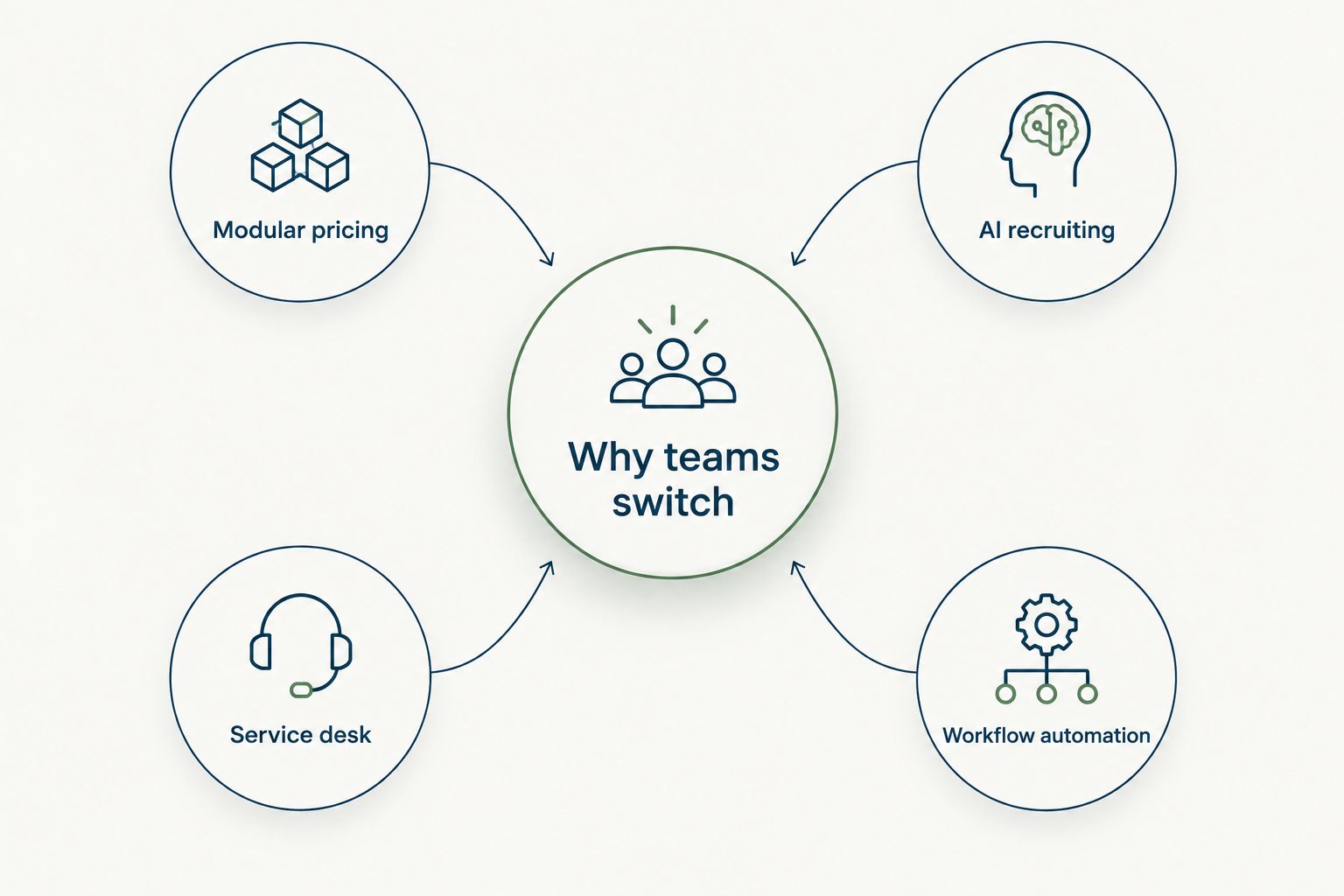
Namely earned its reputation the honest way — a clean employee directory, bundled benefits administration, a mid-market HRIS that just worked. None of that has changed. What's changed is what growing teams expect a single per-employee price to cover, and Namely wasn't built for that list. No workflow automation. No internal service desk. No AI sitting inside recruiting. The gap isn't a flaw so much as a ceiling — and most teams don't notice it until they hit it.
The short answer: HRSpace, if you want one modular platform spanning onboarding through recruiting. Rippling, if HR should share a login with payroll and device management. HiBob, if culture and people analytics matter more than automation.
The Real Reason Teams Leave
Namely was built around one model: HRIS plus benefits, bundled, priced as a tier. That model holds until a company between 20 and 100 employees needs to pick and pay for individual pieces instead of the whole bundle — and the wall usually shows up first in recruiting or internal support, rarely in core HR records.
At a Glance
| Tool | Best For | Standout Feature | vs. Namely |
|---|---|---|---|
| Namely | Mid-market HR with bundled benefits admin | Built-in benefits administration | Baseline |
| HRSpace | Full lifecycle on one modular platform | AI-drafted recruiting + an internal service desk (Service Me), same license | Modular pricing and workflow automation Namely doesn't offer |
| BambooHR | Simple onboarding and reporting | Employee database paired with a lightweight ATS | Lighter overall — no service desk, no automation |
| Rippling | HR, IT, and payroll under one login | One system controls laptops, apps, and paychecks | Heavier scope, more setup than Namely |
| HiBob | Culture and engagement-first teams | People analytics and a social-style feed | Stronger on culture, thinner on automation |
HRSpace — Built for the Gap Namely Left Open
HRSpace covers onboarding, time-off, performance, goals, recognition, AI recruitment, and an internal service desk — priced per employee, per module, not bundled into a fixed tier. For a team that outgrew Namely's packaging, that's the actual reason to switch. Not a feature on a landing page. A different pricing logic entirely.
It's built for lean HR teams that need setup measured in minutes. One login carries a hire from onboarding through their first performance review through their first piece of recognition. Service Me — the built-in service desk — gives every team SLA-routed requests instead of a Slack channel where HR questions go to die. And recruiting comes with AI-drafted job posts and screening baked in, not sold separately.
The trade-off is real: no published integration marketplace yet, so confirm payroll and SSO compatibility before you commit. And it's a younger platform than Namely — ask for references if you're past 100 employees.
Dimension by dimension:
| Namely | HRSpace | |
|---|---|---|
| Pricing | Bundled tiers, benefits baked in | Modular, per employee, per module |
| Recruiting | Standard ATS | AI-drafted posts and screening |
| Internal support | No native help desk | Service Me — SLA-routed requests |
| Setup | Multi-week, typical for mid-market suites | Modules live in minutes per team |
Best for: growing companies, 20 to 100 employees, ready to run the full lifecycle on one modular price.
BambooHR — For Teams That Never Needed the Bundle
If your Namely usage was really just "directory plus onboarding," BambooHR gets you there without the benefits-admin weight. Checklists and e-signature flows are simple. Reporting is readable by people who aren't in HR. What it doesn't have — a service desk, deeper automation — probably wasn't the reason you were unhappy with Namely in the first place.
Best for: small teams that want a clean record system and nothing more.
Rippling — HR Stops Being a Standalone System
Rippling's argument is scope. A new hire's laptop, software access, and paycheck all trace back to one employee record, which matters most where IT and HR are already tangled together. The trade is setup complexity — more to configure before go-live than a platform built for HR alone.
Best for: companies consolidating HR, IT, and payroll, not just replacing an HRIS.
HiBob — Culture Data Over Workflow
HiBob leans into people analytics and an engagement feed that reads more like a social app than a form. It's the right pick when culture metrics carry weight in the budget conversation, and the wrong pick if what you actually wanted from Namely was better request routing.
Best for: fast-growing teams where engagement data matters more than automation.
Why Teams Actually Switch
Not one dramatic failure. A handful of specific gaps that widen as a company grows past the size Namely was packaged for:
Paying for benefits-admin features baked into a tier you don't fully use. HR questions landing in Slack because there's no routed request system underneath them. Recruiting that stays entirely manual, with no AI drafting or screening. Approval chains built as workarounds because the platform has no native automation to configure instead.
"Most teams don't leave Namely because it broke. They leave because they outgrew the bundle."
None of that makes Namely wrong for everyone. It means the platform stops matching the job once a company needs more than a bundled HRIS and benefits tool.
See HRSpace module by module →
Check what modular per-employee pricing looks like for your team size.
When Staying With Namely Is the Right Call
If your bundled benefits administration is doing its job and you don't need a service desk, AI recruiting, or per-module pricing, switching costs more than it saves. Migration always has a real price in setup time and change management. That price only pays off when the new platform closes a gap the old one genuinely can't.
FAQ
What's the best Namely alternative in 2026?
HRSpace, for teams that want onboarding, performance, recognition, recruiting, and an internal service desk on one modular price. Rippling and HiBob fit better for teams prioritizing IT convergence or culture analytics specifically.
Is HRSpace cheaper than Namely?
It prices per employee per module rather than one fixed tier, so cost depends on what you actually turn on. Check current plans directly rather than assuming a flat comparison.
Does Namely have an internal service desk?
No native one with SLA routing. HRSpace builds this in through Service Me, routing HR and IT-style requests instead of leaving them in chat.
What's the difference between Namely and Rippling?
Namely is a bundled HRIS with benefits admin. Rippling extends HR into device management and payroll under one login — the right fit when HR and IT are already tightly linked.
Is HiBob better than Namely for culture?
Yes, on analytics and engagement tracking specifically. Namely's strength stays in bundled benefits, not culture data.
How long does switching HR platforms usually take?
Multi-week implementation is typical for mid-market suites. Modular platforms like HRSpace let individual modules go live in minutes per team, though actual timelines depend on data migration complexity.
Does Namely support AI recruiting?
Not natively — it runs on standard applicant tracking. Modular platforms like HRSpace build AI drafting and screening directly into the base recruiting module.
Is BambooHR a good Namely alternative for a small team?
Yes, if you only need a directory, onboarding, and basic reporting — it's lighter than Namely without the bundled benefits overhead.
One Last Thing
The gap that shows up fastest after leaving Namely isn't pricing. It's where HR requests actually live. Teams that add a service desk with SLA routing stop losing requests to Slack threads within the first few weeks — a bigger day-to-day win in 2026 than any line-item comparison.
Related guides: Best AI recruitment software in 2026 · Best HR software for small business in 2026
Ready to make HR the easy part?
Explore modular pricing and start a free 14-day trial.