Multilingual AI interviews
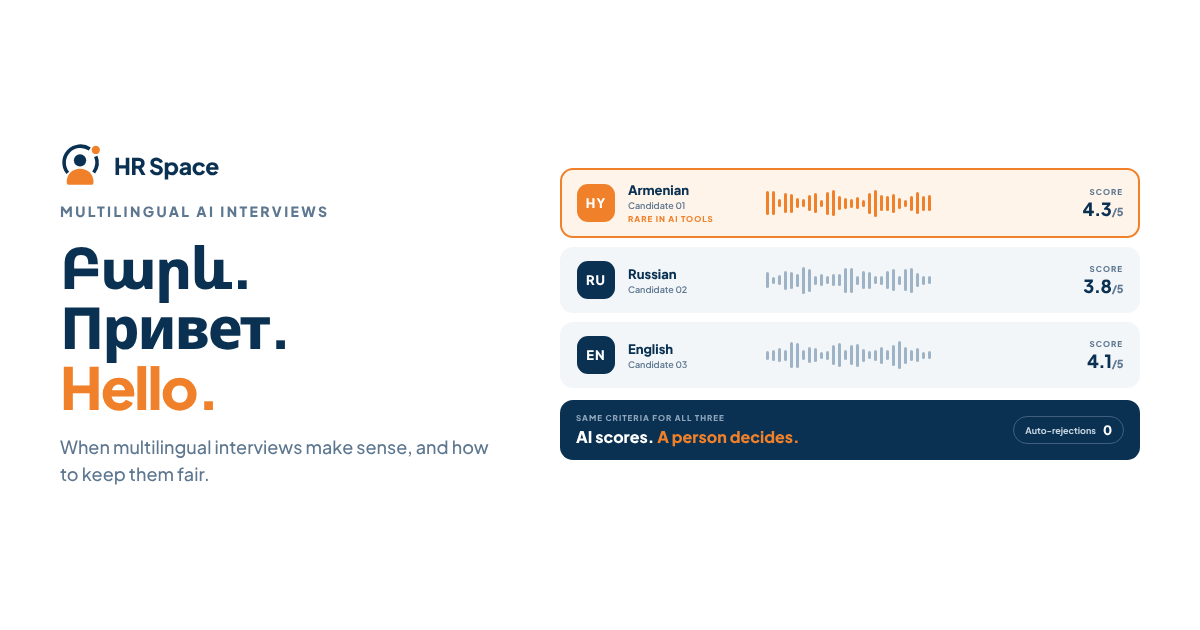
If you hire in Armenia, Georgia or anywhere with Russian-speaking candidates, you have probably met the same problem: a strong candidate gives a flat, hesitant answer in English, and you can't tell whether you're hearing a weak candidate or a second language.
Quick answer: A multilingual AI interview lets candidates answer screening questions in the language they think in, while every answer is still scored against the same role criteria. It works well when the job doesn't need fluent English from day one, when you screen volume across several markets, and when a person still makes every decision. It works badly when language skill is quietly mixed into the score, or when the tool's speech recognition is weak in the candidate's language.
Why the interview language changes what you learn
A screening interview should answer one question: can this person do the work? When it runs in a language the candidate uses less comfortably, a second question slips in: how well do they speak English under pressure?
Sometimes that matters. A client-facing account manager for a UK client needs confident English. A backend developer in a Russian-speaking team, or a warehouse supervisor in Gyumri, may not. If screening rewards fluency for those roles, you shortlist the best English speakers, not the best candidates. The fix is to decide, role by role, whether language is part of the job, and keep it out of the score when it isn't.
Russian is widely supported. Armenian is not.
Of the published language lists we checked in November 2026, Fountain, Braintrust and Hyring all include Russian. None of the four lists we checked included Armenian.
The reason is technical. Armenian is still a low-resource language for speech technology, with far less recorded and transcribed speech to train on. Researchers in Yerevan have been building larger datasets, and one 2025 study reported a word error rate of about 9.9% for its improved Armenian model. That is real progress, and also a reason to check transcripts yourself. If your candidates speak Armenian, ask any vendor to show you an Armenian transcript of a real answer before you trust its scores.
When a multilingual AI interview makes sense
|
Situation |
Language setup |
Why it helps |
|---|---|---|
|
Local roles where English isn't used daily |
Candidate's preferred language |
You assess skills, not fluency |
|
Hiring across Armenia, Georgia and Russian-speaking markets |
Armenian, Russian and English offered |
One process instead of three |
|
Client-facing roles in English |
English, with language as a stated criterion |
Fluency is measured openly |
|
Volume hiring for shifts or support |
Preferred language, voice answers |
Fewer drop-outs at the first step |
|
Senior or specialist roles |
Short AI screen, then live interviews |
AI saves time; people judge depth |
How to set it up so scores stay fair
- Write the criteria before you think about languages. List the three to five things the role needs and what a good answer looks like. If English is one of them, make it its own criterion. A shared interview scorecard helps.
- Write each question once, then check every language version. Ask a native speaker on your team to confirm the Armenian and Russian versions ask the same thing.
- Keep questions short and concrete. "Tell me about a time a delivery was late and what you did" travels across languages better than a question about "ownership culture".
- Tell candidates what to expect: how many questions, how long, voice or video, which languages. More in our guide to one-way interviews that work for candidates.
- Review in the original language when it matters. For borderline candidates, have a speaker of that language check the original answer, not only the summary.
- Compare scores across languages after the first batch. If Armenian answers score lower for the same role, check transcripts before you conclude anything about candidates.
What the AI should and shouldn't decide
AI is good at the repetitive parts: asking the same questions in the same order, transcribing, summarising and showing which criteria an answer touched. It shouldn't be the one rejecting people. A sensible split: AI runs the screen and suggests a ranked shortlist with reasons, a recruiter checks the reasons, and the hiring manager decides.
Regulation points the same way. In the EU, AI used for recruitment is high-risk under the AI Act, and after the Digital Omnibus (Regulation (EU) 2026/1744) those obligations apply from 2 December 2027. If you hire candidates in the EU, building in human review now is easier than adding it later. (This isn't legal advice.) See also AI for recruiters: building a better interview workflow.
How HRSpace handles multilingual AI interviews
This is the problem HRSpace's AI Recruitment module was built for. It runs one-way AI interviews by video or voice in English, Armenian and Russian, so you don't need a separate tool or process for each market.
- Questions from your job description, drafted by AI and edited by you before anything goes out.
- Scoring you can check: each answer is scored against your criteria, with the reasons linked to the answer.
- People decide: HRSpace produces summaries and ranked shortlists, but the AI never rejects a candidate on its own.
- Updates in the candidate's language at every stage, sent automatically.
- Plain-language search, for example "React devs in Yerevan, 3+ years".
- No re-typing after the offer: hired candidates move straight into HRSpace onboarding.
AI Recruitment is a $1 per employee per month add-on to the $1 Base Layer, with a 14-day free trial and no credit card. The easiest test is to run one real role through it and compare the shortlist with the one your team would have made. See how HRSpace Recruiting works.
FAQs
Can AI interview candidates in Armenian? Some tools can, but Armenian is still rare because it has less speech data than major languages. HRSpace supports one-way AI interviews in Armenian, English and Russian. Whatever tool you use, review a few real Armenian transcripts first.
Is it fair to let candidates choose their interview language? Yes, if language isn't a job requirement and every answer is scored against the same criteria. If the role needs a language, say so in the advert and score it separately.
Does answering in a second language lower AI interview scores? It can, if the tool rewards fluency or transcribes poorly. Compare scores by language after your first batch.
Should AI make the final hiring decision? No. Use AI to screen, summarise and suggest. A person reviews the reasons and decides.
Do multilingual AI interviews replace live interviews? No. They replace the repetitive first screen. Live interviews still test depth and fit.
Further reading: Best AI Recruitment Software in 2026 · Is AI Recruitment Software Worth It in 2026? · Armenian speech recognition study (arXiv)
CTA block: Ready to make HR the easy part? Explore modular pricing and start a free 14-day trial. [See pricing]
Ready to make HR the easy part?
Explore modular pricing and start a free 14-day trial.