Job Adverts That Help the Right People Recognize the Role
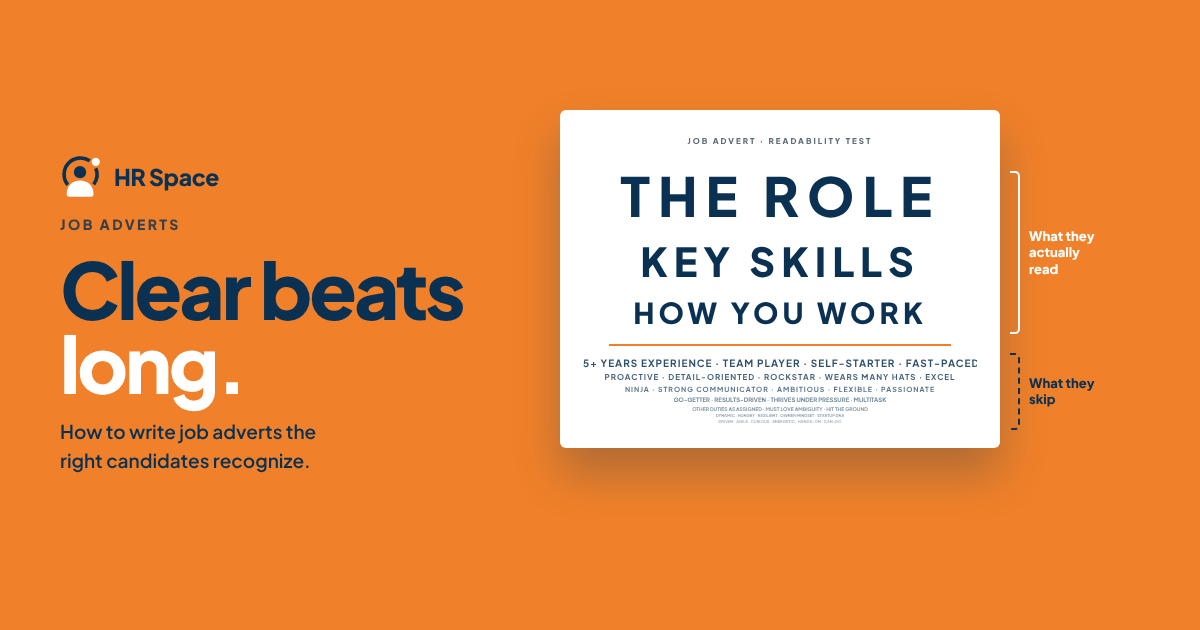
Lead with the work someone will own
Name the main responsibility in familiar language. Describe the problems the person will handle, the people they will work with, and the decisions they can make.
A marketing role might involve producing campaigns, coordinating contributors, and reviewing performance. Explain which of those the person owns and where they receive support. Avoid asking the reader to infer a department's entire operating model from a job title.
Workable's job-description guidance recommends clear titles, understandable duties, and attention to overlong requirement lists. Use that as a prompt to inspect the advert from the candidate's side, rather than as a reason to copy a generic template.
If the vacancy is newly created, be honest about what is still being developed. Confirm the expectations that matter before presenting the role as fully defined.
Show which requirements are essential
For each requirement, identify the responsibility it supports. If the connection is unclear, ask the manager whether it belongs in the advert or needs a better explanation.
Separate capabilities required on arrival from knowledge the team can teach. A particular tool may be convenient experience, while the real requirement is the ability to analyze a problem or manage a recurring workflow.
Explain acceptable alternative evidence where the team has agreed it. Relevant project experience, another tool in the same category, or work in a comparable setting may answer the underlying question.
Do not imply flexibility that the hiring team will not honor. The public advert and the review criteria need to describe the same standard.
Check each part of the advert for a clear purpose
|
Advert section |
What the reader needs |
Review question |
|
Job title |
A recognizable description of the role |
Would a suitable person search for this title |
|
Responsibilities |
The main work and decision scope |
Can the reader picture an ordinary week |
|
Requirements |
Capabilities needed for that work |
Is each essential item justified |
|
Working arrangement |
Confirmed location, schedule, and relevant terms |
What could surprise the candidate later |
|
Application process |
How to apply and what follows |
Is the next step understandable |
The table helps you review meaning. A well-formatted advert can still fail these questions if the information underneath remains vague.
Replace broad claims with a useful example
“Fast-paced” can describe frequent customer requests, an early product team, or poorly planned work. Explain what the person will actually encounter.
Likewise, “great development opportunities” needs a grounded description. If the team provides a learning budget, mentoring, or a planned progression review, describe the confirmed arrangement accurately. Avoid making a general promise that nobody owns.
Ask the manager for a recent example of the work. A short explanation of a typical project or recurring challenge can help candidates understand the opportunity more clearly than another adjective.
Keep the example proportionate. The advert should offer enough context to support an application decision without becoming a detailed internal handbook.
Review practical terms before publication
Check the location, working pattern, travel expectations, engagement type, and approved compensation information you intend to publish. Ask the appropriate owner to confirm anything the recruiter cannot authorize.
Be precise about remote or hybrid arrangements. Explain required attendance or collaboration windows in terms a reader can understand. A label alone does not tell the candidate what their week would involve.
Check that the application form supports the advert. If the advert welcomes a range of backgrounds but the form requires one narrowly defined qualification, resolve the inconsistency before publishing.
Have someone outside the hiring team read both. Ask them to explain the job and identify the question they would need answered before applying.
Use early conversations to improve the advert
Listen for repeated misunderstandings. If suitable people keep asking whether the position includes management, check whether the responsibility was actually stated. If applicants describe a different kind of work, revisit the title and opening explanation.
Update the advert when the underlying role has been clarified. Record material changes and review active conversations so the team does not continue describing two versions of the vacancy.
Avoid reacting to one unusual application by adding another exclusion. Look for a genuine ambiguity and fix the information that produced it. The aim is a clearer invitation to relevant candidates, rather than an ever longer screening list.
FAQs
How many requirements should a job advert contain
Include the essential capabilities justified by the work and explain useful preferences separately. There is no universal ideal count. Review whether every line helps a candidate understand the role or the evidence the team needs.
Should every tool the team uses be listed as essential
Only where the role genuinely requires that competence on arrival. Check which tools can be learned and which underlying capability matters. Keep the advert aligned with the standard interviewers will apply.
What if the role is still evolving
Confirm the main responsibility, practical terms, and decision scope before publishing. Explain the relevant uncertainty honestly. If the role changes materially during recruitment, update the advert and the people already in the process.
How can we test whether the advert is clear
Ask someone unfamiliar with the vacancy to describe the work, essential requirements, and working arrangement after reading it. Use their questions to identify missing information, then check the application form for consistency.
Review one requirement before publishing
Ask why it is essential and what alternative evidence the team would accept. If you are exploring HRSpace Recruiting, bring the completed advert and ask to follow it through publication and application review.
Further reading
Ready to make HR the easy part?
Explore modular pricing and start a free 14-day trial.