Is an HR Service Desk Worth It for Small Companies?
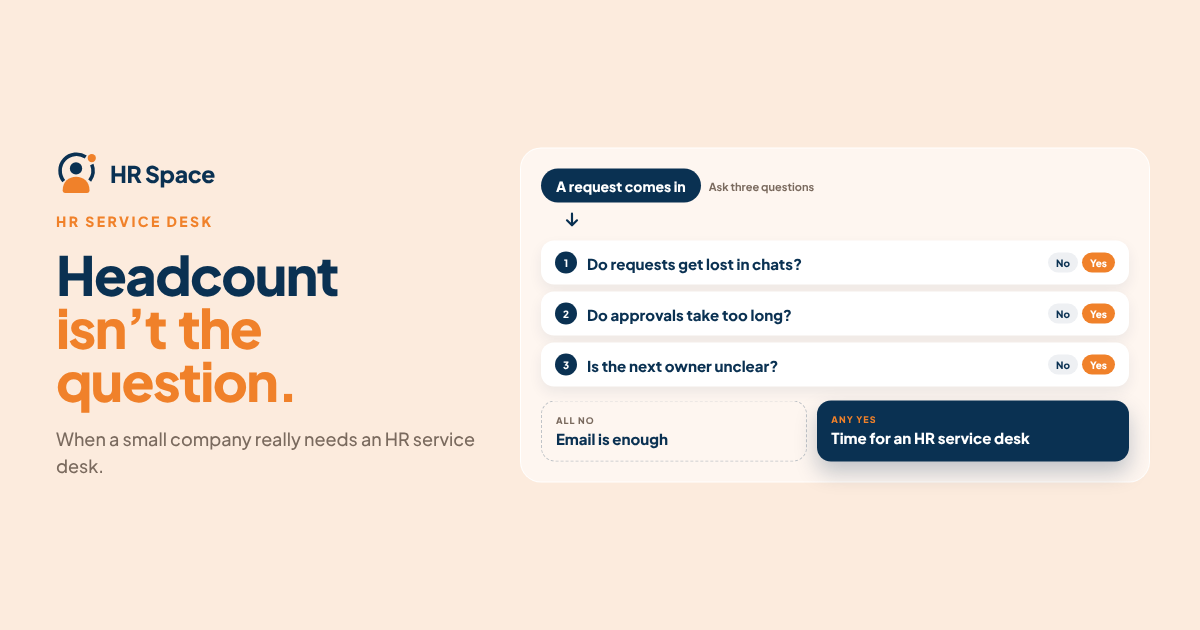
An HR service desk is worth it for small companies when employee requests get lost in chats, require repeated follow-ups, or pass between HR and managers without a clear owner.
However, not every small business needs one. If requests are straightforward and a responsible person can track them reliably, email or a shared inbox may be enough.
The decision comes down to one question: Can your current process reliably show who owns each request, what happens next, and when the issue is resolved?
Is an HR Service Desk Worth It for Small Companies?
An HR service desk earns its place by improving how employee requests are handled, not simply by adding another portal.
The difference is visibility. Your team should be able to identify who is responsible for a request, what information or approval is still needed, and what counts as a completed resolution.
When evaluating HR service desk software, compare how each option supports your actual workflow rather than choosing based on the length of its feature list.
| Approach | Best for | Main advantage | Main drawback |
|---|---|---|---|
| Email or chat | Straightforward requests handled by a named person | Employees can use familiar channels | Unresolved requests and handoffs may be difficult to track |
| Shared inbox with a request log | Teams that need more consistent ownership | Creates a common queue without replacing every existing process | Someone must maintain assignments, statuses, and follow-ups |
| HR service desk | Requests involving routing, approvals, and response targets | Organizes work around ownership and defined workflows | Requires setup, configuration, and ongoing administration |
These approaches are not a ranking by company size. A small team with complicated approval requirements may need more structure than a larger team handling straightforward questions.
Choose a service desk when your current process cannot reliably track ownership and resolution. Keep the simpler approach when it works. Growing headcount alone is not a reason to replace a functioning process.
Why This Matters for Small HR Teams
In a company with 20–100 employees, HR responsibilities often overlap with operations and management. The person handling employee questions may also be responsible for onboarding, recruitment, or other day-to-day tasks.
The request process should make that work easier to manage, not create another system that requires constant administration.
For example, an employee may have an onboarding question that requires information from HR and a decision from their manager. Without clear ownership, the employee may have to contact several people and repeat the same information.
A structured process should provide three things:
-
A clear place to submit a request.
-
A person responsible for moving it forward.
-
An understandable outcome and next step.
For your 2026 evaluation, focus on the employee experience and the work HR needs to coordinate. Features matter only when they help achieve those outcomes.
When Email Is Still Enough
Best for: small teams with straightforward requests and reliable follow-through.
Email or chat can work well when employees know where to ask questions and the responsible person can keep track of open requests.
The advantage is simplicity. Employees already understand these channels, and your team does not need to introduce a new process just to answer routine questions.
The limitation appears when requests involve other people. A manager may need to approve something, another team may need to provide information, or HR may need to follow up several days later.
Sending a message does not necessarily mean the request has been resolved.
Before buying software, check whether your current process can answer these questions:
-
Who is responsible for the request right now?
-
What information or decision is still needed?
-
Can someone else take over without reconstructing the entire conversation?
-
Does the employee know what happens next?
If the answers are clear, keep your existing process. You may only need better instructions, clearer ownership, or a shared way to track open work.
When an HR Service Desk Becomes Useful
Best for: growing teams whose employee requests involve handoffs, approvals, or response commitments.
An HR service desk provides a more structured way to receive, organize, and track employee requests.
Depending on the platform, it may support:
-
Request routing: Directing each request to the appropriate person or team.
-
Approval workflows: Sending requests to the person responsible for making a decision.
-
SLA targets: Defining expected response or resolution times.
-
Request tracking: Making it easier to see what remains open and what needs attention.
-
Resolution records: Recording the outcome rather than treating a forwarded message as completed work.
The main benefit is structure. The trade-off is that someone must define the rules, assign responsibilities, and update the process as the company changes.
Software cannot determine which manager should approve a request unless your team has established that responsibility.
At 20 employees, evaluate the coordination problem instead of assuming you are too small. At 100 employees, use the same approach instead of assuming a service desk is automatically necessary.
Headcount provides context. Unclear ownership is a stronger reason to change.
Start with the request types that create the most confusion rather than introducing every possible workflow at once.
How to Decide Whether a Service Desk Is Worth the Investment
Before comparing platforms, consider the following factors.
1. Request Ownership
Can every employee request be assigned to someone responsible for moving it forward?
A shared queue helps only if someone is accountable for the work inside it. If requests remain unassigned, a new system may simply make the existing problem more visible.
2. Routing Requirements
Which requests can HR handle directly, and which require another team?
Your routing rules should reflect how the company actually operates. Avoid creating complicated workflows based on an ideal organizational structure that does not match daily work.
3. Approval Steps
Separate requests that need a decision from questions that only need an answer.
For example, explaining an onboarding policy should not automatically require the same approval process as granting an exception.
Add approval steps where they serve a clear purpose.
4. Response Expectations
Decide whether employees need explicit response targets and what those targets should measure.
Acknowledging a request and resolving it are different outcomes. Make sure employees understand what the expected timeframe means.
5. Employee Lifecycle Scope
Consider whether your service desk should operate alongside onboarding, time-off management, performance reviews, and other HR processes.
If your team already uses several separate tools, a broader platform may be worth evaluating. If you only need to organize occasional questions, a more focused solution may be sufficient.
6. Administrative Ownership
Someone must maintain request categories, routing rules, instructions, and responsibilities.
Before choosing software, identify who will manage these tasks and how much ongoing work they will require. An outdated workflow is not improved simply because it exists in a digital system.
Two companies with similar headcounts can have very different needs. The right choice depends on their request volume, approval requirements, and ability to manage follow-up.
Set Up the Process Before Choosing the Platform
A clear process makes it easier to evaluate software and avoid paying for features your team does not need.
Use these five steps to define what your HR service desk should do.
Step 1: Define Request Intake
Choose the types of requests you want the service desk to handle first.
Onboarding questions and requests involving time-off processes may be useful starting points if those are areas where your team needs better coordination.
Describe request categories in language employees understand. Ask only for the information needed to act on the request.
Also decide which matters should not enter the general request queue. Sensitive employee issues may require specific access controls and handling procedures. Confirm that any platform you consider supports your requirements before using it for such cases.
Step 2: Assign a Named Owner
Give each request type a responsible person.
That person should be accountable for moving the request forward, even when another manager or team must provide information or approve the next step.
Define backup coverage as well. A process that stops whenever one person is unavailable will still create delays, regardless of the software you use.
Treat ownership and backup arrangements as requirements to evaluate rather than assuming every service desk handles them in the same way.
Step 3: Map the Approval Path
Document which requests require approval, who makes the decision, and what information they need.
Keep routine questions separate from decisions. Explaining an existing policy should not automatically trigger the same workflow as approving an exception.
Ask each vendor to demonstrate your intended approval process. A general statement that a product supports approvals is less useful than seeing a request reach the correct decision-maker.
Step 4: Define Response Targets
Decide what employees should expect after submitting a request.
Will the target cover acknowledgment, a substantive response, or final resolution? Make the distinction clear.
Choose targets your team can realistically meet. A short deadline may look impressive in a product demonstration but will not help employees if the responsible people cannot deliver.
Also check how the platform displays overdue requests and what happens when progress depends on another person's decision.
Step 5: Define Resolution
Decide what it means for a request to be complete from the employee's perspective.
Forwarding a question to another person does not necessarily resolve it. The process should identify the expected outcome, how the employee will be informed, and what conditions allow the request to be closed.
Ask vendors to demonstrate how the outcome is recorded.
Use these five steps as your 2026 demonstration script. Give each vendor the same request scenario and compare how clearly their platform supports it.
Do not substitute a polished, unrelated demonstration for the workflow your team actually needs.
Where HRSpace Fits
HRSpace offers a modular cloud HR platform that includes onboarding, time-off management, performance reviews, goals, recognition, AI-assisted recruitment, workflow automation, and an internal service desk.
Its stated service-desk capabilities include routing rules, SLA targets, and approval chains. These features are relevant to teams that need to manage requests through defined responsibilities, response expectations, and decisions.
HRSpace is best suited to growing HR and People Operations teams that want an internal service desk alongside their employee lifecycle software.
HRSpace uses modular per-employee pricing, so your evaluation should consider both your employee count and the modules you intend to use. Confirm the current commercial terms and the exact scope of the selected modules.
A broader HR platform may be useful if you want to manage employee support and other HR workflows together. However, if your company only receives occasional, straightforward questions, the additional scope may not be necessary.
Evaluate each capability for its actual purpose. AI-assisted recruitment, for example, should not be treated as evidence of AI-powered service-desk resolution. They are different functions.
Before making a decision, confirm how the platform handles sensitive requests, required approvals, and any connections to your existing systems. Treat these as specific purchasing requirements rather than assumptions based on the product category.
Will an HR Service Desk Reduce HR's Workload?
An HR service desk can help reduce avoidable coordination work, but it does not eliminate the need to answer questions, make decisions, or handle difficult conversations.
To evaluate its impact, compare your team's work before and after introducing the new process.
Look at the time spent:
-
Finding requests across different conversations.
-
Identifying who should handle each issue.
-
Following up on pending approvals.
-
Checking which requests remain unresolved.
-
Confirming that employees received an outcome.
If the new system simply copies email conversations into tickets, it may add administration without improving the underlying workflow.
Use your own request records to assess the result. Better tracking and reduced workload are related goals, but they are not the same outcome.
Does a Small Company Need SLA Targets?
A small company needs SLA targets when explicit response commitments help employees and request owners coordinate.
It does not need a different target for every request category simply because the software allows it.
Start by distinguishing response from resolution. Some requests depend on a manager's decision or information from another team. Define those dependencies before promising an outcome.
Keep targets realistic and explain them in plain language so employees know what to expect.
Is an Employee Portal Enough?
An employee portal may be enough when employees primarily need access to policies, information, or basic employee services.
An HR service desk addresses a different need: managing requests that require action, ownership, and resolution.
For example, a policy page can explain how the time-off process works. But an individual request that needs a manager's decision still needs someone responsible for handling it.
Evaluate information access and request management separately, even if one platform offers both.
Frequently Asked Questions
Is an HR service desk worth it for small companies in 2026?
Yes, when employee requests need clearer ownership, approvals, or tracked resolution. Keep a simpler process if your team can already manage requests reliably without another system.
Does a company with 20 employees need an HR service desk?
A 20-person company needs an HR service desk only if its request process requires more structure. Evaluate handoffs, approvals, and unresolved work rather than treating headcount as a buying threshold.
Is an HR service desk better than email?
An HR service desk is better suited to requests that require structured ownership and workflow tracking. Email remains a reasonable choice for straightforward requests that a responsible person can manage reliably.
What's the difference between an HR portal and an HR service desk?
An HR portal gives employees access to information or employee services. An HR service desk organizes requests that need action and resolution. Evaluate the specific capabilities you need rather than relying on the product label.
What should I ask for in an HR service desk demonstration?
Ask the vendor to demonstrate request intake, ownership, approvals, response targets, and resolution using your actual workflow. Confirm sensitive-request handling and other requirements separately.
Does HRSpace include an internal HR service desk?
Yes. HRSpace includes an internal service desk alongside onboarding, time-off management, performance reviews, goals, recognition, AI-assisted recruitment, and workflow automation. Its stated service-desk features include routing rules, SLA targets, and approval chains.
Can an HR service desk replace an HR manager?
No. An HR service desk organizes requests and workflows, but people are still responsible for interpreting policies, making decisions, and resolving employee concerns.
One Last Thing
Test the handoff, not just the submission form.
A request form is easy to demonstrate. The more revealing test is a request that requires someone outside HR to take action.
Before choosing a platform, follow a request from submission to closure. Ask who owns it while approval is pending, how the employee receives updates, and what confirms that the work is complete.
If those answers remain unclear, revisit the process before committing to the software.
The right next step is not always buying a new system. It is making responsibility visible, then choosing the simplest solution that keeps it visible.
Related Guides
Ready to make HR the easy part?
Explore modular pricing and start a free 14-day trial.