Is AI recruitment software worth it in 2026?
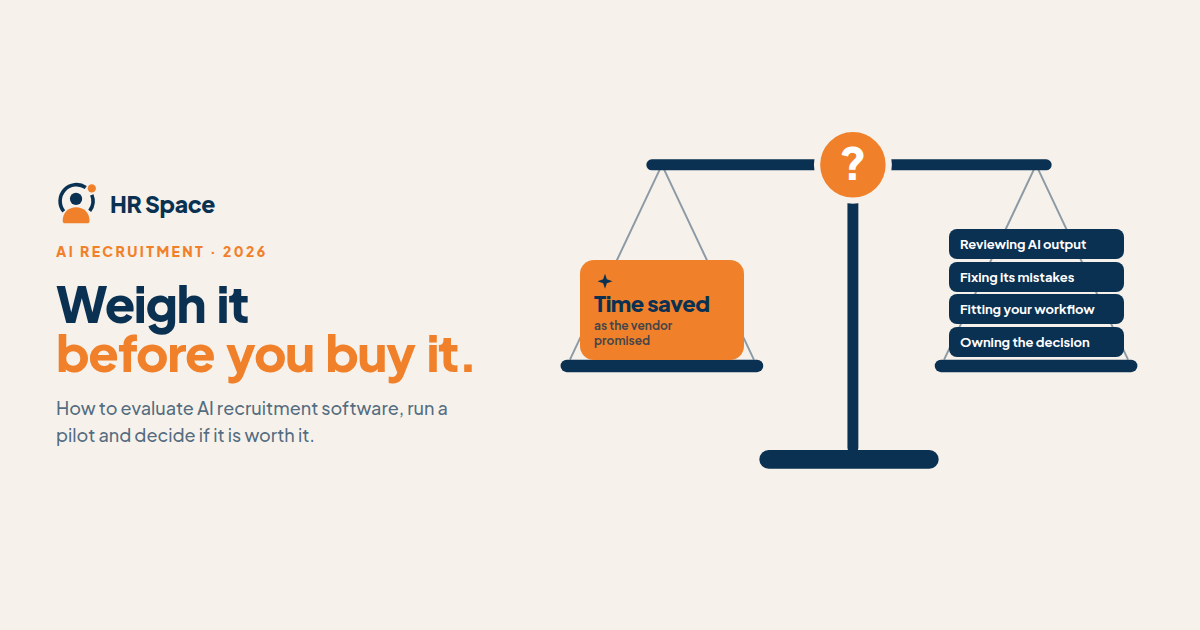
AI recruitment software can be worth the investment in 2026, but only when it improves a real hiring workflow without creating more work for the people using it. The right solution should help your team complete specific tasks more efficiently while maintaining the quality and fairness of candidate assessment.
For growing businesses, the decision is not simply whether AI can support recruitment. It is whether the software fits the existing hiring process, reduces total manual effort, and provides enough value to justify its cost.
This guide explains how to evaluate AI recruitment software, compare recruitment-focused tools with broader HR platforms, and run a practical pilot before committing to a solution.
Is AI Recruitment Software Worth It in 2026?
AI recruitment software is worth considering when your team has a recurring hiring task that consumes significant time and can be evaluated against clear quality standards.
However, adopting AI does not automatically make recruitment faster or more effective. A tool might generate a candidate summary quickly but require extensive checking, rewriting, or manual data transfer afterward. Those additional steps must be included when evaluating its value.
Before choosing recruitment software, consider three questions:
-
What problem are you solving? Identify a specific bottleneck, such as preparing recruitment materials, organizing candidate information, or managing a repeatable step in the hiring workflow.
-
Does the software improve the complete task? Evaluate the result alongside the time spent checking, correcting, approving, and transferring information.
-
Can your team use it responsibly? Establish who reviews outputs, approves decisions, and handles exceptions.
The goal is not to introduce more technology. It is to improve a defined part of the recruitment process.
AI Recruitment Software vs. Traditional Hiring Processes
Not every business needs a new recruitment platform. The right approach depends on the problems your team experiences and the scope of the solution required.
| Approach | Best suited for | What to evaluate |
|---|---|---|
| Improve the existing process | Teams without a clear software-related bottleneck | Whether better templates, responsibilities, and workflows solve the problem |
| Use recruitment-focused software | Teams with a specific hiring task to improve | Task quality, review effort, and compatibility with existing systems |
| Use a broader HR platform | Teams evaluating recruitment alongside employee management | Required HR functions, workflow continuity, and implementation needs |
These approaches are not a ranking of software quality. A specialized recruitment tool may be sufficient for one team, while another may benefit from managing recruitment and employee processes within a broader HR platform.
Choose based on demonstrated requirements rather than the number of features a vendor offers.
What Should You Look for in AI Recruitment Software?
Before comparing recruitment software, document the task you want to improve. This makes vendor demonstrations more useful and gives your team a consistent way to evaluate different solutions.
A practical task brief should define five elements:
-
Input: What information does the task require?
-
Output: What should the completed work contain?
-
Owner: Who reviews and approves the result?
-
Acceptance criteria: What makes the result accurate and usable?
-
Handoff: Who receives the result and what happens next?
For example, if your team wants AI assistance with recruitment materials, specify the information those materials must contain and who will approve them. If you want assistance reviewing candidate information, define the job-related evidence that a reviewer needs to assess.
This approach prevents a common mistake: evaluating software based on an impressive demonstration without checking whether it solves a problem your team actually has.
Where HRSpace Fits in the Recruitment Software Landscape
HRSpace is a cloud-based HR platform that combines AI-powered recruitment with employee management workflows.
Its scope includes recruitment, onboarding and offboarding, time-off management, performance reviews, goals, recognition, workflow automation, and an internal service desk.
For growing businesses evaluating both recruitment and ongoing HR administration, HRSpace may be relevant when these processes need to be considered together rather than as entirely separate systems.
The important distinction is that a broader platform should be evaluated across the workflows your team intends to use. Having recruitment and onboarding within the same platform does not automatically establish how every transfer of information works or eliminate all manual steps.
When evaluating HRSpace, focus on the actual recruitment tasks you need, the handoff into onboarding, the available approval controls, and the steps your team will still perform.
Explore HRSpace to learn more about its HR management and recruitment capabilities.
How to Evaluate AI Recruitment Software Before Buying
A controlled pilot is one of the most practical ways to determine whether AI recruitment software is worth the investment.
Instead of changing your entire hiring process, select one repeatable task and compare the current workflow with the proposed one.
1. Record Your Current Recruitment Workflow
Start by documenting how your team completes the selected task today.
Record the time spent performing the work, reviewing the result, correcting errors, obtaining approvals, and transferring information to the next person.
Include the effort required from hiring managers as well as HR staff. A task may appear faster for the recruiter while creating additional work for another team member.
This baseline gives you a more accurate picture of the process you want to improve.
2. Test the Software on a Realistic Task
Ask the vendor to demonstrate the exact workflow you identified.
Use representative materials that your organization is permitted to share, and confirm the vendor's data-handling terms before uploading candidate information.
Evaluate whether the software can produce the required output consistently. Distinguish functionality that is available in the actual product from features shown only in a conceptual demonstration.
Keep the test focused on the selected task instead of expanding it into an evaluation of every available feature.
3. Evaluate Output Quality
Speed matters only when the result meets your team's requirements.
Check whether the output preserves relevant information, follows the role's requirements, and avoids introducing unsupported details.
For candidate-related work, reviewers should be able to inspect the underlying information and understand why a result is useful. A polished summary or confident recommendation should not be treated as evidence on its own.
Record both accepted and rejected outputs. Reviewing only successful examples can hide the amount of checking required in everyday use.
4. Measure Review Time and Rework
Track the work that remains after the AI produces an output.
Include corrections, manual copying, approval steps, explanations, setup, and training. Separate initial implementation effort from recurring work so that you can understand the ongoing impact.
For example, a tool that saves 15 minutes on an initial task but requires substantial additional review may offer less value than expected. The result depends on the complete workflow, not the speed of one individual step.
Do not count work as eliminated when it has simply moved from HR to a hiring manager.
5. Decide Which Tasks to Adopt
Compare the new workflow with your original baseline.
Assess the total human effort, output quality, handoff requirements, and remaining risks. Approve only the tasks that meet your acceptance criteria.
Document the decision, the person responsible for the task, the quality standard, and the evidence supporting adoption.
Set a review point after implementation. A successful pilot demonstrates that one task is suitable for the software; it does not automatically justify using AI throughout the entire hiring process.
What Determines the Value of AI Recruitment Software?
The value of AI recruitment software depends on more than company size or the number of available features.
Several factors should influence your decision.
Task frequency. Repeated tasks provide more opportunities to evaluate improvements than activities performed only occasionally. Identify how often the selected task occurs before estimating its potential value.
Output quality. Define what an acceptable result looks like. If the output regularly needs extensive correction, the apparent time saving may not translate into a genuine improvement.
Review workload. Count the effort required to check, approve, and correct results. This is particularly important when the task involves candidate information or hiring recommendations.
Platform scope. Decide whether you need recruitment functionality alone or also need to manage onboarding, employee records, time off, and other HR processes. Evaluate each required function separately.
Implementation and adoption. Include configuration, training, and changes to responsibilities. Software creates operational value only when people can use it effectively within an established workflow.
Human accountability. Determine who remains responsible for decisions, exceptions, and the quality of the process. AI assistance should not remove accountability from the people making hiring decisions.
A company with 20 employees may have a strong reason to evaluate recruitment software, while a company with 100 employees may be better served by improving its existing process. Headcount provides context, but it does not prove that a purchase is necessary.
How to Keep AI-Assisted Hiring Accountable
AI recruitment software should support a recruitment team, not replace accountable human judgment.
Candidate-related decisions can affect people's employment opportunities. For that reason, organizations should define clear, job-related assessment criteria and establish how AI-generated outputs will be reviewed.
Before adopting a tool, ask the vendor:
-
Can reviewers inspect the information supporting an output?
-
Can a person correct or reject a result before it affects the next stage?
-
How does the workflow handle missing or contradictory information?
-
Who approves actions involving candidates?
-
Can the team document decisions and manage exceptions?
-
What data-handling practices and applicable legal requirements must be considered?
Treat these as requirements to verify rather than capabilities to assume.
Avoid making automatic candidate rejection the starting point of an AI evaluation. Begin with a bounded task whose output can be reviewed by a person, and assess any broader application against your organization's standards and applicable obligations.
Is AI Recruitment Software Worth It for Small Businesses?
For small and medium-sized businesses, AI recruitment software can be worth evaluating when recurring hiring tasks compete with other HR and operational responsibilities.
The decision should begin with the team's actual workload rather than a general assumption that smaller companies need automation.
If recruitment happens infrequently and the current process works well, improving templates, clarifying responsibilities, and standardizing evaluation criteria may be sufficient.
If your team repeatedly handles the same time-consuming tasks, a controlled software pilot can help establish whether AI assistance provides a measurable benefit.
Before purchasing, compare the expected improvement with the software cost, implementation effort, training requirements, and ongoing review workload.
Can AI Recruitment Software Replace a Recruiter?
AI recruitment software should be evaluated as a tool that supports specific recruitment tasks, not as a complete replacement for a recruiter.
Recruiters and hiring managers remain responsible for understanding role requirements, evaluating relevant candidate evidence, handling exceptions, and making accountable decisions.
Software may assist with parts of a workflow, but the usefulness of that assistance depends on the task, the quality of its outputs, and the controls available to the team.
The right question is not whether AI can perform recruitment activities independently. It is which tasks it can support reliably while allowing people to retain appropriate oversight.
How Do You Know Whether an AI Recruitment Pilot Succeeded?
A successful pilot demonstrates that the selected task can be completed with less total human effort without weakening the required quality standard.
Evaluate at least four areas:
-
Total effort: Time spent performing, checking, correcting, and approving the task.
-
Output quality: Whether the result meets the agreed acceptance criteria.
-
Workflow fit: Whether the result reaches the next person without unnecessary manual work.
-
Accountability: Whether responsibilities and review controls remain clear.
The outcome should be a documented decision about which tasks to adopt, which to leave unchanged, and what needs further testing.
Success with one task does not prove that the same software is suitable for every recruitment activity.
Frequently Asked Questions
Is AI recruitment software worth it in 2026?
AI recruitment software is worth considering when a controlled pilot demonstrates a useful improvement in a recurring hiring task. Include setup, training, review, and correction effort when evaluating the results.
What is the best way to test AI recruitment software?
Select one repeatable task, record your current workflow, and test the software against the same quality standard. Measure the total effort required, including corrections, approvals, and handoffs.
Is HRSpace only recruitment software?
No. HRSpace is a cloud-based HR platform that includes AI-powered recruitment alongside employee management workflows such as onboarding, time-off management, performance reviews, goals, recognition, workflow automation, and an internal service desk. Evaluate the functions that match your team's requirements.
Should we choose recruitment software or an all-in-one HR platform?
Choose the option that fits your verified needs. A recruitment-focused tool may be appropriate when one hiring task is the priority. A broader HR platform may be worth evaluating when recruitment and employee administration also need to be managed together.
Can AI recruitment software make hiring decisions for us?
AI recruitment software may assist with recruitment tasks, but organizations should retain appropriate human oversight and accountability for hiring decisions. Verify the available controls and applicable requirements before introducing automated actions involving candidates.
What should we measure besides time saved?
Measure output quality, correction effort, approval time, workflow handoffs, and implementation requirements. A task completed faster is not necessarily more efficient if someone else must spend additional time rebuilding the result.
Do we need to replace our existing HR software?
Not necessarily. Identify the recruitment task that needs improvement first. Then evaluate whether a specialized tool can work with your existing setup or whether a broader platform change is justified.
Final Thoughts: Choose AI Recruitment Software Based on Evidence
The most useful question to ask before investing in AI recruitment software is simple: Which work will this tool actually remove, and what new work will it create?
A practical evaluation should answer that question with evidence from your team's workflow, not just a vendor presentation.
Identify a recurring task, define what a good result looks like, measure the complete process, and keep people accountable for decisions involving candidates.
If the software improves the task without creating disproportionate review work or weakening assessment quality, it may be worth adopting. If the benefits remain unclear, continue improving the existing process until there is a stronger case for change.
For teams evaluating recruitment alongside employee management, explore HRSpace to learn more about its platform and available workflows.
Related Articles
Ready to make HR the easy part?
Explore modular pricing and start a free 14-day trial.