Interview Scorecards for Small Business Hiring Teams
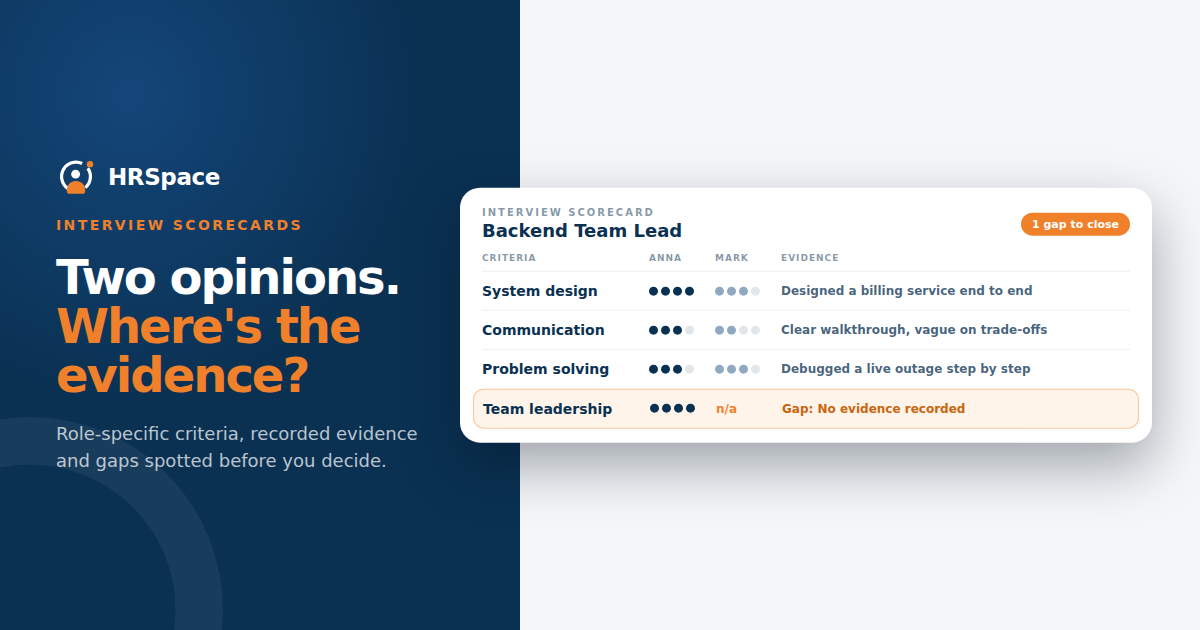
After the interview, one colleague says they would hire the candidate immediately. Another is less sure. You ask why and hear that the person seemed confident, but might not fit the team.
Now you have two opinions and very little to compare. Did the candidate explain how they would handle the work? Which example caused the concern? Was the same requirement assessed in both conversations?
An interview scorecard helps a small hiring team keep those answers together. Agree what you need to assess, record what the candidate actually demonstrated, and identify the gaps. The numbers become useful when the team can explain the evidence behind them.
Start with role requirements
Choose the capabilities that matter to the work and can reasonably be explored during the interview. Use the agreed job description as the starting point.
For a fictional customer success lead, you might assess handling customer escalations, improving onboarding processes, and coaching colleagues. Each criterion should have a clear connection to a responsibility.
Avoid broad labels such as personality or energy. If collaboration matters, define the behaviour you need to understand, such as coordinating a difficult handover with another team. That gives the interviewer something concrete to ask about.
Decide where each criterion will be assessed
An interview scorecard does not require every interviewer to cover everything. Divide the work so the process produces the evidence you need without repeating the same conversation several times.
The recruiter might confirm practical requirements and understand the person's interest. The manager can explore delivery responsibilities. A colleague may examine how the person works across teams.
Keep the main criteria consistent across candidates. Follow-up questions can respond to individual examples, but applicants should have a comparable opportunity to demonstrate the capabilities being assessed.
Use questions that produce evidence
Ask for an example connected to the criterion and explore the person's contribution. What was the situation? What did they decide? What happened, and what would they change?
Follow the example far enough to understand the person's part in it. We improved onboarding could describe leading the redesign or contributing one document. Both may be relevant, but you need to know which experience you are assessing.
If a hypothetical question is appropriate, explain the situation and examine the reasoning. Do not treat a polished answer to an invented scenario as equivalent to evidence of having performed the work. Record which type of evidence you gathered.
Define what ratings mean
Choose a simple scale that the team can explain. The following four-point example is a suggested internal structure, not a validated assessment instrument.
|
Rating |
Suggested meaning |
|
1 |
Available evidence does not demonstrate the required capability |
|
2 |
Some relevant evidence is present but important gaps remain |
|
3 |
Evidence supports the capability at the level needed for this role |
|
4 |
Evidence supports the requirement and demonstrates relevant additional depth |
|
Not assessed |
The interview did not produce enough information to rate this criterion |
Do not treat not assessed as a low score. It identifies an assessment gap that the team needs to address. A candidate should not appear weaker because an interviewer ran out of time.
Before interviewing, ask two reviewers what would earn a three for one of your criteria. If their answers are quite different, agree the expected level using an example from the role. That short conversation can save a much longer disagreement later.
Record notes alongside the rating
For each criterion, write a concise account of the relevant example. Include what the candidate did, the result they described, and any uncertainty.
For instance, an interviewer might note that the candidate redesigned the escalation handover for a six-person support team and explained how they agreed ownership with engineering. If the impact was reported by the candidate and has not been independently checked, keep that distinction clear.
Then explain why the example supports the rating. This makes the scorecard useful to someone who did not attend the interview and allows the team to discuss a disagreement about evidence rather than exchange impressions.
Complete scorecards before group discussion
Give interviewers time to write their notes before discussing the candidate together. A few specific observations recorded while the conversation is fresh are easier to use than a detailed account reconstructed days later.
In the discussion, ask what each person observed before asking who they would hire. A strong opening opinion from the most senior reviewer can make a quieter colleague's concern harder to raise. Independent notes give that colleague something specific to bring into the conversation.
Set a practical deadline for completion, such as the agreed end of the interview day, and give people time to meet it. A process that schedules interviews back to back and expects detailed notes immediately may need an adjustment.
Use the discussion to resolve specific gaps
Begin with criteria on which the evidence differs or remains incomplete. Ask what each interviewer observed and whether the disagreement concerns the evidence, the rating definition, or the importance of the requirement.
Avoid simply averaging all scores and selecting the highest total. An essential requirement may deserve a separate decision, and not all criteria have equal significance. If you use weights, agree them before reviewing the candidates.
An additional conversation should answer a defined question. We want to meet them again is too vague to justify another round. Identify what needs clarification, choose the person who can assess it, and tell the candidate what the discussion will cover.
Common mistakes with interview scorecards
Record information needed for the role assessment. Avoid remarks about unrelated personal circumstances or unsupported guesses about someone's character.
Use a shared, controlled location for the record so authorized reviewers can find the current version. Private notes that never reach the decision maker can make the process difficult to reconstruct.
Periodically check whether the scorecard still reflects the role. If managers repeatedly ignore a criterion or add new ones during interviews, revisit the job definition and update the process consistently.
Using interview evidence with HRSpace
In an HRSpace Recruitment demo, bring a sample scorecard and ask how reviewers would store and find role-specific interview evidence.
If you use AI-led interviews, also ask how human reviewers inspect the responses and add their own assessment. Confirm scoring, templates, reviewer permissions, and exports as separate requirements in your proposed setup.
FAQ
What is an interview scorecard
It is a structured record of role criteria, interview evidence, ratings, and unresolved questions. It helps the hiring team compare observations against agreed requirements.
Should every role use the same scorecard
A shared layout can be helpful, but criteria should reflect the role. Reusing identical requirements for unrelated jobs can make the assessment less meaningful.
Do interview scorecards remove hiring bias
They do not guarantee that. Clear criteria, relevant questions, independent notes, and careful discussion can make the assessment more explicit, but the team still needs to examine its judgments and decisions.
What should happen when a criterion was not assessed
Record the gap and decide whether further evidence is needed. Do not silently convert missing information into a low rating.
Build the first scorecard with one role
Choose an open vacancy and write down the capabilities the hire will use most often. For each one, add a question and an example of sufficient evidence. Let two interviewers try the scorecard, then compare whether the notes help you reach the next decision.
Ready to make HR the easy part?
Explore modular pricing and start a free 14-day trial.