Interview Debriefs When the Hiring Team Disagrees
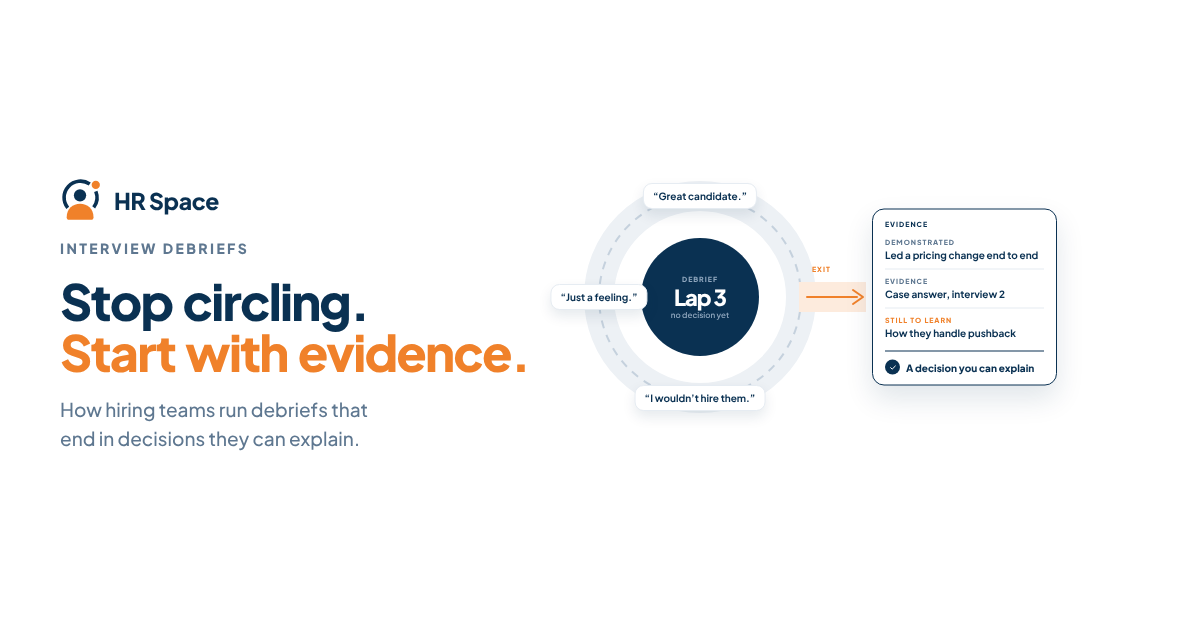
Ask interviewers to record their observations before reading the panel's conclusions. This gives the meeting something concrete to review and makes it easier to notice where interpretations differ.
Lever's official interview-debrief guide recommends preparing individual feedback and scorecards before the meeting and using a clear agenda. You can apply that principle with a short set of prompts suited to your own process.
Ask what the candidate demonstrated, which role requirement the evidence relates to, and where the interviewer still has a question. Include the relevant answer or example rather than a broad label such as “good fit.”
Give interviewers enough time to do this work. A meeting scheduled immediately after the final call may encourage people to arrive with a feeling rather than usable notes.
Identify the kind of disagreement
Sometimes interviewers observed different things. One explored a technical problem while another discussed collaboration. Their assessments may both be reasonable but relate to different responsibilities.
Sometimes they disagree about the same answer. Ask each person to explain which part of the response supports their interpretation. Return to the agreed criterion rather than debating who has better instincts.
A third possibility is an unclear standard. One interviewer expects independent ownership immediately, while another expects the person to learn with support. That is a question about the role brief and should be resolved as such.
Distinguishing these situations prevents the team from treating every difference as a conflict between interviewers.
Give the discussion a practical structure
|
Discussion area |
Useful question |
Record to keep |
|
Requirement |
What does the role actually require |
Agreed criterion |
|
Evidence |
What did the candidate say or demonstrate |
Relevant observation |
|
Interpretation |
Why does this support the assessment |
Reviewer's reasoning |
|
Uncertainty |
What information is missing |
Specific unanswered question |
|
Decision |
What happens next and who owns it |
Outcome and communication owner |
Keep the meeting focused on those links. The candidate's experience and the team's time both depend on reaching a decision the group can explain.
Replace vague concerns with a question about the work
“Not confident enough” might describe presentation style, uncertainty about an unfamiliar scenario, or a missing skill. Ask which responsibility would be affected and what evidence supports that concern.
If the role requires explaining a recommendation to clients, assess how the candidate makes an argument and responds to questions. Do not assume that a particular speaking style establishes every part of that ability.
Likewise, “very experienced” needs context. Ask which examples demonstrate the required responsibility. A long career history does not remove the need to understand how someone would approach the work in this role.
These questions help the team discuss evidence without pretending that every judgment can be reduced to a simple number.
Add another stage only for a specific reason
An extra interview can be appropriate when an important question remains unanswered. Name that question, decide who can assess it, and explain the purpose to the candidate.
Avoid arranging another conversation simply because the panel feels uncomfortable making a decision. If the requirement was never agreed, another interviewer may produce another interpretation without resolving the original problem.
Before adding work, check whether the existing notes or work sample already contain the information you need. If the team overlooked it, review it together. If the information is genuinely missing, keep the follow-up focused.
End with ownership and a realistic update
Record the outcome, the reasons that matter to the role, and any unresolved condition. Name who makes the final decision and who communicates with the candidate.
If the decision needs more time, agree on an update the team can actually provide. The recruiter should not have to guess whether the meeting produced an offer, another stage, or a pause.
Afterward, note any process issue revealed by the disagreement. Perhaps the brief needs a clearer requirement or an interviewer needs a better question. Make that improvement before the next candidate reaches the same point.
FAQs
Is disagreement in a debrief a problem
It can reveal useful differences in evidence or expectations. Ask what each assessment relates to and whether the standard was clear. The problem is unresolved opinion without enough context to make a decision.
Should interviewers see each other's feedback first
Collect individual observations before the group discussion where practical. Then review the evidence together. This helps the team understand each person's assessment before the meeting begins to shape the conversation.
When is another interview worthwhile
Add a stage when a relevant unanswered question needs new evidence. Define the purpose, choose an appropriate reviewer, and explain it to the candidate. Check existing information before asking them to repeat work.
What should the debrief record include
Keep the role-related reasons, outcome, any outstanding question, and the owners of the decision and candidate update. Record enough context for someone who did not attend to understand the next action.
Improve one debrief this week
Ask every interviewer to bring one relevant observation and its connection to the role. HRSpace Recruiting describes interviewer scorecards. If you are exploring HRSpace, ask to see how your team would use them before and during a debrief.
Further reading
Ready to make HR the easy part?
Explore modular pricing and start a free 14-day trial.