HR Reports Every Founder Should See Monthly
Most founders know their monthly revenue to the dollar. Far fewer can say how many people left last quarter, how long the open roles have been open, or who has been working overtime for six weeks. People problems usually show up in the numbers months before they show up in a resignation letter.
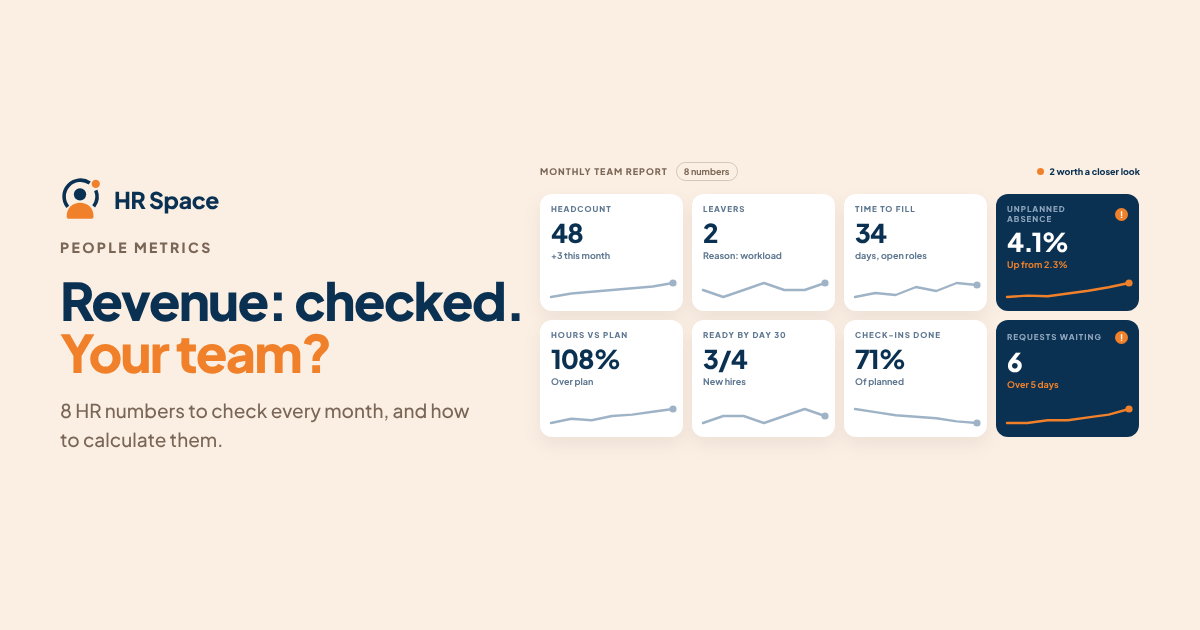
Quick answer: A founder needs about eight HR numbers each month: headcount change, attrition, open roles and time to hire, absence, hours against plan, onboarding completion, review completion and open internal requests. Keep them on one page, compare each with last month, and for every number agree one question to ask, not just a figure to note.
The eight reports
|
# |
Report |
How to calculate it |
The question it should raise |
|---|---|---|---|
|
1 |
Headcount and change |
People at month end; joiners and leavers this month |
Are we growing at the pace we planned and budgeted? |
|
2 |
Attrition |
Leavers this month ÷ average headcount × 100; split voluntary and involuntary |
Is someone leaving who we didn't expect to lose? Is it one team? |
|
3 |
Open roles and time to hire |
Open roles; days from approval to accepted offer |
Which role is stuck, and at which stage? |
|
4 |
Absence |
Leave days taken; unplanned absence; who is off next month |
Is unplanned absence rising anywhere? Is next month covered? |
|
5 |
Hours against plan |
Logged hours per project vs estimate; people regularly over their contracted hours |
Which project is over, and who is carrying it? |
|
6 |
Onboarding completion |
New hires with all onboarding tasks done by day 30 |
Are new people actually ready, or still waiting for access? |
|
7 |
Review and check-in completion |
Check-ins or reviews completed vs due |
Which managers are skipping conversations? |
|
8 |
Open internal requests |
Requests open; requests past their target time |
Where do employees wait longest for answers? |
How to read them
Look at the trend, not the single month. One leaver in a team of 30 means little on its own. Three leavers from the same team in a quarter is a pattern.
Split by team where you can. Company-wide averages hide problems. Attrition, absence and overtime are most useful by team or manager.
Pair numbers that explain each other. Rising hours on a project plus rising unplanned absence in the same team is a warning. Long time to hire plus high overtime usually means the same few people are covering the gap.
Keep the context in one sentence. Next to each number, write one line: "Two leavers were planned contract ends" saves a long discussion.
What not to put in a founder report
- Numbers nobody will act on, such as total training hours with no goal behind them
- Engagement scores without the comments that explain them
- Individual performance ratings (those belong in one-to-ones, not in a dashboard)
- Anything you can't calculate the same way every month
A short report that is read beats a long one that isn't.
A 30-minute monthly routine
- Day 1–3 of the month: HR or the office manager refreshes the eight numbers.
- Same week: founder reads them and marks up to three questions.
- Leadership meeting: 15 minutes on those three questions only.
- Write down one action per question, with an owner and a date.
If you're not sure the data is worth collecting, our guide to building a business case for HR software shows how to cost the problems these reports reveal.
How HRSpace builds this report for you
The hardest part of a monthly HR report isn't reading it. It's assembling it from a leave spreadsheet, a hiring tracker, a time tracker and someone's inbox. In HRSpace, headcount, leave, recruiting, time tracking, onboarding, reviews and internal requests sit on the same employee records, so the eight numbers come from one place.
HRSpace's analytics dashboards already cover headcount, attrition, the hiring funnel and time saved. The Reports add-on ($1 per employee per month) adds report templates, a custom report builder, dashboard widgets and scheduled PDF emails, so the founder report can arrive in your inbox on the first of each month without anyone building it by hand.
FAQs
What HR metrics should a startup track?
Start with headcount, attrition, time to hire and absence. Add hours, onboarding and review completion as the team grows.
How do you calculate employee attrition rate?
Divide the number of leavers in the period by the average headcount in that period, then multiply by 100. Track voluntary and involuntary leavers separately.
How often should founders review HR data?
Monthly for the core numbers, with a deeper quarterly look at trends by team.
Who should prepare the HR report in a small company?
Usually the office manager or HR lead. With HR software, most of the numbers can be generated automatically.
What is a good attrition rate?
It depends on industry, country and company stage. Compare your own trend over time and by team before comparing with others.
Ready to make HR the easy part?
Explore modular pricing and start a free 14-day trial.