How to Write a Job Description That Helps the Right People Apply
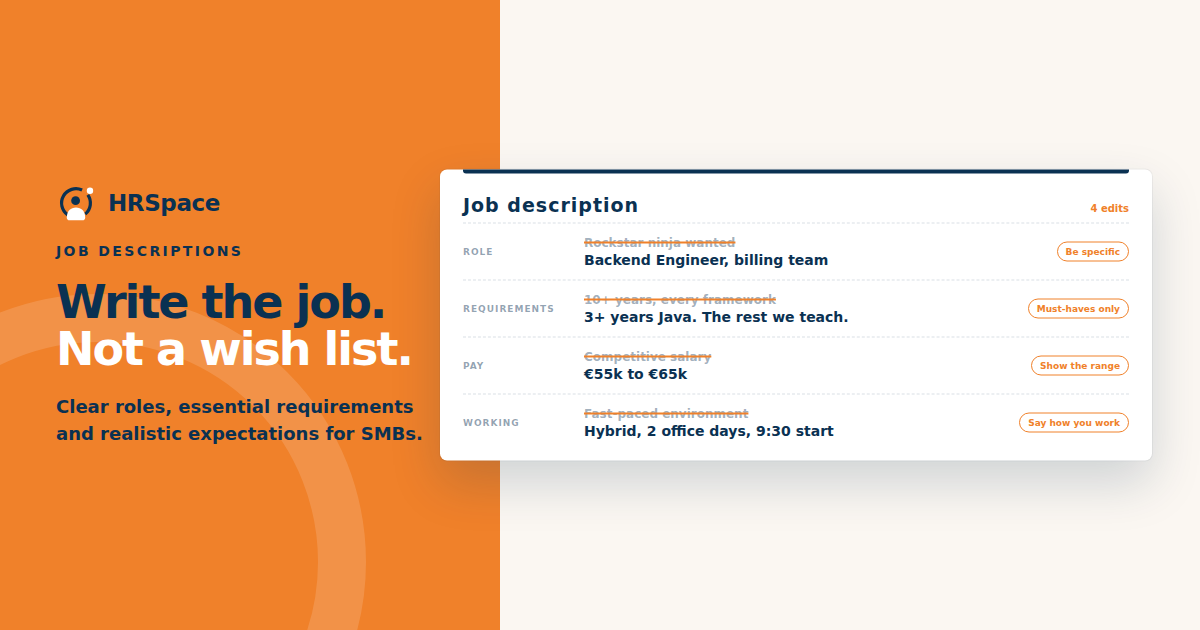
You need another person in customer support, so you open the last job description and start editing. A few minutes later, the draft asks for excellent communication skills, a proactive attitude, and the ability to thrive in a fast-paced environment.
It sounds like a job advert. It does not yet sound much like the job. A candidate still cannot tell which customers they will help, what a difficult day looks like, or whether the schedule includes evenings.
If you are working out how to write a job description for a small business, start with those ordinary details. They help applicants decide whether the role fits and help your team agree on what to assess. You do not need impressive language to make useful work sound worthwhile.
Establish the role before writing the advert
A vacancy can become a collection of unfinished work from several people. The founder wants reporting support. The sales lead wants help with customer follow-ups. The operations manager wants someone to own documentation.
Decide which responsibility is central and how the others relate to it. If the tasks belong to different jobs, acknowledge that before presenting them as one coherent opportunity.
Identify the manager, the team, and the decisions the person can make. A job description should not hold someone accountable for outcomes they cannot influence. If the role depends on another team approving priorities, explain how that relationship works.
Use a recognizable job title
Choose a title that people searching for this kind of work are likely to understand. Internal labels and playful titles can obscure the level and responsibilities.
Someone looking for support work will probably recognize customer support specialist more easily than customer happiness superhero. There is still room for the company's personality in the description. Give the person a title they can understand before asking them to get to know your team.
Check that the title matches the actual responsibility. Calling a role manager when it has no management duties can create expectations that the rest of the advert cannot support.
Describe the purpose in a short opening
Open with the work. For the support role, explain that the person will handle customer questions and use recurring issues to improve the documentation. That gives applicants a useful picture of the responsibility.
Give enough company context to understand that work, then explain the role. A long introduction about ambition can wait.
If processes are still being built, say so and explain the support available. Candidates need to know whether they will follow an established process or help create one.
Turn responsibilities into concrete work
Write responsibilities that an applicant can picture and an interviewer can discuss. Avoid including every occasional task as though it carries equal weight.
|
Vague wording |
More useful wording for a fictional support role |
|
Deliver excellent customer service |
Respond to product questions and explain the next step clearly |
|
Work cross-functionally |
Send reproducible product issues to engineering and update the customer |
|
Drive continuous improvement |
Identify repeated questions and suggest updates to support articles |
|
Own reporting |
Prepare a weekly summary of unresolved requests and recurring issues |
|
Be flexible |
Cover one agreed late shift each week as part of the team schedule |
Use accurate wording for your business. These examples show the level of detail; they do not describe an HRSpace vacancy or a recommended schedule for every company.
Separate requirements from useful extras
Ask what the person needs on arrival and what they can learn with reasonable support. Small businesses can unintentionally narrow their applicant pool by treating every tool and preference as essential.
Think about the support work again. Someone who can explain a difficult product problem clearly may learn your ticketing tool quickly. If knowing that particular tool on day one is essential, explain why. If it can be taught, do not let the tool name become a hidden rejection rule.
Keep requirements connected to the responsibilities. If you ask for a qualification or a specific length of experience, be able to explain why it matters for the work. Avoid adding requirements simply because an old advert included them.
List useful extras separately so applicants can understand that missing one does not necessarily disqualify them. The hiring team should use the same distinction during screening.
Make working conditions easy to find
State the location, expected working arrangement, schedule, and relevant travel. Explain remote or hybrid requirements precisely enough that a candidate can judge compatibility.
Include compensation information you are authorized to publish and describe material benefits accurately. Avoid promising flexibility that managers have not agreed to provide.
If some conditions remain open, resolve them where possible before posting. An advert that conceals a fixed requirement can attract people who could never take the job, creating work for both sides.
Explain the hiring process
Give candidates a realistic outline of what happens after applying. That might include an initial review, a conversation with the manager, and a short work-related exercise.
Explain the purpose and expected effort of any exercise. A candidate should know what they are being asked to demonstrate and how it relates to the role. Check that the assignment is proportionate to the decision it supports.
Provide a way to ask process questions. Before publication, make sure someone will monitor that channel and that the application link actually works.
Review the description with the people doing the work
Give the draft to the manager and someone who understands the daily work. Ask each person which responsibility matters most. If one says reporting and the other says customer escalations, you have found a role discussion to finish before publishing.
If their answers differ substantially, revise the role definition before publishing. Clear copy cannot resolve an underlying disagreement about what the hire will own.
Read the advert from a candidate's perspective too. Can they understand the level, conditions, and next step without looking elsewhere? Remove repeated adjectives and replace the space with details that affect the decision.
Connect the advert to screening
Use the agreed requirements to build the application review and interview questions. If candidates are screened against criteria that never appeared in the role definition, update the description or reconsider the criteria.
Keep a copy of the published version. When a requirement changes, decide how to communicate that to people already in the process. A candidate who applied to one working arrangement should not discover a different one only at the offer stage.
Publishing with HRSpace
HRSpace's recruitment offering includes job posts and a career portal. In an HRSpace Recruitment demo, test the applicant's route from the published description to the relevant application.
Use your draft role and check formatting, required fields, and the information reviewers receive. Confirm any external job-board distribution separately during evaluation.
Common mistakes when writing a job description
Check an old advert against the current role. A task may now belong elsewhere, or the person may report to a different manager.
Avoid adding responsibilities to make the role sound more senior. If budget management is not part of the work, leave it out. Applicants will use the description to form their expectations.
FAQ
What should a small business job description include
Explain the role's purpose, main responsibilities, essential requirements, working conditions, manager or team context, and application process. Include information that helps candidates assess the actual opportunity.
How long should a job description be
It should be long enough to explain the role and short enough to scan. Remove repeated company claims and vague requirements before cutting useful practical details.
Should every preferred skill be included
Include preferences that meaningfully help assess the work, and identify them as useful extras. Do not let a long wish list obscure the essential requirements.
Can AI help write a job description
It can help organize a draft from confirmed information. The manager still needs to check the responsibilities, conditions, and requirements before publication, including any details the draft has added.
A final check before publication
Read the description as someone who has never visited your company. Could you explain the main work, the working arrangement, and what happens after applying? Replace the vaguest paragraph with a concrete detail, then use the same requirements when you start screening.
Ready to make HR the easy part?
Explore modular pricing and start a free 14-day trial.