How much does employee recognition software cost?
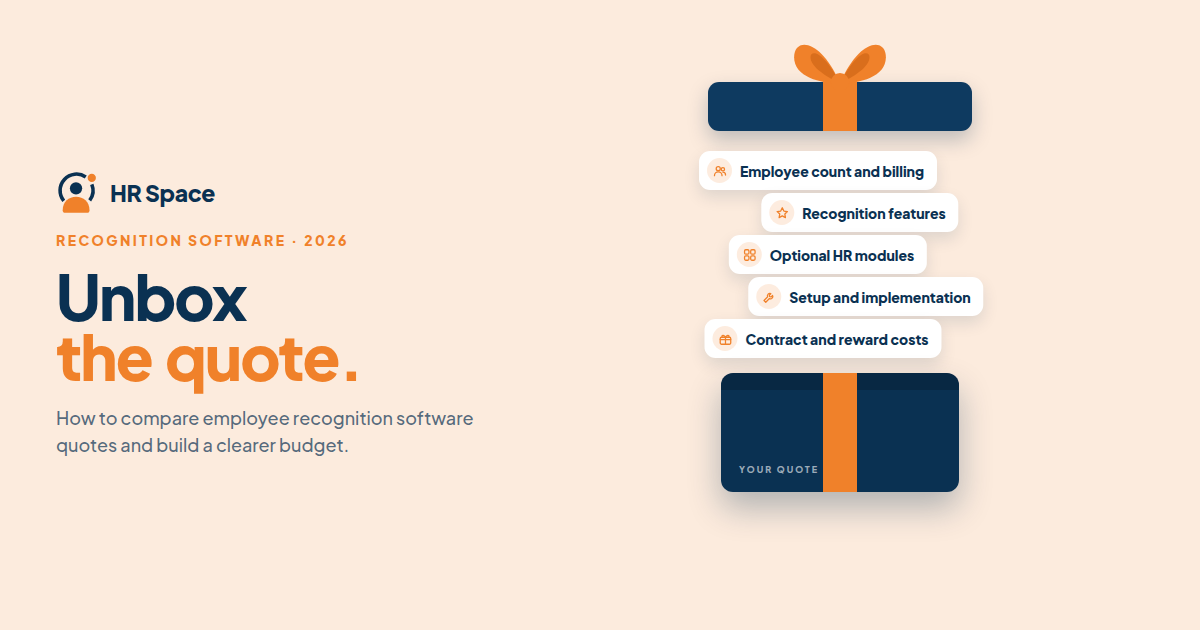
Employee recognition software costs depend on the number of employees covered, the features included, and whether recognition is purchased as a standalone tool or as part of a broader HR platform. For a reliable 2026 budget, request a written quote based on your employee count, required capabilities, and contract terms instead of relying on an unsupported market average.
It is also important to separate software subscription fees from employee reward spending. Both may support the same recognition program, but they represent different budget commitments.
This guide explains how to compare employee recognition software pricing, evaluate standalone tools against modular HR platforms, and prepare a quote that reflects your company's actual requirements.
How Much Does Employee Recognition Software Cost?
The most useful price is the total quoted cost for your employee count and selected features. A per-employee rate alone does not explain what the agreement includes, how employees are counted, or whether additional modules are required.
When comparing employee recognition software, request a breakdown covering:
| Budget component | What to check |
|---|---|
| Employee coverage | The exact number of employees included and how changes affect billing |
| Recognition features | The capabilities available within the quoted subscription |
| Additional HR modules | Which modules are included, optional, or priced separately |
| Implementation and setup | Configuration, data preparation, training, and responsibilities |
| Employee rewards | Any separate costs or commitments related to rewards |
| Contract terms | Billing frequency, renewal conditions, and employee-count adjustments |
Not every vendor charges separately for each item. The purpose of this breakdown is to clarify what applies to each proposal rather than assume that every potential cost will appear on every invoice.
A quote is ready for comparison when your team can understand the scope and commercial terms without relying on verbal explanations from a sales representative.
HRSpace offers a modular, per-employee-priced cloud HR platform that includes employee recognition alongside onboarding, time-off management, performance reviews, goals, recruitment, workflows, and an internal service desk. This makes it worth evaluating recognition in the context of the HR functions your company needs, rather than considering the feature in isolation.
Why Employee Recognition Software Pricing Varies
Employee recognition software pricing depends on the scope of the purchase. Two proposals may look similar at first but cover different employee populations, capabilities, or contractual commitments.
Several factors deserve particular attention.
1. Employee count
The number of employees covered by a subscription can affect the quoted price. However, the company-wide headcount and the number of employees used for billing are not necessarily the same.
Ask vendors to clarify:
-
Which employees are included in the quoted population
-
How new hires and departing employees affect billing
-
When the employee count is measured
-
Whether different employee statuses receive different billing treatment
Use the same employee population when comparing proposals. If your company expects to grow, request additional scenarios that reflect realistic future headcounts.
2. Recognition features
The phrase employee recognition software does not guarantee that every product supports the same workflows.
Before requesting a quote, define what your program needs. For example, determine who should be able to give recognition, who can view it, and what administrators need to manage.
If your program includes employee rewards, specify that requirement separately. Recognition features and reward fulfillment are different requirements, even when employees experience them as parts of the same program.
Ask vendors to confirm each essential capability instead of relying on a general product description.
3. Selected HR modules
Some companies need recognition software alone. Others are evaluating recognition alongside onboarding, time-off management, performance reviews, goals, recruitment, or employee support.
These are different purchasing decisions.
A modular HR platform can bring several HR functions into one evaluation, but its broader feature set does not automatically make it cheaper. Compare the cost of the modules you actually intend to use with the cost of a standalone recognition tool and the systems you plan to retain.
4. Implementation and setup
The subscription price does not explain how much work your team must complete before employees can use the software.
Ask who is responsible for preparing employee information, configuring the recognition program, checking access permissions, and training managers or administrators.
Request a written description of these responsibilities. A claim that implementation is simple or fast is not enough to establish what your team will need to do.
5. Contract terms
Billing frequency, renewal conditions, and changes in employee count can affect the commitment your company makes.
Review the agreement against your original requirements. Confirm the covered population, selected modules, billing period, renewal terms, and any additional commitments before approving the purchase.
Employee Recognition Software vs. an HR Platform
Choosing between standalone employee recognition software and a broader HR platform starts with the scope of your requirements.
| Buying approach | Best suited for | Main consideration |
|---|---|---|
| Standalone recognition software | Companies focused on a specific recognition program | Other HR requirements may remain in separate systems |
| Modular HR platform | Growing teams evaluating recognition alongside other HR processes | Each selected module needs to be justified and reviewed |
Standalone employee recognition software
A standalone tool may be appropriate when your company has a clearly defined recognition requirement and does not want to change its other HR systems.
This approach keeps the evaluation focused. Your team can concentrate on the recognition workflows, administration requirements, and capabilities needed for the program.
However, the purchase should be evaluated in the context of your existing software. If onboarding, performance reviews, and other HR processes remain in separate systems, account for those ongoing commitments when comparing the available options.
Recognition within a modular HR platform
A modular HR platform is worth evaluating when recognition is part of a wider HR software decision.
Rather than purchasing every available feature, list the functions your company needs now and identify which ones should be included in the initial scope.
HRSpace includes employee recognition within its broader HR platform, alongside functions such as onboarding, time-off management, performance reviews, goals, recruitment, workflow automation, and an internal service desk.
This makes HRSpace relevant to growing teams looking to evaluate recognition alongside other employee lifecycle processes. However, the actual value depends on the modules your company needs and the capabilities confirmed for your intended use.
A broader platform is not automatically the better option. Choose based on requirements, not the length of a feature list.
How to Compare Employee Recognition Software Quotes
A consistent request for proposal makes employee recognition software pricing easier to evaluate. Give each shortlisted vendor the same employee count, recognition requirements, and contract scope.
Follow these five steps.
Step 1: Define the employee population
Start with the number of employees the software needs to cover.
For planning purposes, you might request quotes for 20, 50, or 100 employees if those scenarios reflect your company's needs. These are example comparison points, not market benchmarks.
Ask vendors how employee additions, departures, and different employee statuses affect the quoted price. Make sure every proposal uses the same assumptions.
Step 2: Write down your recognition requirements
Describe the activities the software must support before reviewing vendor demonstrations.
Consider questions such as:
-
Who can give recognition?
-
Who can view recognition activity?
-
What administrative controls are required?
-
Are employee rewards part of the program?
-
What reporting or oversight does the team need?
Mark each requirement as essential or optional. This helps your team distinguish necessary capabilities from features that are interesting but not required.
Step 3: Select the modules you need
If you are considering an HR platform, identify the modules that belong in the purchase.
For example, your list may include recognition, onboarding, time-off management, performance reviews, goals, recruitment, workflows, or employee support.
Ask the vendor to distinguish included modules from optional ones. Do not count an available module as a benefit unless it addresses a real requirement.
Step 4: Confirm implementation responsibilities
Ask the vendor to explain how the software will be configured and introduced to your team.
Confirm who prepares employee information, configures the relevant workflows, reviews permissions, and trains users. If your company has specific launch requirements, ask how those will be addressed.
A written implementation plan gives you a clearer picture of the work involved than a general statement about ease of setup.
Step 5: Review the contract and compare the total scope
Before making a decision, confirm the employee population, selected modules, billing period, renewal conditions, and any relevant additional commitments.
Compare the proposals side by side using the same requirements. If one vendor's quote leaves important questions unanswered, request clarification before treating it as the more attractive option.
Keep your requirements brief with the final purchasing decision. It creates a clear record of what the company agreed to buy and why.
Separate Software Fees From Employee Rewards
Employee recognition software supports a recognition process, but the software subscription is not the same as the cost of running the program.
Before purchasing a tool, define the recognition program itself. Decide which contributions your company wants to acknowledge, who will administer the program, and who will answer employee questions.
If the program includes rewards, establish a separate budget and approval process for that spending.
Keeping these categories distinct makes it easier to compare software proposals and understand the overall cost of the initiative. It also helps your team evaluate changes to the recognition program without confusing them with changes to the software subscription.
Is Employee Recognition Software Cheaper Within an HR Platform?
Not necessarily. A combined HR platform is not automatically cheaper than purchasing standalone recognition software.
To make a meaningful comparison, consider:
-
The quoted cost of the recognition features you need
-
The cost of additional HR modules you intend to use
-
Existing subscriptions that would remain in place
-
Any implementation responsibilities your team would take on
-
The contract terms and employee-count rules
Do not count an existing subscription as a saving until you have confirmed that the new platform meets the requirements needed to replace it.
Administrative effort should also be evaluated carefully. If your goal is to simplify HR work, verify how the proposed workflows will operate before assuming that a new tool will reduce the workload.
The best-value option is the one that meets your requirements with a clear, justified scope and understandable commercial terms.
Frequently Asked Questions
How much does employee recognition software cost for a small company?
The total depends on the number of employees covered, the selected features, and the contract terms. Small companies should request quotes based on their actual employee population and compare equivalent requirements rather than relying on a general market average.
What should an employee recognition software quote include?
A quote should identify the covered employee population, included recognition capabilities, selected modules, and commercial terms. It should also clarify implementation responsibilities and any separate reward-related commitments that apply.
Is standalone recognition software better than an HR platform?
Standalone recognition software may suit a company with a narrowly defined recognition requirement. A modular HR platform may be worth considering when recognition needs to be evaluated alongside other HR processes. The right choice depends on your requirements and existing systems.
Does HRSpace include employee recognition in its HR platform?
Yes. HRSpace includes employee recognition within its modular, per-employee-priced cloud HR platform. Its stated platform scope also covers onboarding, time-off management, performance reviews, goals, recruitment, workflows, and an internal service desk. Confirm the specific capabilities and commercial terms relevant to your needs before purchasing.
Are employee rewards included in recognition software fees?
Not necessarily. Employee rewards and software subscription fees should be treated as separate budget categories unless the vendor explicitly confirms otherwise. Ask for written clarification if rewards are part of your program.
How do I compare employee recognition software quotes for 50 employees?
Ask every vendor to quote for the same 50-employee population, recognition requirements, selected modules, and billing period. Then compare the employee-count rules, implementation responsibilities, renewal conditions, and any additional commitments.
What should I check before buying employee recognition software in 2026?
Confirm the recognition workflows, employee coverage, included features, selected modules, setup responsibilities, and contract terms. Request written confirmation of any capability your program depends on, and compare the total scope rather than the headline price alone.
Final Thoughts
The most useful question is not simply how much employee recognition software costs. It is what your company will receive for the price and which requirements the purchase will actually address.
Before approving a subscription, define your employee population, identify the features you need, separate software costs from reward spending, and compare written proposals on equal terms.
If you are evaluating HRSpace, assess employee recognition alongside the other HR modules your team may need. Include each module for a clear business reason, and keep optional features outside the initial scope until there is a requirement for them.
A clear quote and a well-defined scope are the starting points for a sound purchasing decision.
Related Guides
Ready to make HR the easy part?
Explore modular pricing and start a free 14-day trial.