How Long Does It Take to See ROI from HR Software?
HR software is an investment, so companies need a way to determine whether it delivers enough value to justify its cost.
Without clear measurement, the decision can become subjective. HR may feel that administrative work has become easier, while finance or leadership may want evidence that the subscription is worth keeping.
A simple measurement plan helps connect everyday improvements to business priorities. It also makes it easier to identify which features are useful and which may not justify their cost.
There is no universal payback period for HR software. Your results depend on the problems you are solving, the time currently spent on manual processes, and how effectively the new system is adopted.
How long does it take to see ROI from HR software?
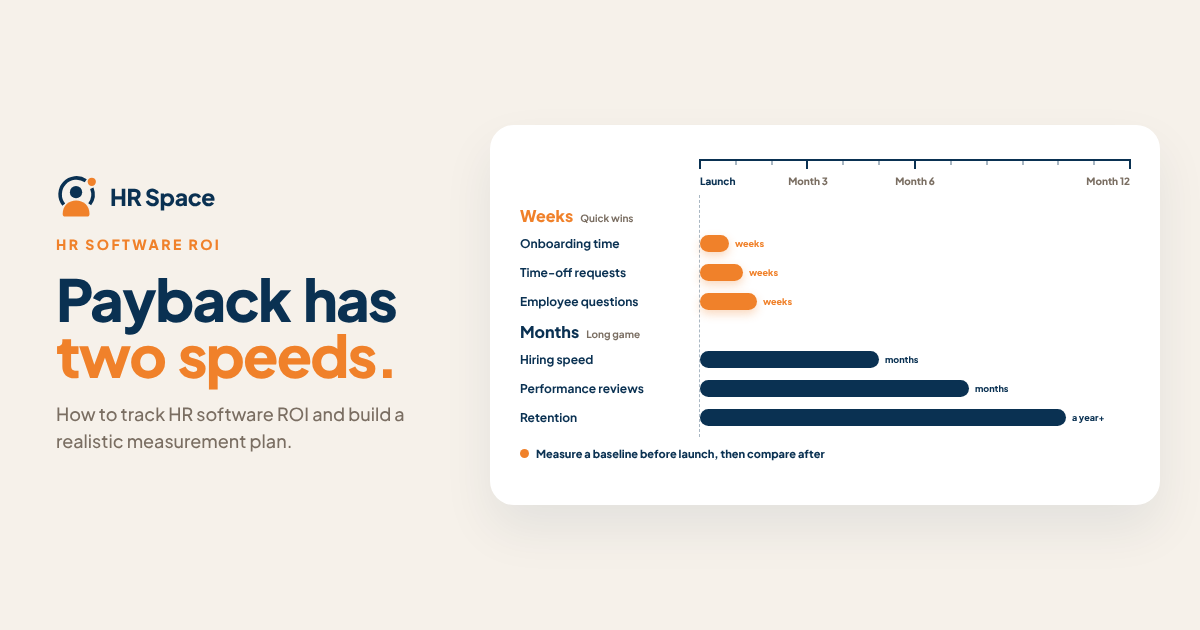
The results can be considered in three stages. These are practical measurement windows rather than guaranteed deadlines, and they begin when people start using the software in their daily work.
| Return type | Indicative measurement window | What to measure |
|---|---|---|
| Administrative time saved | First few weeks after adoption | Hours spent on onboarding paperwork, time-off tracking, and employee questions |
| Process quality | One or two quarters | Onboarding completion, review-cycle completion, and requests resolved within agreed targets |
| People outcomes | Several quarters or longer | Retention, time-to-hire, engagement, and internal mobility |
Administrative savings are often the easiest to measure because they involve recurring tasks that already consume employees' time.
Process improvements require enough usage data to identify changes in consistency and completion rates. People outcomes take longer to evaluate and are affected by other factors, including management practices, compensation, company culture, and the labor market.
For that reason, it is better to use early administrative savings as the starting point for an ROI assessment and treat longer-term people outcomes as additional evidence.
Stage 1: Administrative time saved
Administrative work is often the most practical place to look for early results. Time-off requests, onboarding paperwork, and repeated employee questions can consume hours every week, particularly when information is spread across spreadsheets, email, and chat.
HR software can help organize these processes and reduce some of the manual work involved.
Time-off tracking
A structured process allows employees to submit requests and managers to review them in one place, reducing the need to follow up across multiple conversations.
Explore these time-off tracking software options.
Onboarding paperwork
A centralized onboarding process helps HR and managers track required tasks and identify outstanding steps without relying entirely on manual reminders.
Read more about how HR software can automate onboarding paperwork.
Employee questions
When employees repeatedly ask about the same policies or procedures, a self-service resource or internal service desk can make requests easier to organize and track. The value depends on how well the system fits the company's existing processes.
How to measure the results
Record the time your team spends on the selected tasks for two weeks before implementation. Repeat the measurement after the system has been in regular use for four and eight weeks.
Compare the results, taking into account any changes in workload or employee numbers.
To estimate the financial value of time saved, use this calculation:
Estimated value of time saved = Hours saved × Estimated hourly labor cost
This gives you an initial estimate of the value created by reduced administrative work. It is not automatically a cash saving: the financial benefit depends on how the company uses the time that has been freed up.
Stage 2: Process quality
Once the software is being used consistently, you can begin assessing whether HR processes are becoming more reliable and easier to manage.
Instead of checking individual tasks, look at results across a complete workflow or cycle.
Useful indicators include:
-
Onboarding completion: Were required tasks completed before the employee's first day, where applicable?
-
Performance review completion: Did managers complete reviews within the planned period?
-
Request resolution: What proportion of employee requests were resolved within the response or resolution targets set by the company?
-
Workflow consistency: Are fewer tasks being missed or delayed?
These indicators help show whether the new system is improving process management. They do not necessarily translate directly into monetary savings, but they can help identify where additional improvements may be possible.
Allow enough time for a complete review cycle, onboarding group, or other relevant workflow before comparing the results with the previous process.
Stage 3: People outcomes
Some of the most important HR outcomes take longer to evaluate. Retention, engagement, and hiring speed depend on multiple factors, so it is difficult to attribute changes to software alone.
Hiring speed
Recruitment software can help organize candidate information and reduce manual steps in the hiring process. However, time-to-hire also depends on the availability of candidates, hiring-manager decisions, and the complexity of each role.
Read more about whether AI recruitment software can reduce time to hire.
Employee retention
Structured performance reviews and recognition processes can support better communication and employee development. Their effect on retention depends on how consistently managers use them and how employees experience the wider workplace.
Explore whether employee recognition software can improve retention.
Do not base the entire first-year business case on improvements in retention or hiring. Track these outcomes over time, but begin with measures that are more directly connected to the processes the software changes.
What can delay ROI?
The time needed to see results varies from one company to another. Several factors can delay the benefits of HR software.
1. Implementation time
The longer it takes to configure the system, prepare data, and bring employees into the workflow, the longer it may take to see results.
When comparing providers, consider both the implementation process and how quickly your team can begin using the features it needs.
Read how long HR software takes to implement and compare options based on ease of setup.
2. Data migration
Incomplete, outdated, or inconsistent spreadsheets can make migration more difficult. Cleaning and organizing employee data before implementation can help reduce avoidable delays.
Use this guide to migrate from spreadsheets to HR software.
3. Buying more than you need
A company may pay for features that do not address its current problems. Those features will not create meaningful value if employees rarely use them.
Start with the workflows that consume the most time or cause the most frequent problems.
4. Low adoption
Even a well-configured platform cannot improve a process if employees and managers continue using the old methods.
Clear instructions, practical training, and straightforward workflows can help people understand when and how to use the system.
5. No baseline
Without information about the existing process, it is difficult to determine whether the software has made a difference.
Record the time, workload, and completion rates associated with your priority processes before implementation.
6. Pricing that does not fit your needs
Subscription costs should be assessed against the features the company will actually use, its employee count, and any additional implementation or integration expenses.
Learn more about per-employee versus flat-rate HR software pricing.
How to measure HR software ROI
You do not need a complicated financial model to begin evaluating HR software. A simple process can help your team establish whether the investment is delivering value.
Step 1: Choose two or three priorities
Avoid trying to measure every HR process at once. Choose a few areas where manual work is frequent or where delays create recurring problems.
Time-off administration, onboarding, and employee requests can be useful starting points.
Step 2: Establish a baseline
For two weeks before implementation, record relevant measurements, such as:
-
Hours spent on each process.
-
Number of requests handled.
-
Average time needed to complete a task.
-
Completion rates or delays, where relevant.
Use the same definitions when measuring results after implementation.
Step 3: Set review dates
Plan to review the results around 30, 90, and 180 days after adoption. These checkpoints are useful for tracking progress, but the appropriate timing depends on how often the process occurs.
A frequently used workflow may produce useful data quickly. A quarterly performance review process will require more time.
Step 4: Estimate the value of time saved
Multiply the hours saved by your estimated hourly labor cost.
For example, if a process takes less time after implementation, calculate the difference using your own measurements and cost assumptions. Avoid treating estimated time savings as guaranteed budget reductions.
Step 5: Compare the result with the cost
Compare the estimated value for the same period with the software subscription and other relevant costs, such as implementation, training, and integrations.
A basic ROI calculation is:
ROI (%) = (Estimated benefits − Total costs) ÷ Total costs × 100
Make sure the benefits and costs cover the same period. If you include only administrative time savings, label the result accordingly rather than presenting it as the total business impact of the software.
The calculation becomes more useful as your measurements improve and you account for factors that may have influenced the results.
Why modular pricing can help companies measure ROI
Modular HR software allows companies to focus on the processes they need to improve first rather than adopting every available feature at once.
HRSpace is a cloud-based HR platform with per-employee pricing and modules covering areas such as onboarding, time-off management, performance reviews, goals, recognition, recruitment, and internal service requests.
For a company evaluating ROI, a modular approach can make it easier to connect the cost of a feature with a specific operational need. A team might begin with the process creating the most administrative work, measure the results, and then decide whether additional modules are justified.
The outcome still depends on the company's needs, implementation, and adoption. Modular pricing does not guarantee a faster payback, but it can help keep the initial scope aligned with the problems the company wants to solve.
For a broader comparison, explore our guide to the best HR software for small businesses, or visit HRSpace.
Start with one process
Identify the HR task that takes the most time or creates the most recurring problems. Measure its current cost, improve the workflow, and evaluate the results before expanding the scope.
Does faster implementation mean faster ROI?
It can. If employees begin using the software sooner, the company can start measuring its effects sooner as well.
However, implementation speed is only one factor. The system also needs to address a real problem, fit the team's workflow, and be used consistently.
Is ROI different for small teams?
It can be. In a small company, administrative tasks may fall on a limited number of people, so reducing repetitive work can make a noticeable difference.
At the same time, small teams may have fewer employees and fewer completed hiring or review cycles to use when evaluating longer-term outcomes. This makes it especially important to choose relevant measurements and avoid drawing conclusions from limited data.
Which HR module delivers the fastest ROI?
There is no single module that delivers the fastest return for every company.
The best starting point is usually the process that consumes the most time or creates the most frequent delays. For one company, that might be time-off tracking; for another, onboarding or employee request handling.
Measure the existing process first, then assess whether the chosen module improves it.
FAQ
How long does it take to see ROI from HR software?
Some administrative improvements may be measurable within the first few weeks of adoption. A first-quarter review can help assess early results, while process quality and people outcomes may require several months or longer.
What is the fastest ROI from HR software?
Time saved on recurring administrative tasks is often the easiest early benefit to measure. The result depends on the amount of manual work involved and whether the software meaningfully reduces it.
When does HR software ROI start counting?
For measuring operational benefits, the relevant starting point is when people begin using the system in their daily work. However, implementation costs should still be included when calculating the total investment.
How do I calculate HR software ROI?
Measure the relevant process before and after implementation. Estimate the value of any time saved, include other measurable benefits where appropriate, and compare the result with subscription and related costs for the same period.
Does HR software reduce employee turnover?
It may support processes such as recognition, feedback, and employee development, but turnover is influenced by many factors. Changes in retention should be tracked over time rather than automatically attributed to the software.
Does cheaper HR software deliver ROI faster?
Not necessarily. Subscription price matters, but so do implementation effort, feature suitability, and adoption. A lower-cost tool may not deliver value if it does not solve the problem or employees do not use it.
Can a small business get ROI from HR software?
Yes, if the software addresses a meaningful operational need. A practical starting point is to select one process, record its current cost, and measure the change after adoption.
Before you choose a platform
Record your baseline before evaluating vendors, not after implementation. Two weeks of tracking can help you understand how much time your current process consumes and give you a basis for comparison.
That information makes it easier to set realistic expectations, assess results, and explain the investment to leadership when the next budget or renewal decision comes around.
Related guides
Ready to make HR the easy part?
Explore modular pricing and start a free 14-day trial.