Hiring Manager Feedback That Keeps Recruitment Moving
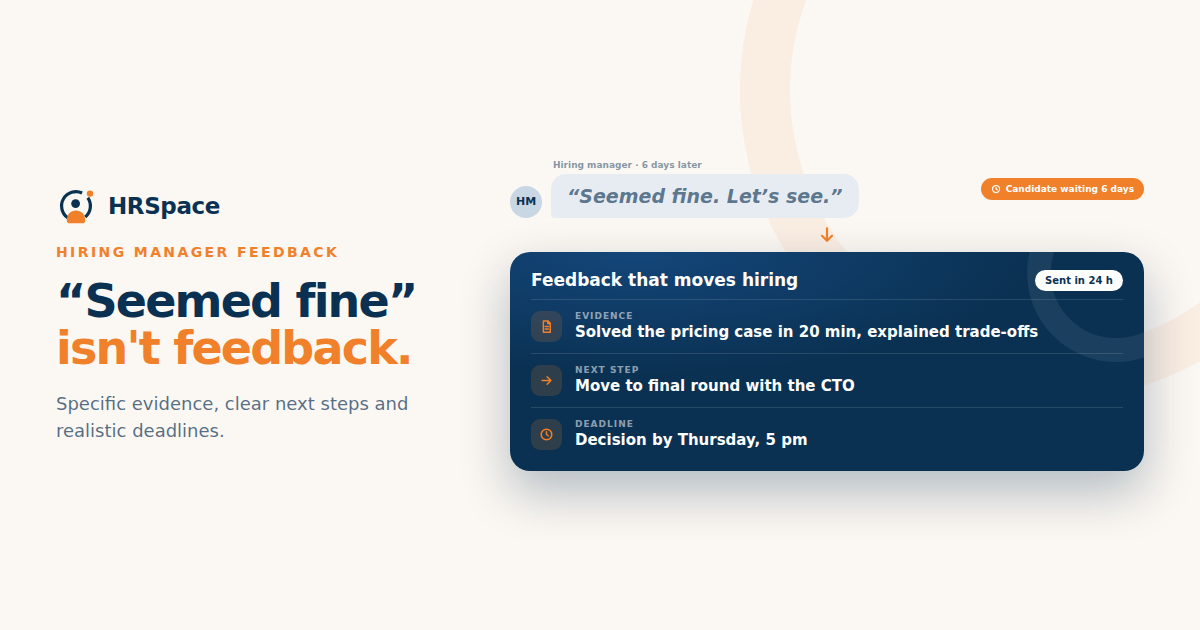
You promised the candidate an update by Thursday. The interview happened on Tuesday, but the hiring manager has not recorded a decision. After your second reminder, a message arrives: good candidate, let's see a few more.
You still have the same problem. Is this person progressing? Are they waiting while the team interviews others? Is there a specific concern to check? You cannot give a useful update because the message does not answer any of those questions.
Good hiring manager feedback makes the next step clear. In a small business, you can usually begin with a short agreement about the information needed and when it will be available. The aim is to make the decision easier to act on during a busy week.
Agree on the decision before the interview
An interviewer should know what their conversation is meant to assess. If the manager is exploring delivery experience, the feedback should explain what the candidate demonstrated about delivery.
Decide what happens after the interview. Does the manager recommend the next round, make the final decision, or provide evidence to another person? A recruiter cannot move the application reliably if the decision owner is unclear.
Agree how a request for more information will be handled. The next conversation should address a specific gap, with an owner who can assess it. Another general interview often postpones the same uncertainty.
Make feedback easy to complete
Use a concise structure that asks for the decision, supporting evidence, and any outstanding question. If you already have a scorecard, the feedback can refer to the relevant criteria rather than repeat every note.
Include a place to say that a criterion was not assessed. This is more informative than a vague maybe and avoids treating the absence of evidence as a candidate weakness.
Try the form after a real interview. If the manager needs twenty minutes to repeat notes that are already in the scorecard, simplify it. Keep the evidence needed to understand the recommendation and the information the recruiter needs to continue.
Replace impressions with relevant observations
Some informal comments are understandable during a conversation but too vague to support a hiring decision. Ask the reviewer to connect their view to the work.
|
Feedback that leaves questions |
More actionable feedback in a fictional hiring process |
|
Good candidate |
Their example supports the delivery requirement and I recommend the final discussion |
|
Not senior enough |
They described executing a plan but did not provide evidence of setting priorities for a team |
|
Not a culture fit |
I need clarification on how they handle disagreement with colleagues |
|
Let's see more people |
I am not ready to decide because the required management experience remains unclear |
|
Another interview would help |
Ask the operations lead to assess their experience managing cross-site work |
These examples do not create rejection rules. They show how to identify the evidence or question behind a judgment so the next decision can be discussed properly.
Set a response time the team can meet
Agree a practical feedback deadline with the interviewers. The right timing depends on interview volume and working arrangements, but it should be specific enough to support a candidate update.
For example, a fictional team may agree to complete notes by the next working day and hold a short decision discussion after the final interview. That is an internal operating choice, not an industry standard.
Look at the calendar as well as the deadline. If interviews sit between back-to-back meetings, the manager may have no time to complete the notes. Reserving a short space after the conversation can be more useful than adding another reminder.
When the deadline will be missed, communicate that before the recruiter has to chase. Explain what is outstanding and set a revised commitment that someone owns.
Give the recruiter a usable outcome
The application needs a clear next state. The manager may recommend progressing, declining, or gathering a defined piece of additional evidence.
Sometimes the delay has nothing to do with the candidate. The budget is being reviewed, or the team is changing the role. Record that as a vacancy decision and tell the recruiter what can be communicated. Leaving the application under review hides the real reason it has stopped moving.
For a candidate who progresses, identify the next interviewer, the purpose of the discussion, and who will arrange it. A positive recommendation without an owner can still leave the candidate waiting.
Handle conflicting feedback through the criteria
Two reviewers can disagree for valid reasons. They may have heard different examples or be assessing different responsibilities.
Bring the discussion back to the agreed criteria and the evidence. If one reviewer believes a candidate lacks management experience, ask which part is missing. If another thinks the experience is sufficient, ask which example supports that view.
Identify whether the remaining question can be resolved with the existing notes. When another conversation is necessary, define the question and avoid repeating the entire process.
The decision owner should record the final reasoning clearly enough that the recruiter knows how to proceed. Consensus is not always possible, but an unexplained outcome creates problems for later communication.
Keep candidate communication honest
An internal delay should not disappear into silence. Tell the candidate when a decision is still pending and provide the next update date that your team can reasonably support.
Do not invent an encouraging signal to fill the gap. Saying the team loved the interview can create a misleading expectation if the evidence has not been reviewed.
When communicating a decision, use the level of explanation your organization has agreed to provide and ensure it reflects the actual reason. Internal interview notes may require a different presentation from the message sent to the candidate.
Watch the workflow rather than count reminders
Review overdue feedback and look for repeated causes. A particular manager may lack time, the template may be too long, or the process may require approval from someone who was never named.
Track elapsed time to an actionable decision if your records support it. Distinguish the date a vague comment arrived from the date the team actually resolved the next step.
Use the findings to change the process. Sending more reminders cannot fix a decision route that nobody understands.
Testing the process with HRSpace
Use an HRSpace Recruitment demo to run a sample application through interview, feedback, and the next decision.
Ask where feedback is stored, what the recruiter can see, and how pending work becomes visible. Confirm whether the reminders, approval steps, and reviewer access you need are supported in the modules you plan to use.
FAQ
What should hiring manager feedback include
State the recommendation, the role-related evidence behind it, and any specific question that remains unresolved. For a candidate progressing, identify the next action and its owner.
How quickly should interview feedback be completed
Agree a realistic deadline that keeps the conversation fresh and allows a timely candidate update. Reserve time for it rather than relying on managers to find an opening later.
What if the manager wants to interview more candidates
Clarify whether the current candidate remains in consideration and why more evidence is needed. Set a review date so the application does not remain open without a decision.
How should recruiters handle conflicting interviewer views
Compare the observations against the agreed requirements. Resolve missing evidence where necessary, then have the named decision owner record the outcome and reasoning.
Make the next feedback request specific
For the next interview, agree which decision the manager needs to return and when. Ask for the evidence behind it and any question that still needs an answer. Then check whether the recruiter can continue the application without a separate explanation.
Ready to make HR the easy part?
Explore modular pricing and start a free 14-day trial.