From Performance Review to Development Plan: A Practical Guide (With Template)
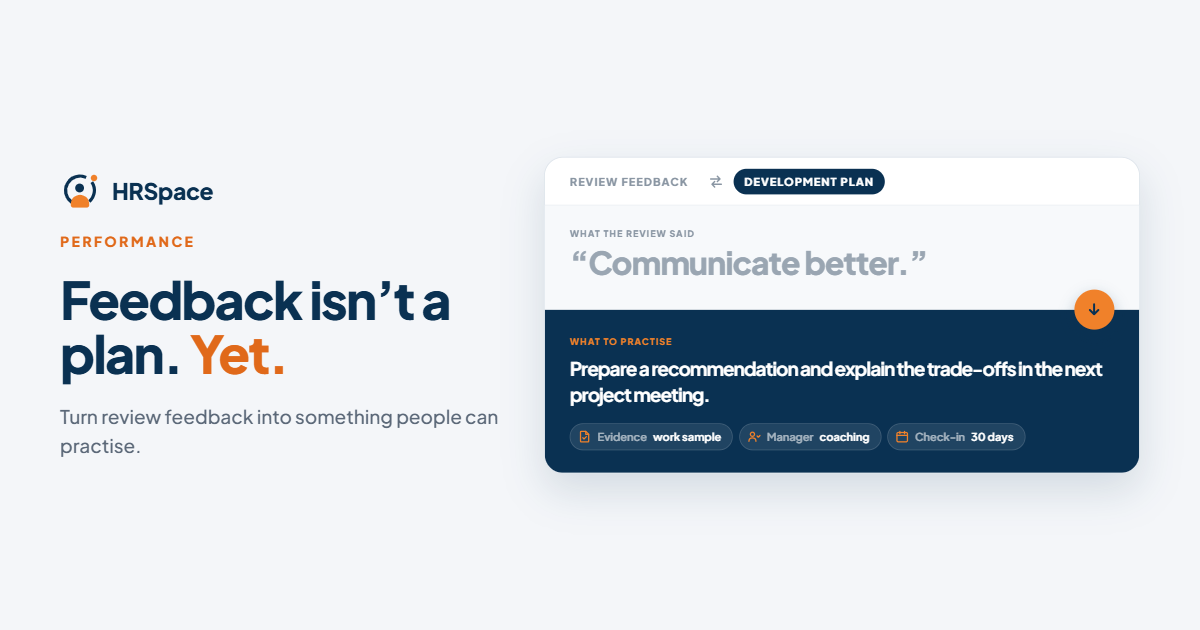
A performance review records what happened. A development plan says what changes next. Without that second step, feedback tends to stay vague: “communicate better”, “take more ownership”. Nobody knows what to practise or how progress will be judged.
This guide shows how to turn review feedback into an individual development plan (IDP) that people actually use, with a template, and how to run it in HRSpace, where goals and reviews sit in one platform.
How it differs from a review and from a PIP
| Purpose | Looks at | |
|---|---|---|
| Performance review | Assess results and behaviour | The past period |
| Development plan (IDP) | Build skills and prepare for growth | The next several months |
| Performance improvement plan (PIP) | Address a documented performance problem through a formal process | A defined short period, with HR involved |
Keep the review and the plan connected, but don’t merge them. If an IDP is used as a scorecard, people hide their weaknesses to look good, and it stops being useful. And a development plan is not a quiet PIP: don’t convert one into the other without following your own policies.
Step 1: Pick the priority from the review
Choose the feedback that matters most for the person’s role and current work. Separate a real skill gap from an unclear expectation or a missing resource. If someone is struggling because nobody told them what good looks like, that’s a manager task, not a development goal.
Start the plan only after the review conversation is complete and the feedback is final, not from a draft rating.
Step 2: Turn it into observable work
Replace trait language with behaviour the person can practise.
Not: “Be more confident.”
Better: “Prepare a recommendation and explain its trade-offs in the next project discussion.”
Two or three focused goals are plenty. More than that, and none get attention.
Step 3: Choose actions and evidence
A common rule of thumb, often called 70-20-10, suggests most development comes from real work (stretch assignments), some from other people (coaching, peers) and the smallest part from formal courses. It’s a heuristic, not a law, but it’s a useful reminder that a list of courses is not a plan.
Decide up front what evidence you’ll look at: a work sample, a decision record, or feedback on a specific behaviour. Finishing a course proves participation. Using the skill at work needs its own evidence.
Step 4: Add manager support
A development plan puts a lot on the employee. Balance it by recording what the manager will provide: practice opportunities, feedback, access, or time. Without that, the employee is responsible for opportunities they can’t create.
Step 5: Agree it, then schedule the follow-up
Go through the draft together. Ask whether the goals reflect the feedback and whether the practice is realistic. Check workload, and remove conflicting expectations rather than adding an invisible second job. Don’t treat the plan as active until both of you agree.
Put the first check-in in the calendar, and name who prepares what.
A template you can copy
| Field | What to write |
|---|---|
| Employee, role, manager, plan period | Basic details and the dates the plan covers |
| Focus from the review | The feedback you’re addressing, in one sentence |
| Goal | The observable behaviour or skill |
| Actions | Work, learning from others and formal learning, each with a date |
| Evidence | What will be brought to each check-in |
| Manager support | What the manager will provide, and by when |
| Check-ins | Dates and who prepares |
| Outcome | What happened and what’s next |
A worked example
- Focus: risks on projects are raised late.
- Goal: raise a risk as soon as its impact is clear, explain the consequence and propose a next step.
- Actions: lead the risk section in two project reviews; shadow a colleague who handles escalations; read the team’s escalation guidelines.
- Evidence: a project risk note, plus the manager’s feedback on whether each escalation was timely and useful.
- Manager support: reviews each escalation within a day and offers one project where the employee owns the risk log.
- Check-ins: after 30 days, then again at 60 if more practice is needed.
These dates are an example, not a rule. Match them to the work.
Run check-ins on evidence
At each check-in, compare the evidence with the original expectation. Separate effort, completed activity and demonstrated improvement. Then choose the next action: continue practising, change the support, revise an unrealistic goal, or close a goal that has enough evidence. Write down why.
If a goal’s scope or deadline changes, update the existing plan rather than creating a duplicate, and record the reason.
How HRSpace makes this easier
The usual problem is that review feedback lives in one document, the plan in another and the check-ins in someone’s calendar. In HRSpace, they sit together:
- Goals & Performance ($1 per employee per month) covers goals with progress tracking, check-ins and review cycles, with AI-assisted drafting of goals and feedback, so turning vague feedback into a clear goal takes less effort.
- The employee record keeps the history in one place.
- Service Me ($0.50) gives requests such as access or training time an owner and a visible outcome.
Check in a trial how you want to set up the handoff from a closed review to development goals. A manager-owned step works well to begin with, and you can add structure later.
What it costs
For a 50-person company:
- Base layer (records, documents, time off, timesheets): $50/month
- Goals & Performance: $50/month
- Total: $100/month, billed monthly with no setup fee
A 14-day free trial needs no credit card.
Frequently asked questions
What is an individual development plan?
A written plan that turns an employee’s development priorities into goals, actions, manager support and check-ins.
How is it different from a performance review?
A review looks back at results. A development plan looks forward at growth.
How many goals should a plan have?
Two or three focused goals usually work better than a long list.
When should the first check-in be?
Often around 30 days, but match it to the work. A check-in is useful when there’s evidence to discuss.
Is a development plan the same as a PIP?
No. A PIP addresses a documented performance concern through a formal process.
What happens if the review is reopened?
Update the existing plan and check whether it needs revising, rather than creating a duplicate.
Can I try HRSpace before buying?
Yes, with a 14-day free trial and no credit card.
One last check
Look at the manager’s commitment before adding more reminders. A notification can’t supply the missing practice opportunity.
Where to go from here
To see goals, check-ins and reviews in one place, start a free 14-day HRSpace trial. You may also like our guides to performance reviews and recognition and the 90-day review workflow.
Ready to make HR the easy part?
Explore modular pricing and start a free 14-day trial.