Employee Pulse Surveys: How Often to Run Them and What to Ask
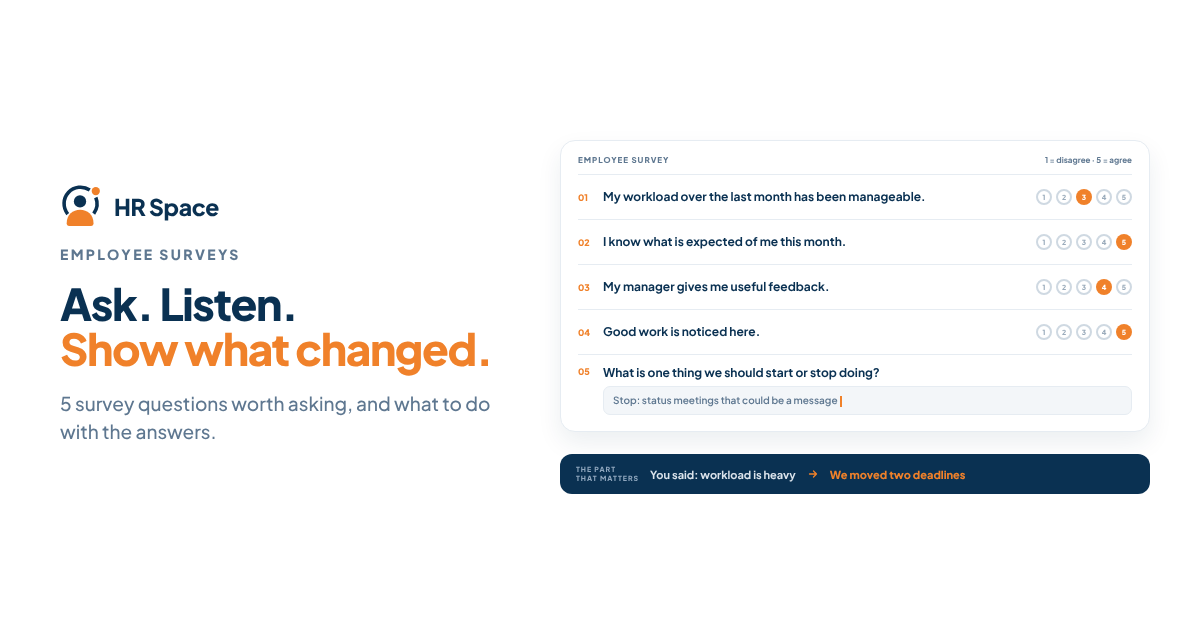
The first pulse survey usually gets a great response. The third one gets half. By the fifth, people stop answering, and the reason is almost never the questions. It's that nothing visibly changed after the first four.
Quick answer: A pulse survey is a short, regular check-in of five to ten questions. Most small and mid-size teams do well with one a month or one a quarter, plus a short one after big changes. Keep it short, keep answers anonymous where possible, report results only for groups large enough to protect individuals, and always share what you will do in response.
How often to run a pulse survey
|
Situation |
Suggested frequency |
Why |
|---|---|---|
|
Stable team, first time running surveys |
Quarterly |
Enough time to act between surveys |
|
Fast-growing team or new managers |
Monthly |
Problems move quickly |
|
After a big change (reorganisation, new office, new policy) |
Once, 2–4 weeks after the change |
Checks how the change landed |
|
Very small team (under 10 people) |
Quarterly, or replace with one-to-ones |
Anonymity is hard to protect |
The right frequency is the one you can respond to. If you can't act on results monthly, survey quarterly.
20 pulse survey questions to choose from
Pick five to ten. Keep the same core questions each time so you can compare, and rotate one or two topical ones.
Workload and wellbeing
- My workload over the last month has been manageable.
- I can take time off without worrying about what happens to my work.
- I rarely work outside my normal hours.
Clarity
- I know what is expected of me this month.
- I understand how my work connects to the team's goals.
- When priorities change, I hear about it in time.
Manager and support
- My manager gives me useful feedback.
- I have regular one-to-ones that are worth my time.
- I feel comfortable raising a problem with my manager.
Team and recognition
- People on my team help each other.
- Good work is noticed here.
- I feel respected by the people I work with.
Tools and process
- I have the tools I need to do my job well.
- I know where to go when I have an HR or admin question.
- Internal requests get answered in a reasonable time.
Growth and intent
- I am learning things that matter for my career.
- I see a future for myself here.
- I would recommend this company as a place to work.
Open questions (use one or two)
- What is one thing we should start or stop doing?
- Is there anything else you want leadership to know?
Use the same answer scale every time, such as a five-point scale from "strongly disagree" to "strongly agree".
How to keep answers honest
- Say clearly who sees what. "Results are shown only for groups of five or more" is more convincing than "this survey is anonymous".
- Don't slice too thin. Breaking results down by team, tenure and role at once can make individuals identifiable.
- Keep it under five minutes. Long surveys get rushed answers.
- Never follow up on an individual answer. Even when you think you know who wrote it.
What to do with the results
This is the part that decides whether people answer next time.
- Share results within two weeks, including the uncomfortable ones.
- Pick one to three things to act on. Not everything.
- Say what you'll do and by when: "You said one-to-ones get cancelled. From next month, managers will reschedule within the same week."
- Report back next time: "Last quarter you told us X. Here is what changed."
Pulse results also make a useful line in a monthly leadership report. See HR reports every founder should see monthly.
Common mistakes
- Changing the questions every time, so trends are impossible to see
- Running surveys more often than you can respond to them
- Sharing averages only, without the comments that explain them
- Treating a low score as a manager's failure instead of a starting point
How HRSpace helps you run pulse surveys that people keep answering
Most teams run their first pulse survey in a separate form tool, export the results to a spreadsheet, and lose them by the next quarter. HRSpace's Forms & Surveys add-on keeps surveys in the same place as the rest of your HR: you build the survey, share it with the team or through a public link, track who has responded, and export answers to CSV.
Because surveys sit next to goals, one-to-one check-ins and recognition, acting on the results is easier. If people say good work isn't noticed, recognition badges and the recognition feed are already there. If they say priorities are unclear, team goals and weekly check-ins are one click away. Forms & Surveys costs $0.50 per employee per month on top of the $1 Base Layer, and you can run your first pulse survey during the 14-day free trial.
FAQs
What is an employee pulse survey?
A short, regular survey of five to ten questions that checks how employees are doing between larger annual surveys.
How often should you run pulse surveys?
Monthly or quarterly for most teams, plus one after a major change. Choose the frequency you can respond to.
How many questions should a pulse survey have?
Five to ten, taking under five minutes to complete.
Should pulse surveys be anonymous?
Usually yes, with results shown only for groups large enough that no individual can be identified.
How do you avoid survey fatigue?
Keep surveys short, don't run them more often than you can act, and always tell people what changed because of their answers.
Ready to make HR the easy part?
Explore modular pricing and start a free 14-day trial.