Connecting Team Goals to the Work People Do Each Week
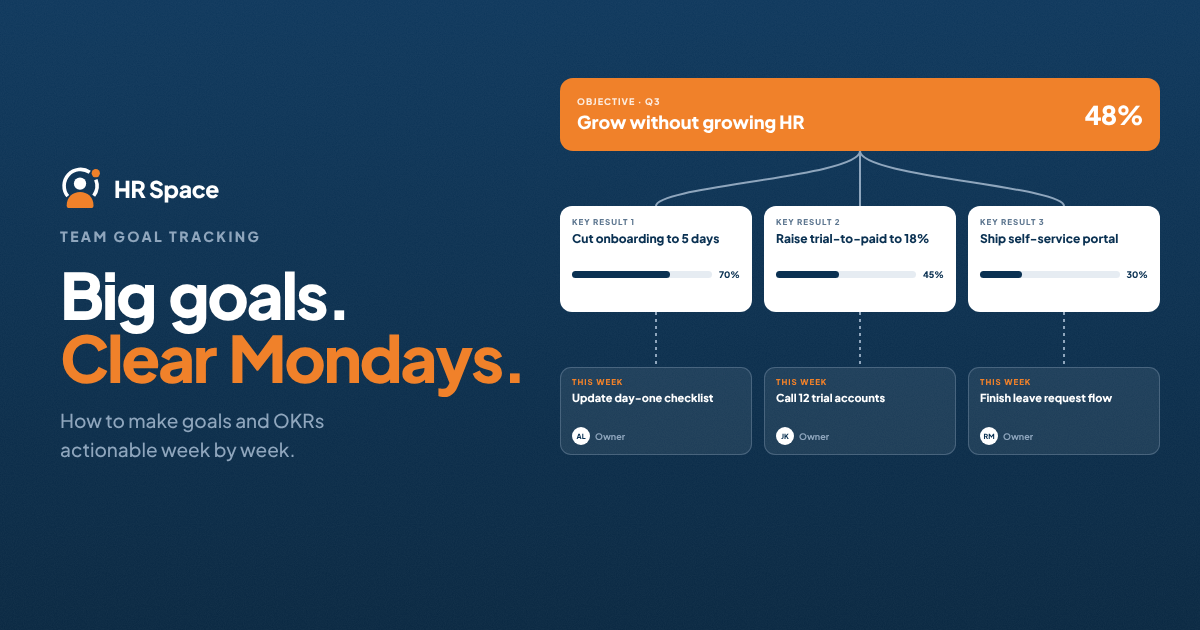
Describe the change before choosing the tasks
“Improve onboarding” could mean several things. Customers might be confused about their first action, waiting for setup help, or reaching a useful result later than expected. Each problem suggests different work.
Start with a specific group and a specific difficulty. For example, a services team wants new clients to understand who owns the next step after the kickoff meeting. That gives the team something concrete to investigate and improve.
The Atlassian goals signals and measures play distinguishes completed outputs from the outcomes a team wants to create. Its guidance provides a useful prompt: decide what success would look like before treating a finished task as proof of progress.
This does not require elaborate terminology. Write one sentence describing the desired change. Then ask what evidence would make you more or less confident that the change is happening.
Choose measures that answer the real question
For the kickoff example, publishing a welcome guide is an output. A client being able to identify their next action and responsible contact is closer to the intended result.
The team could review a sample of kickoff follow ups, ask a short question at an agreed point, or examine requests caused by missing instructions. Select a method that is practical and relevant to the problem. Establish the starting position before choosing a target that sounds impressive.
Be precise about definitions. Does a “new client” mean a signed account, a completed kickoff, or the first active project? When is the question asked? Who records the answer? Changing those definitions halfway through can make a dashboard look different without showing a real improvement.
Also consider what the measure misses. Fewer clarification requests may mean instructions improved, but customers may simply have stopped asking. Discuss the numbers alongside direct feedback and examples of the actual experience.
Give the goal a visible path into weekly work
|
Goal component |
Example for client kickoff |
Weekly review question |
|
Desired change |
Clients understand their next step |
What evidence supports that understanding? |
|
Starting position |
Current follow ups reviewed consistently |
Are we comparing the same situation? |
|
Planned action |
Test a revised kickoff summary |
Who will test it and by when? |
|
Progress signal |
Fewer unanswered ownership questions |
What do the examples tell us? |
|
Decision |
Keep revise or stop the approach |
What should we do next week? |
The table creates a route from purpose to action. It also makes it easier to challenge work that no longer helps. A task may be well executed and still contribute little to the goal.
Assign ownership at both levels
The goal owner keeps the overall question visible. Task owners deliver specific work. These responsibilities can belong to different people, and the distinction should be clear.
Suppose the account lead owns the client experience goal. An operations colleague updates the kickoff template, while a customer lead gathers feedback. Finishing the template does not automatically close the goal. The account lead still needs to bring the evidence together and recommend the next decision.
Name dependencies too. If a test requires approval from another team, record the decision needed and the date. A goal can appear behind schedule because the work is blocked outside the task owner's control.
Avoid assigning individual accountability for a result that depends on several teams without defining their shared commitments. Discuss what each person can influence and which decisions need a common owner.
Use check ins to adjust the plan
A useful goal check in answers three questions. What changed in the evidence? What did we learn from the recent work? What action follows?
This can be a brief discussion when the record is current. The point is to make a decision, including a deliberate decision to continue. Repeating a percentage without explaining the evidence adds little.
If the work is complete but the intended change is absent, investigate the assumption. Perhaps the kickoff summary was difficult to use. Perhaps the real issue occurs later in delivery. The team may need another test rather than more copies of the same document.
If the business priority changes, preserve the reason for changing or stopping the goal. A record of that decision prevents an abandoned target from returning months later as an unexplained performance issue.
Start with one goal the team already cares about
Take an existing goal and list the tasks currently associated with it. Ask each owner to explain how their task is expected to help. Then identify one missing piece of evidence about the desired result.
The exercise should produce a clearer next step, not a larger reporting workload. Keep the goal, measures, and current actions easy to find together, wherever the team maintains them.
HRSpace includes goals and OKRs in its platform overview. When exploring the platform, bring a real goal and ask how progress, ownership, and check ins would work for your team.
FAQs
What is the difference between a goal and a task
A goal describes a result or change the team wants to achieve. A task describes a piece of work. Several tasks may contribute to a goal, and completing them does not always prove the result occurred.
Does every task need to link to a quarterly goal
No. Teams also handle routine operations, maintenance, and unexpected work. Make those commitments visible so the goal plan reflects the capacity actually available.
How many measures should a goal have
Use enough to judge the intended change without creating unnecessary reporting. Start with the main question, choose a practical measure, and add context when one number would be misleading.
What if the team cannot control the final outcome
Describe the parts it can influence and the external dependencies. Agree on meaningful contributions and learning points. Review the outcome with that context rather than assuming every change belongs to one team.
Test the connection between a goal and its next action
Bring one live objective to an HRSpace walkthrough. Ask how the team would review its evidence and identify the work that should happen next.
Further reading
Ready to make HR the easy part?
Explore modular pricing and start a free 14-day trial.