Career Gaps and the Questions That Actually Matter
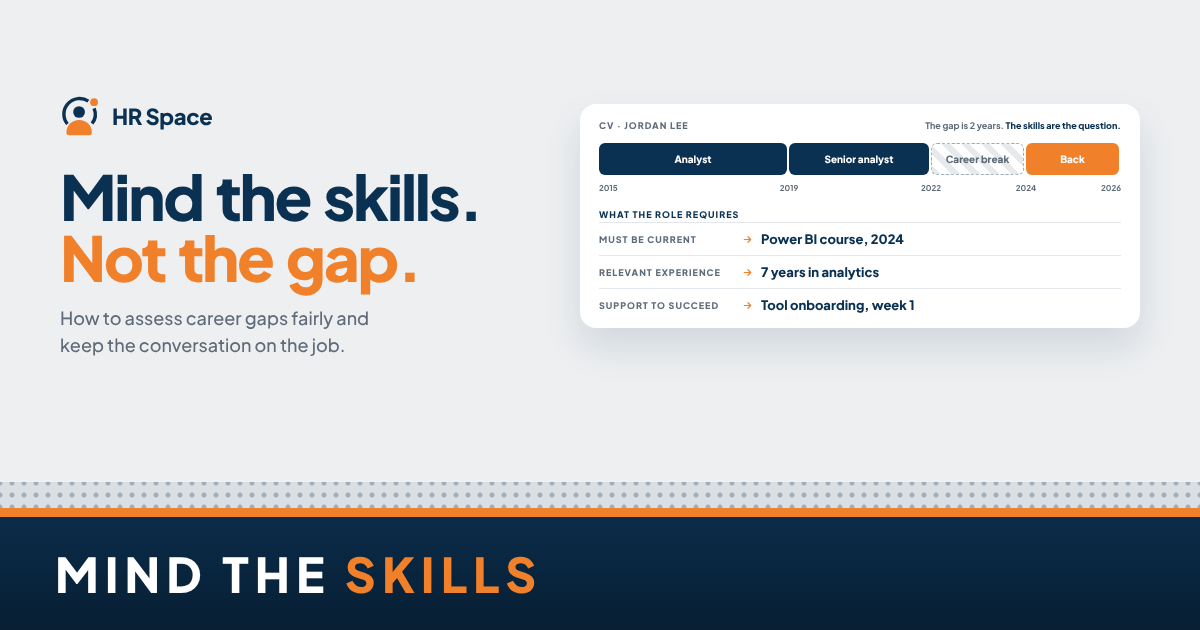
A CV has a period with no employment listed. Before anyone speaks with the candidate, the notes already contain a conclusion: “Might be difficult to bring up to speed.”
That conclusion has skipped the useful part of the conversation. The team still needs to understand the person's relevant skills, current readiness, and the support the role can provide.
When reviewing a career gap, keep the discussion connected to the job. Give candidates room to describe relevant experience without requiring personal detail that the hiring decision does not need.
Check what the role really requires today
Identify the skills that need to be current and explain why they matter. A recent tool change, a particular technical environment, or a responsibility requiring independent judgment may be relevant. A blanket preference for uninterrupted employment says much less about the work.
Separate knowledge that must be demonstrated now from knowledge the team can help someone learn. This distinction should come from the role brief and apply consistently to candidates whose backgrounds look different.
CIPD guidance on recruiting parent returners recommends making required skills clear, allowing relevant learning from a career break to be discussed, and preparing interviewers for these conversations. Its context is parent returners; the wider practical lesson is to ask for role evidence instead of filling an unknown period with assumptions.
Give the person control over the relevant context
You can invite someone to share anything about their experience or learning that helps explain their readiness for the role. Make it clear that the discussion should stay with information they want to contribute and that is relevant to the work.
For example: “You have described experience in [area]. Could you talk us through how you would approach [current role task], and any recent work or learning you would like us to consider?”
This question creates a route to useful evidence. It does not require the candidate to explain private circumstances before the team will consider their ability.
If personal information is volunteered, keep the conversation respectful and return to the work. Avoid turning the notes into a detailed account of circumstances unrelated to the decision.
Connect each concern to something assessable
|
Concern raised |
Role-related question |
Evidence to review |
|
Current knowledge |
How would you approach this task now |
Explanation or relevant work sample |
|
Learning needs |
Which parts would need a refresher |
Specific training needs and available support |
|
Readiness |
What arrangements are needed to start |
Practical terms discussed with the candidate |
|
Relevant experience |
Which previous examples transfer to this work |
Responsibilities and demonstrated skills |
|
Uncertainty |
What important question remains unanswered |
Focused follow-up rather than a broad assumption |
Use the same required standard across applicants. A differently shaped career should not create an undefined additional test.
Design a focused assessment where needed
If the team needs to examine a current skill, use a relevant question or proportionate exercise. Explain what it assesses and provide the preparation information candidates need.
Keep the task close to the role. If the job requires reasoning through a support issue, ask for that reasoning. Do not substitute an unrelated memory test because it is easy to administer.
Review the evidence with the agreed criteria. Distinguish a missing skill from an unfamiliar format or a tool that the team normally teaches. If an answer needs clarification, make the follow-up specific.
The aim is to understand readiness accurately. Avoid adding extra stages solely because the CV includes a gap.
Discuss support honestly
If the role includes training, describe what is available and what the person is expected to handle independently. Avoid promising a structured returner programme when the team has not planned one.
Ask the candidate about the relevant support they would find useful. The conversation might identify a refresher on a tool, a clear introduction to a changed process, or a staged handover of responsibility.
Check the proposal with the manager who would provide that support. A reassuring statement from the recruiter is not enough if the receiving team expects immediate independence in every area.
Keep any practical agreement clear and connected to the role. Do not assume a particular working pattern or level of ambition from the existence of a career break.
Review the notes before making a decision
Read the assessment as if you had not seen the CV. Can you understand the person's relevant strengths, the evidence considered, and any specific unmet requirement?
If the notes say only “long gap” or “might need support,” ask what those phrases mean for this job. Replace assumptions with a clear observation or identify the question that still needs answering.
This check helps the team explain its reasoning and gives the next interviewer a useful starting point. It also keeps the discussion focused on responsibilities the company can actually describe.
FAQs
Does a career gap establish that skills are outdated
The gap alone does not answer the role-specific question. Identify which knowledge needs to be current and assess it directly. Review relevant experience, recent learning, and demonstrated ability rather than guessing from dates.
Should candidates explain personal circumstances
Keep the interview focused on information relevant to the job. Invite useful context without making private disclosure a condition of consideration. Apply your organization's interviewing guidance and handle volunteered information appropriately.
Should returners complete an extra assessment
Use assessment to answer a relevant question, with a consistent required standard. Avoid adding stages simply because the person's career includes a break. Explain the purpose and keep the task proportionate.
What should interview notes contain
Record role-related evidence, any specific learning need, the support discussed, and unresolved questions. Avoid broad labels that turn an unknown period into a conclusion about motivation or capability.
Review one assumption in your screening notes
Find a concern that needs a clearer link to the role and turn it into an assessable question. If you are exploring HRSpace Recruiting, ask how your reviewers would keep that evidence and context available during the hiring decision.
Further reading
Ready to make HR the easy part?
Explore modular pricing and start a free 14-day trial.