Candidate Screening Questions That Help Recruiters Confirm Fit
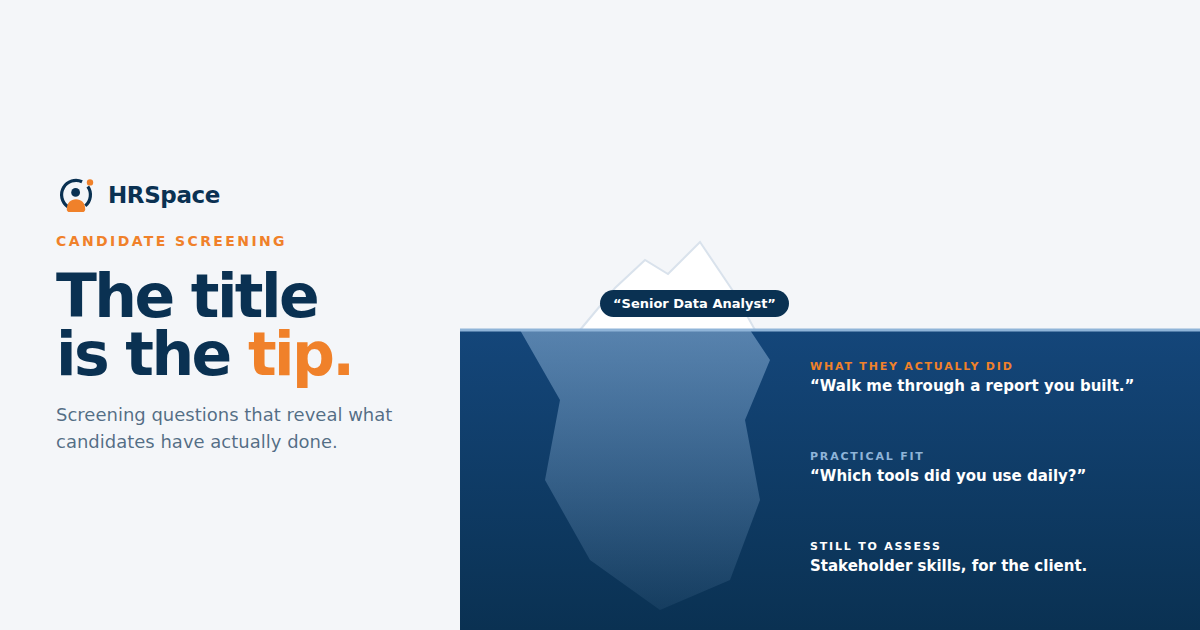
A candidate looks promising on paper. The title matches, the sector is familiar, and their last employer is relevant. Ten minutes into the screening call, you realize you have talked about their career without learning whether they have done the part of the job the client cares about most.
Good candidate screening questions help you use that first conversation deliberately. They confirm the requirements that matter, clarify practical expectations, and identify what needs deeper assessment later.
For an independent recruiter or agency, screening should leave you with a defensible next step. You should be able to explain why someone is worth an interview, which points are confirmed, and what you still do not know. A pleasant conversation alone cannot provide that.
Decide what the first conversation needs to establish
Read the brief before choosing questions. Identify the requirements that can reasonably be checked in an initial call and the evidence that belongs in a later interview or assessment.
For a customer support manager, you might confirm experience managing a team, handling escalations, and working with the relevant service model. You would not expect a short call to establish every aspect of their leadership performance.
Write a clear decision for the end of the call: progress, seek a specific clarification, or close the application for this role. If the conversation has no defined purpose, it is easy to collect notes without knowing what they establish.
Ask about the work behind the title
Job titles vary between companies. Ask what the person actually owned, who they worked with, and what decisions they made.
“Have you managed a team?” may produce a yes without telling you enough. “How many people reported to you, and which parts of their work were you responsible for?” gives you a clearer starting point. A follow-up about a specific situation can then test the relevant experience.
Listen for the difference between supporting work and owning it. Both can be valuable, but the brief may require one in particular. Record the candidate's actual involvement rather than expanding a short answer into a stronger claim.
Use follow-up questions to resolve the missing detail
A useful follow-up stays close to the answer. If a candidate says they improved response times, ask what they changed and how the team tracked the result. Do not immediately move to the next question just because the first answer sounded positive.
Keep the conversation proportionate. You are collecting evidence for an initial decision, not asking the candidate to disclose confidential client information or solve the hiring team's full operating problem.
If an answer remains unclear, record that uncertainty. “Has worked with escalations; level of ownership needs confirmation” is more accurate than “strong escalation management” when the call did not establish the latter.
|
Screening area |
Example question |
Useful evidence to record |
|
Relevant responsibility |
What did you own in that part of the role |
Scope and actual involvement |
|
Working example |
Can you describe a situation where you used that skill |
Actions taken and context |
|
Role interest |
Which responsibilities in this brief interest you |
Connection to the actual work |
|
Working arrangement |
How does this location and schedule fit what you would consider |
Current preference or constraint |
|
Compensation |
Does the stated range fit what you would consider |
Response to the disclosed range |
|
Timing |
What would affect a realistic start date |
Current timing and open questions |
Adapt the questions to the assignment. The examples are conversation prompts, not a universal script for every role.
Explain the opportunity before asking about interest
“Why do you want this job?” is difficult to answer when the candidate has only seen a title. Explain the work, the team, and the practical details you are authorized to share.
Then ask what appeals to them and what they want to understand. Their questions can reveal whether the opportunity fits their priorities. Someone may have the required experience but prefer a different kind of responsibility.
Avoid treating hesitation as a lack of motivation. The person may need accurate information about the role before deciding whether to continue. Record the question and get an answer from the client where necessary.
Confirm practical fit early and respectfully
Location, working pattern, range, and timing can determine whether the process is workable. Share confirmed details and ask whether they fit what the person would consider.
Use job-related questions. Ask whether the stated schedule works rather than investigating unrelated personal circumstances. If the person needs an adjustment to take part in the process, use the agreed support route.
Distinguish a preference from a firm constraint. A candidate may prefer remote work while considering a suitable hybrid role. Asking a specific question gives them room to explain, and prevents the recruiter from turning a broad preference into an automatic rejection.
Keep a consistent core without reading mechanically
Use the same core areas for candidates applying to the same role so the team can compare relevant evidence. Follow-ups will differ because people's experience differs.
A script can help a new recruiter remember the essentials. It becomes less useful when reading it prevents them from listening to an answer or following an important detail.
Leave time for the candidate's questions and explain the next step. A screening call is also their chance to decide whether to invest further time. If you need more information, tell them what and why rather than leaving the outcome vague.
Record evidence before writing the recommendation
Write notes while the details are fresh. Separate the candidate's examples, your interpretation, and the remaining questions.
A recommendation might say that the person has the required team management experience and that their knowledge of a particular system needs review. That gives the client something usable. “Excellent candidate” adds little if the supporting evidence is missing.
Avoid giving a confident score for an area you did not assess. Mark it as unassessed and plan how it will be checked later. This keeps a short screening call from appearing more comprehensive than it was.
Where AI can fit into the first stage
If you are considering AI interviews, decide which parts of screening they would support and which decisions a person will review. Check the questions, candidate instructions, and how the resulting information is presented.
In an HRSpace Recruitment demo, bring a real role brief and ask to examine the screening workflow. Review an incomplete answer as well as a strong one, and confirm how a recruiter handles missing evidence or a candidate needing another route.
Do not assume an automated output has verified every requirement. Your recommendation should still reflect the information actually collected.
FAQ
What are good candidate screening questions
They connect directly to the role, invite useful examples, and clarify practical fit. Each question should help the recruiter make the initial decision or identify what a later stage needs to assess.
How many screening questions should a recruiter ask
Use enough to cover the essential areas within the agreed conversation time. Leave room for relevant follow-ups and candidate questions rather than setting a fixed number for every role.
Should every candidate receive identical questions
Keep a consistent core for the role and adapt follow-ups to the answers. This supports comparison while allowing the recruiter to understand different experience accurately.
What if a candidate cannot answer a question clearly
Clarify the wording and ask a focused follow-up. Record what remains uncertain and decide whether that evidence is needed before progressing or can be assessed at the next stage.
Change one question in your next call
Find a question that usually produces a yes or no. Rewrite it to ask about the candidate's actual responsibility or an example of their work. Check whether the answer makes your recommendation more specific.
Ready to make HR the easy part?
Explore modular pricing and start a free 14-day trial.