Candidate Rediscovery How to Revisit People Already in Your Database
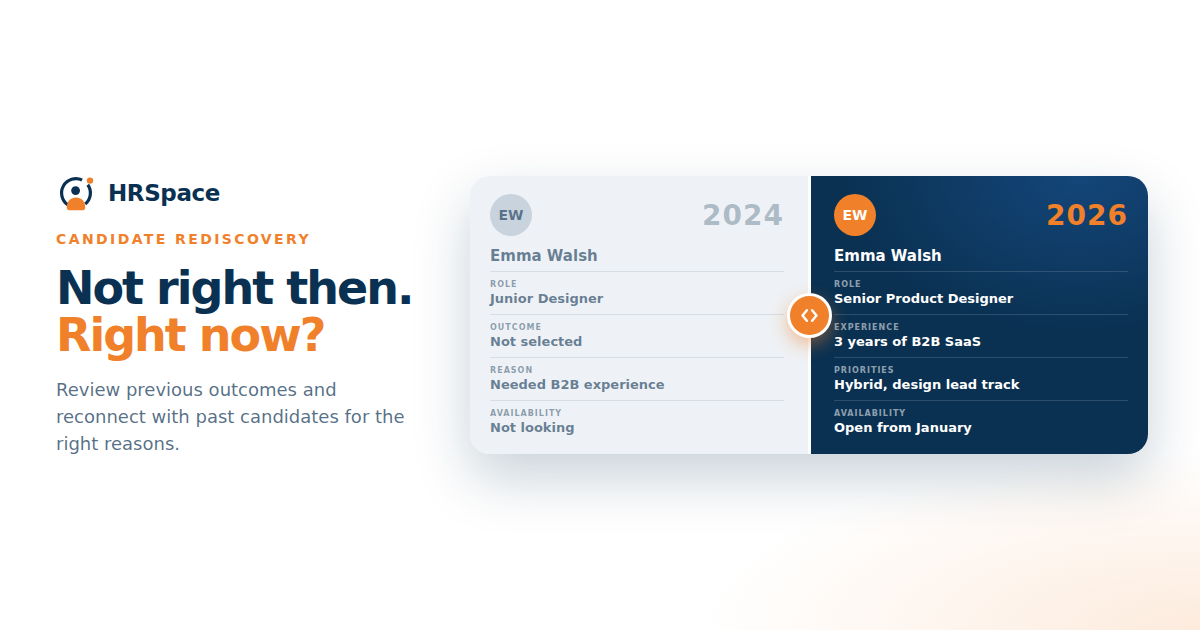
A client sends a brief for a new operations role, and you open your usual sourcing tools. Before you build another list, there may be people worth reviewing in the database you already have.
One interviewed for a different role last year. Another reached the final stage but chose a position with a shorter commute. A third was interested when the timing was wrong. None of those outcomes tells you whether they fit today's opportunity.
Candidate rediscovery means reviewing existing records against a current role and reconnecting when there is a relevant reason. For a recruiter working alone or a small agency with years of conversations, it can turn forgotten context into a useful starting point. It still requires a fresh assessment.
Translate the new brief into a search
Start with the work the person needs to do. If the role involves managing warehouse operations, define which responsibilities matter: staffing, inventory accuracy, supplier coordination, or another specific part of the job.
Search across the fields your database actually contains. A title filter may miss someone who performed the work under a different title. Notes and previous role history may provide the missing context, provided the system lets you retrieve them reliably.
Write down the search terms and filters you use. If the first search returns too little, you can see which condition to change. Removing every filter at once makes it difficult to understand why someone appeared in the results.
Read the previous outcome in context
“Rejected” is rarely a complete explanation. A previous application might have ended because the salary did not fit, the role changed, or another candidate had a particular skill. The reason matters to the new search.
Look for the dated decision and the evidence behind it. If the notes are unclear, treat the outcome as incomplete information. Do not infer that the candidate was weak or unavailable simply because they did not join a previous client.
Also check whether they asked not to be contacted or set limits on future approaches. A good match for the current role does not override those instructions.
|
Previous situation |
Question for the current search |
Possible next step |
|
Strong interview but another person hired |
Are the relevant strengths still applicable |
Review current experience and approach if relevant |
|
Compensation mismatch |
Is the new range materially different |
Share the accurate range early |
|
Location mismatch |
Does the working arrangement now fit |
Confirm the current location preference |
|
Timing was wrong |
Is the person open to a conversation now |
Make a low-pressure, relevant approach |
|
Limited evidence in the record |
What would establish fit |
Ask a focused screening question |
|
Contact restrictions recorded |
Is this approach permitted by the instructions |
Follow the recorded preference |
Build a review list before contacting people
Search results are candidates for review, not a ready-made outreach campaign. Read the profiles, remove obvious mismatches, and identify what still needs confirmation.
Give each person a short reason for appearing on the list. “Managed multi-site warehouse teams during the previous search” is better than “good profile.” The reason helps you write an approach and gives a colleague something specific to check.
Keep the list small enough to review properly. A large export can feel productive while leaving you with the same assessment work later. If you cannot explain why a person might fit, return to the brief or improve the search.
Reconnect with enough context to be recognized
Mention the earlier conversation accurately and briefly. People do not always remember a recruiter from a process that ended months ago, and they should not have to search old email to understand why you are writing.
Here is an illustrative message: “Hi Jordan, we spoke last spring about a distribution manager role. You mentioned wanting more responsibility for team planning. I am working on an operations position that includes that responsibility, with three days on site in Bristol. Would you like me to send the brief and salary range?”
The message gives the person a recognizable connection and a concrete reason to reply. It does not assume their situation has stayed the same. If you cannot verify the detail from the earlier conversation, leave it out.
Update the information that affects this role
When the person replies, confirm their current experience and what they would consider. Ask about the details that matter to the search rather than repeating a full screening call without purpose.
Someone who was a senior individual contributor may now manage a team. Someone who previously wanted a move may have settled into a new job. Record the current position and date it so the conversation improves the database for future work too.
Explain the role before asking for extensive information. The candidate should be able to judge whether the opportunity deserves more time. A familiar record does not mean they have agreed to join the new process or be submitted to a client.
Avoid sending the same person several approaches
In an agency, check whether another recruiter is already speaking with the candidate. Two unrelated messages from the same team can create confusion, especially if neither recruiter knows what the other has offered.
Agree how the team records active conversations and who coordinates when a person may suit several roles. Keep ownership practical. It should help the candidate receive a coherent approach, while allowing relevant information to reach the recruiter working on the search.
For a solo recruiter, the same principle applies across your own assignments. Review the last message before sending another one. If an earlier opportunity is still open, explain how the new role relates to it.
Measure what happened after the search
Record how many reviewed profiles led to relevant conversations and what happened next. Keep rediscovered candidates distinct from newly sourced candidates if you want to compare the routes.
Use consistent definitions. A reply saying “please remove me from your list” is a response, but it is not an interested candidate. A profile viewed during a search has not yet been assessed or contacted.
Review small numbers carefully. One successful placement can justify looking at the records again, but it does not establish a reliable conversion rate for every future role. Read the reasons behind the outcomes and use them to improve the search terms or approach.
Test rediscovery with a real brief
In an HRSpace Recruitment demo, ask to explore the searches your agency needs. Bring a sample brief and describe the fields, notes, and previous applications you want to review.
Confirm what is searchable, how current information is distinguished from history, and how the team can see active conversations. Do not assume every database search or communication function is included in the proposed setup.
FAQ
What is candidate rediscovery
It is the process of finding and reviewing existing candidate records for a new opportunity. Recruiters then confirm current fit and interest before moving someone into the new search.
Is rediscovery the same as sending a database email
No. Rediscovery starts with role relevance and record review. An email campaign alone does not establish whether the recipients fit the position or whether their information is current.
Can a previously rejected candidate fit another role
Yes, depending on the earlier reason and the new requirements. Review the evidence and assess the person against the current brief rather than carrying an unexplained decision forward.
What if the database contains very old information
Treat it as historical context. Confirm the information needed for the current search through an appropriate conversation, and follow your organization's rules for using and maintaining the records.
Revisit one previous shortlist
For your next relevant role, review a previous shortlist before starting new outreach. Choose people whose recorded experience gives you a specific reason to reconnect. Even when none are interested, the replies can help you understand which records and search assumptions need updating.
Ready to make HR the easy part?
Explore modular pricing and start a free 14-day trial.