Candidate Outreach That Gives People a Reason to Reply
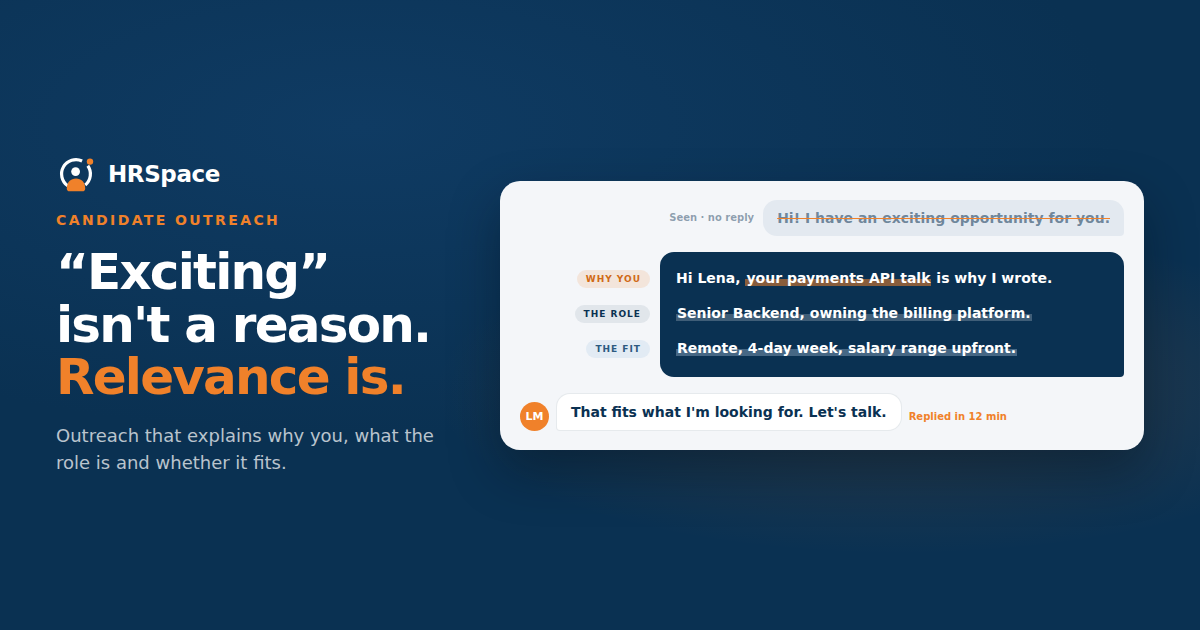
You find someone whose experience looks right for the role. You write a message, add their name, and send it. A week later, there is still no reply.
From your side, it was a considered approach. From theirs, it may have looked like another message about an exciting opportunity with no salary, location, or explanation of the work. The time you spent reviewing the profile did not make it into the message.
Useful candidate outreach makes the connection visible. Explain why you approached this person and share enough about the role for them to decide whether a conversation is worthwhile. You can sound interested and professional without writing a sales pitch.
Start with relevance you can explain
Before writing, identify the connection between the role and the candidate's actual experience. A job title alone is a weak reason. Titles cover different responsibilities across organizations.
Look for work that relates to the assignment: a market they have served, a system they have built, or an operational problem they have handled. Use information you can reasonably support from the profile or a previous conversation.
Avoid claiming detailed knowledge of someone's achievements when the evidence is limited. You can say that their listed experience in implementation caught your attention without claiming that you know the results they delivered.
If you cannot explain the match in a sentence, revisit the search criteria before sending the message.
Give enough information for a useful first decision
A passive candidate may be reasonably happy in their current role. They need something concrete to decide whether a conversation is worth their time.
Explain the role's central responsibility, the location or working arrangement, and the level of experience being sought. Where you can share compensation information, include it or say what you are able to discuss. If the client is confidential, explain that constraint plainly and offer the information you can provide.
Do not hide a known requirement until after the person replies. Asking someone who only wants remote work to discover a five-day office requirement in the first call creates avoidable friction.
A first message that sounds like a real approach
For example, an approach for a customer success assignment could read like this. The role and candidate below are illustrative.
Hi Maya, I noticed your profile lists work on customer onboarding for B2B software teams. I'm helping a company hire a customer success lead to improve the handover from sales to implementation. The role includes coaching a small team and rebuilding that process, rather than managing a large existing department. It is hybrid in Dublin, with two office days expected. Would you like the role brief and the confirmed compensation range before deciding whether to speak?
Maya can understand why you contacted her and what she would learn by replying. She can also rule the role out if two office days do not work for her. That is useful information for both of you. Shorten the message if the channel calls for it, but keep the details that affect her decision.
Choose the channel from the relationship
A previous candidate may have told you how they prefer to hear about opportunities. Follow that preference and check the context of your last conversation before reaching out again.
For a new contact, choose a professional channel you are authorized to use and a process consistent with your organization's outreach policies. Avoid contacting the same person through several channels at once simply because no reply has arrived.
Check the agency's existing record before sending. Another consultant may have approached the person yesterday, or the candidate may have told you last month that they are unavailable. That small check can save an awkward conversation later.
Make follow-ups add something
Before writing a follow-up, ask whether you have anything useful to add. Perhaps the client has clarified the reporting line or agreed to share the compensation range. That gives you a reason to return to the conversation. Repeatedly asking whether the person saw your message gives them little new information.
|
Candidate response |
Sensible next action |
|
Interested and asks for details |
Send the brief and answer the specific question |
|
Interested but timing is wrong |
Agree whether and when to reconnect |
|
Declines this role |
Record the decision without treating every future role as unsuitable |
|
Requests no further contact |
Stop outreach and update the relevant records |
|
No reply |
Follow your agreed cadence and stop after the planned sequence |
|
Reply is ambiguous |
Ask one focused question rather than assuming interest |
For illustration, a small recruiting practice might send an initial message, one follow-up several business days later, and a final message the following week. That is a starting scenario to adapt to the relationship and channel, not a proven optimum.
An email open or profile view does not establish interest. Avoid messages that tell the person you noticed them viewing your approach. Base the next step on the content of a reply or the agreed outreach process.
Close the conversation respectfully
When someone declines, a short acknowledgment is usually enough. If they volunteer future preferences, record them accurately. Do not turn a polite refusal into a lengthy attempt to overcome objections.
If there is no reply by the end of your planned sequence, close the active outreach task. You may discover a genuinely different opportunity later, but that requires a fresh relevance assessment. Repeating the same offer indefinitely does not improve the match.
Be clear about what a positive reply means too. Asking for the brief is an information request. It does not automatically authorize submission to a client or confirm availability for interviews.
Measure conversations rather than message volume
Large send counts can distract from whether the approach is producing relevant conversations. Track delivered messages, meaningful replies, interested replies, and the next agreed step using consistent definitions.
Review the content of negative replies. If several candidates say the working arrangement is unsuitable, the issue may be targeting or the brief. If they ask what the role actually involves, the message may be too vague.
Compare like-for-like groups. A highly specialized search and a broad entry-level vacancy are unlikely to produce comparable response patterns. Small batches also produce noisy percentages, so inspect the actual conversations before declaring a template successful.
Keep outreach connected to candidate records
Store the role, date, channel, response, and any future commitment in the appropriate record. Keep observations factual and relevant to recruitment.
If you are evaluating HRSpace Recruitment, ask how outreach history from your existing tools would be recorded alongside applications. Confirm any messaging integrations, automation, or import needs directly. A candidate pipeline does not itself demonstrate an outbound messaging capability.
Common mistakes
Generic praise, long introductions about the agency, and a request for a full résumé before sharing basic role details all make the candidate work harder to assess relevance.
Another mistake is treating silence as a personal objection that needs a persuasive response. People may be busy, unavailable, or uninterested. A concise follow-up and a clear stopping point leave a better basis for a future relationship.
FAQ
What should a candidate outreach message include
Explain why you approached the person, what the role involves, important working requirements, and a simple next step. Share enough information for them to assess whether the opportunity is relevant.
How should recruiters approach passive candidates
Connect the role to specific experience and respect that the person may not be looking. Offer useful information before asking them to commit to a call or application.
Does an email open mean a candidate is interested
No. Treat interest as something established through a meaningful response. An open event can have several explanations and does not reveal the person's intent.
When should a recruiter stop following up
Stop when the person requests it, declines without inviting future contact, or the planned sequence ends. Keep any agreed future conversation separate from repeated reminders about the same vacancy.
Try this with your next approach
Read your first message and ask whether a person unfamiliar with the client could explain the role and the reason you contacted them. Replace one generic compliment with a specific, supported connection to their experience. Then check that the next step is easy to answer.
Ready to make HR the easy part?
Explore modular pricing and start a free 14-day trial.