Candidate Experience Surveys People Can Answer Honestly
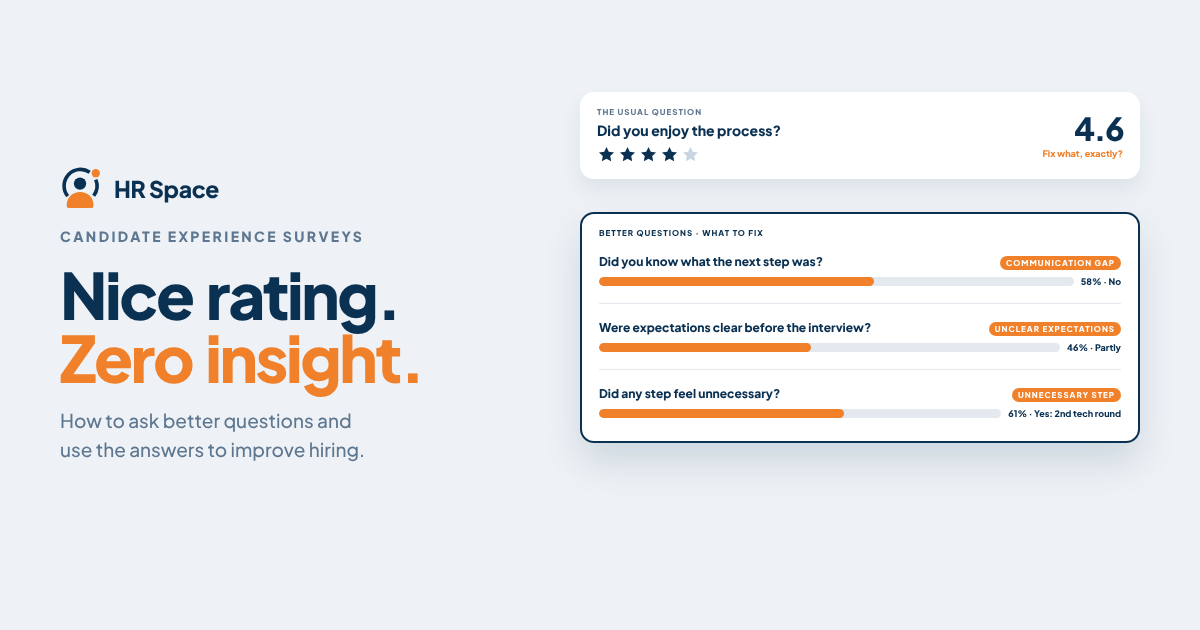
Decide what the survey should help you understand
Choose a small number of questions about the process people actually experienced. You might need to understand whether invitations explained the stages, whether assessments matched their stated effort, or whether updates arrived when promised.
Keep the recruitment outcome separate from those experiences. A person can be disappointed by rejection and still describe clear communication. Someone who accepts an offer can still identify a confusing stage.
Greenhouse's candidate-survey guidance discusses using ratings alongside space for comments and reviewing whether the survey is too long. Apply the same practical discipline to your own questions: collect enough detail to understand an issue without making feedback another lengthy task.
Avoid asking candidates to evaluate work they did not see. Someone who completed one screen cannot comment meaningfully on an entire interview sequence.
Explain what happens to the response
Tell the candidate why you are asking, whether participation is optional, and who can access the answers. Describe anonymity accurately according to the actual survey setup.
A small team should be especially careful about promising that a detailed comment cannot identify someone. A response may mention a distinctive event even when a name field is absent. Verify the process before using reassuring language in the invitation.
Keep feedback requests separate from any implication that the person must respond to remain eligible for future roles. Use a neutral invitation and an appropriate route for questions.
Agree internally who reviews concerns that need individual attention. A survey may reveal an unresolved practical problem that needs a response rather than an entry in a monthly score.
Ask about observable parts of the journey
|
Area to explore |
Example question |
What the answer can inform |
|
Preparation |
Did the invitation explain what to expect |
Interview instructions |
|
Role clarity |
Was the role described consistently through the process |
Brief and interviewer alignment |
|
Time commitment |
Did the assessment match the effort explained |
Task scope and invitation |
|
Updates |
Did you know when to expect the next contact |
Communication routine |
|
Improvement |
What one change would have helped you |
Specific follow-up work |
These are suggested editorial prompts. Adapt the wording, response options, and timing to the stage you are reviewing and test the questions before sending them widely.
Keep the response choices understandable
Use a consistent scale with clear labels if you ask for ratings. Include a suitable way to say that a question does not apply or that the person did not experience the stage.
Give people an optional comment field where an explanation would be useful. Do not require a detailed justification for every low rating. A short, specific observation can be enough to start an internal review.
Check the survey on a phone. Can someone complete it without repeatedly scrolling through dense instructions? Is the purpose clear before they start? Test any links and avoid asking for information the team already holds unless there is a reason to confirm it.
Ask a colleague unfamiliar with the design to explain each question. If they interpret it differently from the intended meaning, revise it before collecting responses.
Read the feedback with its limits visible
Review who received the survey and who responded. A small voluntary sample cannot represent every candidate automatically. Keep role, stage, and outcome context where available and appropriate.
Do not average away a specific issue. A generally positive rating can still contain a comment about an interview invitation that never arrived. Investigate the relevant event instead of relying solely on the headline score.
Equally, avoid treating one response as proof of a universal problem. Check the actual messages and process record. Use the feedback to form a question you can investigate and an improvement you can test.
Close the loop inside the hiring team
Assign the issue to someone who can change the relevant material or workflow. If candidates did not understand an assessment, review the invitation and task together. If updates were unclear, compare the promised timing with the communication record.
Choose an observable change and check it in the next process. Keep a short record of the feedback theme, the action taken, and what the team will review afterward.
Where an individual reply is appropriate and supported by the survey arrangement, respond respectfully. Do not debate a person's experience to persuade them to change a rating. The useful outcome is a clearer process for the next candidate.
FAQs
When should a candidate survey be sent
Choose a point when the person can comment on the stage you want to understand. Explain the purpose and keep participation optional. Avoid requiring candidates to evaluate parts of the process they have not experienced.
Should the survey be anonymous
Decide what the process can genuinely support and explain it accurately. Check access, technical settings, and whether small groups or detailed comments may identify a respondent. Do not promise anonymity merely because a name field is absent.
How many questions should we ask
Use the few questions needed to inform an improvement the team can make. Test the survey on a phone and ask whether each question adds useful information. Make comments optional where practical.
What should happen after responses arrive
A named owner should review themes, investigate specific issues, and assign a concrete action. Keep sample limits visible and check whether the change is used in the next hiring process.
Test one question with a colleague
Ask what they think it means and what change their answer could support. If you are exploring HRSpace Recruiting, ask how the process records needed to investigate candidate feedback would be available to your team.
Further reading
Ready to make HR the easy part?
Explore modular pricing and start a free 14-day trial.