Can HR software run without an IT team?
For a company with 20–100 employees, implementing HR software should not create an unassigned technical responsibility. HR needs to manage onboarding, leave requests, employee information, and reviews without becoming responsible for maintaining servers.
However, easy hosting and easy administration are not the same thing. A cloud application can still require configuration, data cleanup, or technical work to connect other systems.
The right choice depends on what your team can realistically manage and which responsibilities the vendor agrees to handle.
As you build your 2026 shortlist, use our guide to HR software ranked by ease of setup alongside practical demonstrations of the administrator experience.
Can HR Software Run Without an IT Team?
Yes. A practical operating model combines vendor-managed hosting, business-owned configuration, and a defined escalation route for technical problems.
Use these steps to prepare before launch.
1. Assign an administrator
Give an HR or operations leader responsibility for employee records, routine workflow settings, and access decisions. Name a backup who can cover absences or departures.
Without a clear owner, even simple changes can become requests that nobody knows how to handle.
2. Define the initial scope
List the workflows you need first, such as onboarding, time-off management, performance reviews, or employee requests.
Separate essential functions from features you may introduce later. A focused rollout makes it easier to test whether your team can manage the system before expanding its use.
3. Confirm the hosting arrangement
Ask the vendor who manages application hosting, infrastructure, updates, and technical incidents.
Request a clear explanation of what the vendor supports and what remains your organization's responsibility. The word cloud alone does not define the complete support arrangement.
4. Configure business rules
Document who approves requests, who can view sensitive information, and who handles exceptions.
During the demonstration, ask your intended administrator to make a routine change. Watching a salesperson configure the system does not prove that your team can manage it independently.
5. Test real workflows
Use fictional employee records to test a new hire, a leave request, a manager change, and an employee departure.
Check both the normal process and the exception path. Record unresolved issues before employees begin relying on the system.
6. Establish technical support
Decide where your administrator should send technical questions and who handles issues involving connected systems.
Include access problems, failed imports, and interrupted workflows in your support plan. Keep the instructions accessible outside the HR application so they remain available if the system is unavailable.
These steps distinguish operational ownership from technical maintenance. HR can own business rules without owning the underlying infrastructure.
Which Operating Model Should You Choose?
For your 2026 evaluation, compare where technical responsibilities sit, not just which features appear on a product checklist.
| Operating model | Best suited for | Main advantage | Main limitation |
|---|---|---|---|
| Vendor-hosted cloud software | Teams that want to avoid managing internal servers | The vendor manages the hosted infrastructure within the agreed service scope | Your team still owns configuration, access decisions, and data quality |
| Self-hosted software | Organizations with assigned technical resources | The organization controls its hosting environment | Someone must manage maintenance, updates, and recovery arrangements |
| Cloud software with custom integrations | Teams that need connections between business systems | Connections can support workflows across multiple systems | Setup and troubleshooting need clearly assigned technical responsibility |
Vendor-hosted cloud software is usually the most practical starting point for a team without internal IT resources. However, hosting is only one part of the operating model.
Self-hosted software may still be appropriate for some organizations, but only if qualified internal or external support is available.
Custom integrations deserve separate consideration. Before adding a connection, identify the business need, potential failure points, and person responsible for resolving problems.
Why the Need for IT Support Varies
The amount of technical support required depends on your setup and workflows, not just employee count.
Hosting model
Vendor-hosted and self-hosted applications place infrastructure responsibilities in different hands. Confirm the arrangement before comparing how easy each system is to manage.
Workflow complexity
Onboarding, leave management, recruitment, reviews, and employee support involve different rules and exceptions. Define ownership for each workflow you activate.
Employee data quality
Duplicate records, inconsistent names, and incorrect manager assignments can complicate implementation. Someone on your team must be able to resolve these business-data questions before importing records.
Access requirements
Decide who can view employee information and who can change system settings. Test the actual permission levels rather than relying on a general feature description.
Connections to other systems
Payroll, identity, or other integrations can introduce additional technical responsibilities. Document who manages each side of the connection and how failures will be investigated.
Support responsibilities
Establish which tasks the vendor handles, which belong to your administrator, and which require external expertise.
These factors are more useful buying criteria than simply asking whether a platform is described as easy to use.
HR Owns the Process. Technical Support Handles the Faults.
A small company does not need a full IT department to assign responsibilities clearly. It does need to distinguish a business decision from a software problem.
For example, an incorrect leave allowance may be a business-rule issue. A manager who cannot approve a request might have an incorrect assignment, insufficient permissions, or a technical problem.
Your administrator needs a repeatable way to identify the issue and direct it to the appropriate person.
A simple responsibility list can help:
-
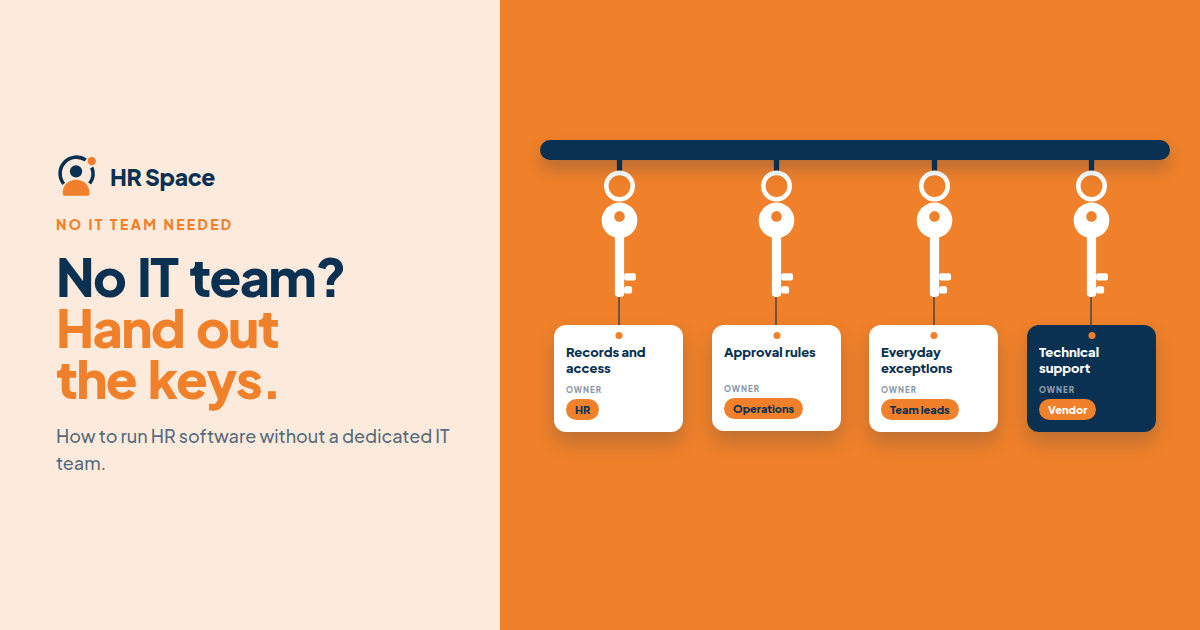
HR or operations: Employee records, manager assignments, approval policies, workflow ownership, and business decisions about access.
-
Software vendor: The hosted service and technical support described in the agreement.
-
Assigned technical contact: Integration troubleshooting and technical work outside the vendor's agreed scope.
-
Managers: Assigned approvals and timely reporting of workflow problems.
Do not automatically make the founder the default technical contact. Assign that responsibility deliberately. The contact may be an external specialist rather than an employee, but the arrangement should be in place before a problem occurs.
Operating without an IT team does not mean operating without technical support. It means having a defined destination for technical work instead of leaving it unassigned.
Where Does HRSpace Fit?
HRSpace is a modular HR platform for growing teams seeking cloud-based tools across the employee lifecycle.
Its stated scope includes:
-
Employee onboarding
-
Time-off management
-
Performance reviews and goals
-
Employee recognition
-
AI-assisted recruitment
-
Workflow automation
-
An internal service desk
HRSpace uses modular, per-employee pricing. This allows your team to evaluate the functions it needs rather than assuming every available module is essential to the initial setup.
The advantage of a broader platform is the opportunity to manage several HR workflows in one place. However, shared software does not eliminate the need for clear ownership of approval policies, employee records, recruitment decisions, or service requests.
For a team without dedicated IT, evaluate the administrative workload alongside the feature set. Ask your intended administrator to demonstrate routine changes, access management, and the process for resolving problems.
Confirm support responsibilities, data imports, permissions, and any planned integrations before deciding whether the platform fits your operating model.
How to Test Whether Your Team Can Manage the Software
A useful demonstration should involve your team performing the work, not simply watching a vendor representative.
Change a manager
Create a fictional employee record and change the assigned manager. Check whether approval responsibilities and relevant access change as expected.
Ask what happens to requests that are already waiting for approval. The goal is to confirm that your administrator understands the consequences of the change.
Handle an exception
Test a leave request that needs a different approver or an employee request assigned to the wrong person.
Ask your administrator to locate the issue and explain how to correct it. Exception handling reveals whether the team can recover when a workflow does not follow the expected path.
Remove access
Walk through an employee departure using fictional data. Identify who initiates the change, which actions occur in the HR application, and which require action in other systems.
Do not assume that changing an employee's HR record automatically removes access to every connected service. Each system needs a verified process and an owner.
Find technical help
Ask your administrator to locate the support instructions and explain how to submit a technical request.
Confirm how the team will receive updates if a problem interrupts an important workflow.
Accept a workflow only when the owner can run it, correct it, and explain how to get help. A polished employee-facing screen is not enough evidence that the system will be manageable.
What Should You Prepare Before Implementation?
Prepare clean employee records, named workflow owners, approval rules, and a written access plan before implementation.
Create a short handover document containing:
-
The primary administrator and backup
-
The initial modules and workflows
-
The source of employee records
-
Decisions required before data import
-
The process for approving configuration changes
-
Vendor and external technical support contacts
Keep passwords and other access credentials out of shared process documents. Instead, document where authorized people can retrieve them securely.
For a team growing from 20 employees toward 100 employees, also explain how new managers are added and how responsibilities transfer when someone leaves. Growth should not require the team to rediscover how the system was configured.
Do You Need Technical Support for Payroll Integrations?
You need an assigned support route for payroll integrations even if you do not employ an IT specialist.
Confirm who configures the connection, checks transferred information, and investigates failures. Do not assume a payroll integration is included, automatic, or supported by the HR vendor.
Verify the specific systems and responsibilities involved before making an integration part of your implementation plan.
Is Employee Self-Service Enough to Remove Administration?
No. Employee self-service allows employees to complete selected tasks themselves, but HR still needs to manage permissions, approval rules, exceptions, and record accuracy.
Evaluate self-service through a complete workflow. Ask what happens after an employee submits a request, who handles exceptions, and how the administrator corrects mistakes.
Frequently Asked Questions
Can HR software run without an IT team?
Yes. Vendor-hosted cloud HR software can operate without an internal IT team when a named administrator manages routine tasks and a technical support route is available for faults and integrations.
Who should manage HR software in a small company?
An HR or operations leader can manage everyday administration, supported by a named backup. Assign responsibility for employee records, approval rules, access decisions, and support escalation.
Does cloud HR software remove all technical work?
No. Cloud hosting shifts infrastructure management to the vendor within the agreed service scope, but configuration issues, integrations, and responsibilities outside that scope still need owners.
Can a company with 20 employees use HR software without IT?
Yes. A company with 20 employees can use vendor-hosted HR software without an internal IT team. Before launch, test whether the administrator can handle routine changes and obtain technical support.
Is self-hosted HR software suitable when nobody manages IT?
Not unless qualified internal or external support is assigned to maintain the hosting environment, updates, and recovery arrangements.
Is HRSpace relevant for a team without an IT department?
HRSpace is relevant to teams seeking modular cloud HR software across employee lifecycle workflows. Confirm the administrator's responsibilities, support boundaries, access requirements, and planned integrations during evaluation.
What should I ask an HR software vendor in 2026?
Ask the vendor to demonstrate how your administrator changes records, manages access, handles exceptions, and obtains technical help. Get the hosting and support responsibilities in writing before committing.
Final Thoughts
Your strongest readiness test is a handover, not a sales demonstration. Ask the backup administrator to complete a routine change using only the documented instructions.
If that person cannot identify the owner, follow the process, or find the support route, improve the operating plan before expanding the rollout.
HR software can run without a dedicated IT team when responsibilities are clear and support is available. The system should not depend on one person's memory to keep everyday HR operations moving.
Related Guides
Ready to make HR the easy part?
Explore modular pricing and start a free 14-day trial.