Can Employee Self-Service Reduce HR Headcount Needs?
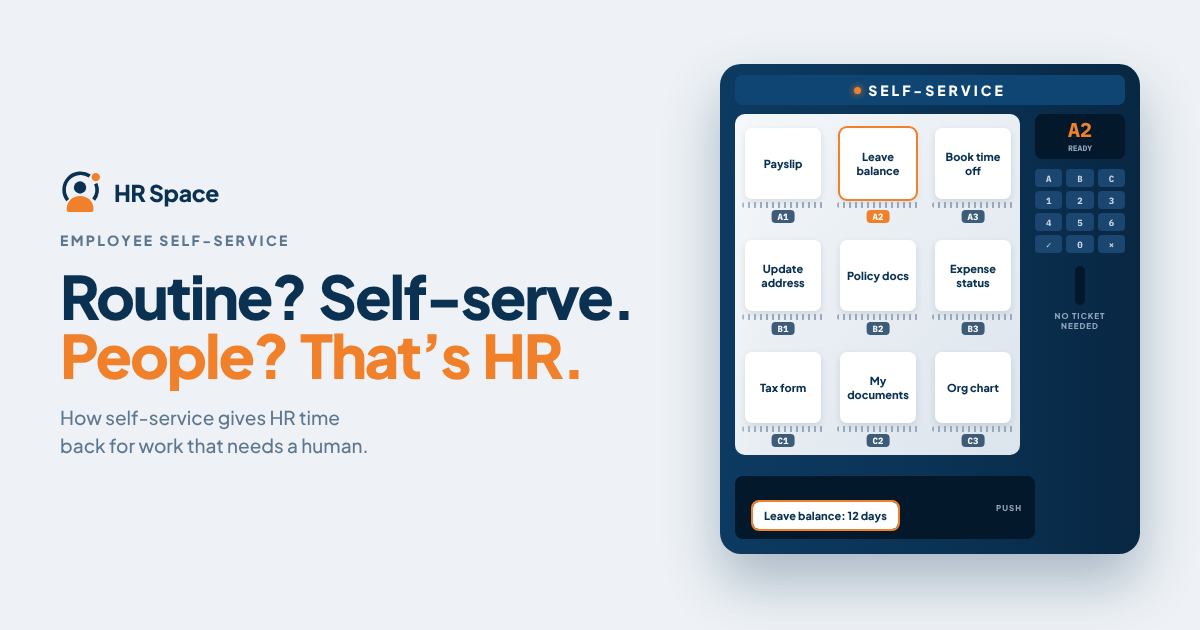
Employee self-service can reduce the need for additional HR headcount by allowing employees to handle routine tasks without contacting HR every time. But fewer HR requests do not automatically mean fewer HR hours.
The real question is whether self-service reduces the total work involved in completing a process, including follow-ups, corrections, approvals and ongoing maintenance.
The short answer: Yes, employee self-service can help growing companies manage HR operations without adding staff as quickly. However, staffing decisions should be based on measured workload, not portal adoption or ticket volume alone.
Why Employee Self-Service Matters for Growing Teams
For companies with 20–100 employees, HR workload can grow faster than the team itself. Questions about time off, onboarding, documents and internal processes may seem small individually, but handling them repeatedly takes time away from more important responsibilities.
Employee self-service gives employees a direct way to access information and complete routine actions.
However, there is an important distinction between reducing HR ticket volume and reducing HR workload. If employees stop submitting requests through the portal but start messaging managers instead, the work has simply moved to another person.
The goal should be to reduce unnecessary administration across the company, not just make the HR inbox look quieter.
Which HR Tasks Can Be Handled Through Self-Service?
Not every HR responsibility should be automated or delegated to employees. The best starting point is to identify tasks that follow clear, repeatable steps.
| Self-service approach | Suitable tasks | What it can reduce |
|---|---|---|
| Published guidance | Common policy questions, process instructions and FAQs | Repeated explanations |
| Structured requests | Time-off requests, document requests and routine employee updates | Manual information collection and follow-ups |
| Automated workflows | Onboarding steps, approval notifications and task assignments | Repetitive coordination |
| Human-led support | Sensitive concerns, disputes and unusual cases | No work should be removed without assessing the need for human judgment |
The right balance combines accessible information, structured workflows and a clear way to contact HR when an employee needs personal support.
1. Published Guidance: Reduce Repeated Questions
Start with questions that have consistent, approved answers.
Employees should be able to find information about company policies, procedures and common HR processes without waiting for someone to explain them individually.
For this to work, information must be accurate, easy to find and regularly reviewed. Each topic should have an owner responsible for keeping it up to date.
If employees continue asking the same questions after accessing the guidance, review the content and instructions before assuming they are not using the system correctly.
2. Structured Requests: Reduce Manual Follow-Ups
Routine processes often involve collecting the same information through emails, messages or conversations.
Structured requests can make these processes easier to manage by collecting the necessary details from the beginning and making the next step clear.
Time-off requests and employee document requests are useful examples. Instead of exchanging several messages, employees submit the required information through a defined process.
However, a form alone does not eliminate administrative work. Approval rules, responsible owners and exception handling must also be clear.
3. Automated Workflows: Reduce Repetitive Coordination
Some HR processes involve several people completing different steps.
Onboarding, for example, may require HR to coordinate with managers and other departments. A structured workflow can make responsibilities and pending actions easier to track.
The value comes from reducing manual reminders and repeated coordination, not from removing every human decision.
Before automating a process, identify who owns each step and what should happen when something goes wrong.
4. Human Support: Keep People Involved Where It Matters
Employee self-service should not become a barrier between employees and HR.
Sensitive concerns, disputes, policy exceptions and situations requiring individual judgment still need an accountable person.
Employees should always know where to go when their situation does not fit the standard process.
The objective is to free HR from repetitive administration so the team can focus on work that requires experience, communication and decision-making.
Why Self-Service Does Not Always Reduce Headcount Needs
The staffing impact depends on how much work actually disappears from the process.
Several factors determine whether self-service creates meaningful capacity:
-
Request complexity: Routine questions are easier to handle through self-service than investigations or individual employee concerns.
-
Completion quality: Incomplete requests and unclear instructions create additional work.
-
Approval delays: Processes still require attention when managers or other owners do not complete their steps.
-
Maintenance effort: HR must account for updating guidance, managing workflows and reviewing exceptions.
-
Work transferred elsewhere: Manager and employee time should also be considered.
-
Changes in demand: Hiring, organizational growth and performance cycles can increase HR workload even after self-service is introduced.
This is why a universal employee-to-HR headcount ratio is not enough to make a reliable decision. Companies need to understand their own processes and workload.
How to Measure the Impact Before Changing HR Staffing
Before postponing a hire or changing an existing staffing plan, establish a baseline.
A 30-day observation period can be a practical starting point. Extend it if it does not include important activities such as recruitment, performance reviews or seasonal workload changes.
Track the following:
| What to measure | Why it matters |
|---|---|
| Requests received across all channels | Shows the actual volume of HR demand |
| HR handling time | Measures time spent resolving requests |
| Repeat contacts and corrections | Reveals whether processes are working |
| Unresolved requests | Helps identify hidden workload |
| Manager involvement | Shows whether work has shifted to another team |
| Process maintenance time | Accounts for the effort required to keep self-service running |
Measure handling time separately from resolution time. A request may remain open while waiting for approval without requiring continuous HR attention.
After introducing self-service, compare the same categories against the baseline. This helps determine whether the company has reduced administrative effort or simply changed how that effort is recorded.
Run a Pilot Before Making Staffing Decisions
Instead of introducing self-service across every HR process at once, start with one recurring task that has clear rules and an assigned owner.
A practical pilot can follow these steps:
-
Document how the process currently works.
-
Identify the information employees need to provide.
-
Introduce a structured self-service path.
-
Keep a clear route to human support.
-
Track handling time, repeat requests and unresolved cases.
-
Review the results after a suitable observation period.
A 60-day review can serve as an initial checkpoint, but it is not a guaranteed payback period.
If the pilot reduces repetitive work without increasing the burden on managers or employees, consider extending it to other suitable processes.
Only then should the results inform a decision about future HR hiring.
Where HRSpace Fits
HRSpace helps growing teams manage HR processes through a modular platform that brings together employee management, workflows and an internal service desk.
Its capabilities include:
-
Employee records and document management
-
Onboarding and offboarding workflows
-
Time-off and attendance management
-
Goals, performance reviews and recognition
-
Projects, tasks and timesheets
-
Forms and workflow automation
-
Internal employee support through Service Me
-
AI-assisted recruitment and hiring workflows
For companies looking to reduce repetitive coordination, these capabilities can help bring more HR processes into a structured environment.
HRSpace uses modular, per-employee pricing, allowing companies to select the functionality that fits their needs.
The important point is to evaluate the platform against your actual workflows. During a product evaluation, check how employees submit requests, how responsibilities are assigned, how approvals work and how HR can monitor unresolved tasks.
Do not base a staffing decision on software features alone. Measure the operational impact after implementation.
Can Employee Self-Service Replace an HR Generalist?
Not by itself. An HR generalist may handle recruitment coordination, employee relations, policy questions, manager support and other responsibilities that cannot simply be transferred to a portal.
Self-service can reduce the administrative portion of the role, but companies should review the full workload before considering any staffing changes.
Can We Delay Hiring Another HR Employee?
Potentially, if the existing team can manage the remaining workload without compromising employee support or important HR responsibilities.
Review unresolved requests, upcoming hiring needs, sensitive cases and the time required to maintain the new processes before making that decision.
Does Fewer HR Tickets Mean Fewer HR Hours?
No. Fewer tickets do not necessarily mean less work.
Employees may contact managers directly, use informal communication channels or stop reporting unresolved problems. Compare total handling time across channels to understand the real impact.
FAQ
Can employee self-service reduce HR headcount needs?
Yes. It can reduce the need for additional HR staff when routine tasks are completed with less administrative effort. The impact depends on request complexity, process quality and the amount of work that remains with HR.
Which HR tasks are best suited for self-service?
Common policy questions, time-off requests, document requests, employee information updates and structured onboarding tasks are good starting points when their rules and ownership are clear.
Can self-service eliminate the need for HR support?
No. Employees still need human support for sensitive concerns, disputes, exceptions and situations requiring individual judgment.
What should companies measure before changing HR staffing?
Track request volume, HR handling time, repeat contacts, unresolved cases, manager involvement and the time required to maintain self-service processes.
How long should a self-service pilot run?
A 30-day baseline followed by a review around 60 days after implementation can provide an initial comparison. Extend the period when important business cycles are not represented.
Is HRSpace suitable for growing teams?
HRSpace is designed for growing teams that want to manage employee information, HR workflows and internal support through a modular platform. Companies should evaluate the specific modules and workflows they need before choosing a solution.
The Bottom Line
Employee self-service can help a growing company handle more HR work without increasing headcount at the same pace.
But the goal should not be to remove human support. It should be to stop spending valuable HR time on tasks that employees can complete independently.
Before changing your staffing plan, measure what has actually changed: the work completed, the time spent, the requests that remain and the responsibilities transferred to other teams.
Better HR operations start with less repetitive work—not simply fewer people in the department.
Related Guides
Ready to make HR the easy part?
Explore modular pricing and start a free 14-day trial.