Can employee recognition software improve employee retention?
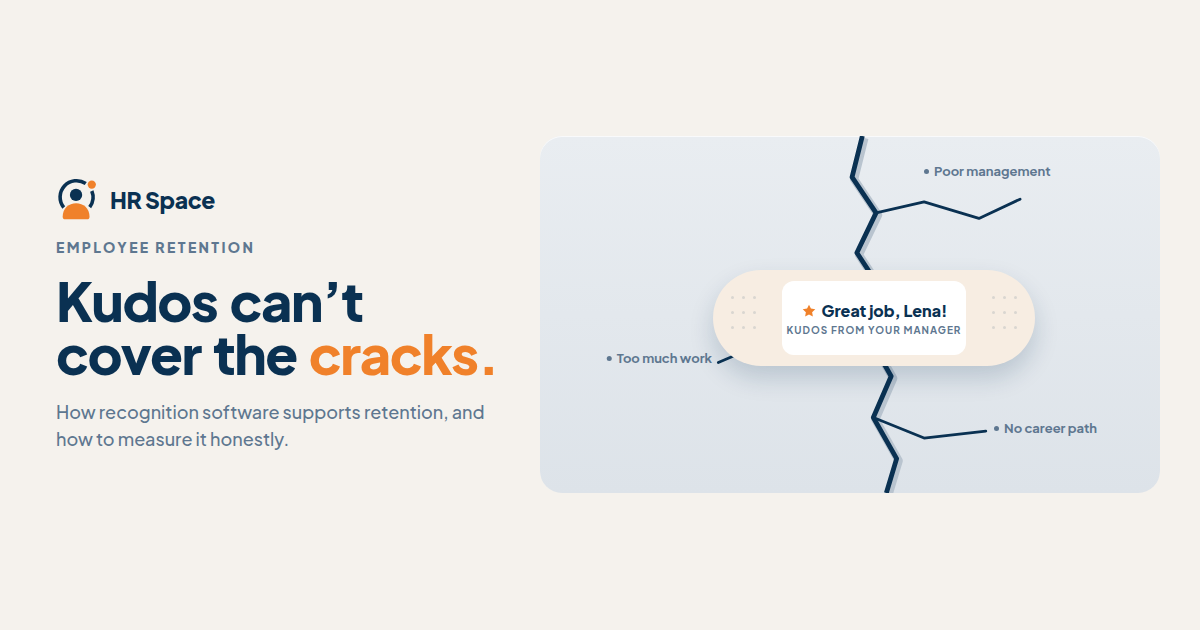
Employee recognition software can support employee retention when it helps managers acknowledge meaningful contributions consistently and fairly. However, software alone cannot solve poor management, excessive workloads, limited career opportunities, or other reasons employees leave.
For HR teams evaluating recognition tools in 2026, the important question is not simply whether employees receive more recognition. It is whether the recognition process addresses a real workplace concern and whether there is evidence of a better employee experience.
This guide explains what employee recognition software can change, how to evaluate its role in retention, and which indicators to track before deciding whether the investment is working.
Can Employee Recognition Software Improve Retention?
Yes, employee recognition software can support retention when it helps organizations build a more consistent and meaningful approach to appreciation. It is a support tool, not a guarantee that employees will stay.
In many growing companies, recognition depends on individual managers remembering to acknowledge good work. Contributions that are less visible, such as documentation, preparation, mentoring, and reliable follow-through, can receive less attention than major launches or public achievements.
Recognition software can give teams a defined place to acknowledge contributions. Its value, however, depends on how managers and employees use it.
Before selecting a product, identify the problem you want to address. Are employees saying their work goes unnoticed? Is recognition inconsistent across teams? Or are employees primarily concerned about workload, compensation, management, or career development?
The answer determines whether recognition software is likely to help.
For an overview of the available options, read our guide to employee recognition software.
Comparing recognition approaches
| Approach | Best suited for | Main consideration |
|---|---|---|
| Informal manager recognition | Teams building basic appreciation habits | Depends on managers remembering to acknowledge contributions |
| Dedicated recognition software | Teams that need a structured recognition process | Introduces another tool and process employees must adopt |
| Recognition within an HR platform | Teams evaluating recognition alongside other HR processes | Broader software capabilities do not automatically improve retention |
None of these approaches replaces effective management. Choose the approach that addresses your company's actual needs, then evaluate how employees experience it.
Why Employee Recognition Matters for Retention
Employee retention is influenced by more than one factor. Employees may leave because of workload, compensation, management practices, limited development opportunities, or a mismatch between their expectations and their actual responsibilities.
Recognition belongs in that broader picture, but it should not be treated as the answer to every retention problem.
If employees feel that their contributions are consistently overlooked, a more deliberate recognition process may address part of the problem. If they report unmanageable workloads, recognition will not resolve the underlying issue.
For companies with 20–100 employees, this distinction is especially important when planning HR improvements. A departure can reveal a problem with team management, workload distribution, role expectations, or career development.
Before introducing new software, document what employees need to experience differently. This helps your team evaluate whether the proposed solution addresses the original concern instead of simply measuring whether the software is being used.
What Employee Recognition Software Can Actually Change
Recognition software can support a structured appreciation process. The quality of that process depends on the behavior it encourages, the needs of employees, and the way managers apply it.
1. Make recognition specific and meaningful
A useful acknowledgment explains what someone did and why it mattered.
For example, thanking an employee for documenting a complicated handoff and helping another team understand the process is more informative than sending a generic message of appreciation.
Specific recognition helps employees understand which contributions are valued. Software can provide a place to record that acknowledgment, but managers remain responsible for making it relevant and sincere.
2. Recognize work that is easy to overlook
Not every valuable contribution is highly visible.
Preparation, documentation, mentoring, problem-solving, and reliable follow-through can keep a team operating effectively without attracting much attention.
Review whether recognition reaches employees who perform these responsibilities, not just those associated with visible launches or public-facing achievements.
Employee feedback can help identify gaps. If some employees consistently feel overlooked, investigate their experience before deciding how the recognition process should change.
3. Support more consistent management practices
Recognition can become inconsistent when it depends entirely on individual managers.
A defined process gives teams a clearer way to acknowledge contributions. However, introducing a tool does not guarantee that every manager will use it appropriately.
Set expectations for meaningful acknowledgment and review whether employees across different teams experience the process fairly. Software should support better management habits, not become a substitute for them.
4. Keep recognition separate from performance evaluations
Recognition and performance reviews have different purposes.
Recognition acknowledges a contribution. A performance review examines responsibilities, results, expectations, and development needs.
Both can contribute to the employee experience, but they should not be confused. A stream of positive messages is not a replacement for constructive feedback, and every acknowledgment does not need to become a performance rating.
Why Recognition Does Not Always Improve Retention
The relationship between recognition and retention depends on the problem being addressed and the way the program is managed.
Before treating recognition software as a retention initiative, consider the following factors.
The underlying employee concern. Determine whether employees are asking for more appreciation or raising concerns about compensation, workload, management, or career opportunities. Recognition should address the problem it is designed to solve.
Manager behavior. Software cannot replace a manager's understanding of an employee's work. Recognition should reflect real contributions rather than become a routine task performed simply to meet a target.
Fairness and visibility. Review whose contributions receive attention and whose work may be overlooked. Message volume alone does not establish that recognition is distributed fairly.
Employee preferences. Some employees appreciate public acknowledgment, while others prefer private thanks. Ask employees about their preferences instead of assuming everyone wants the same form of recognition.
Follow-through. Appreciation should not replace action on workplace concerns. Thanking someone for repeatedly handling an excessive workload does not make that workload sustainable.
Measurement. Software adoption, employee experience, and employee departures are different indicators. Track them separately to understand what has actually changed.
These factors are evaluation criteria, not promises of improved retention. A recognition program should continue only when the evidence supports its purpose and value.
How to Measure Whether Recognition Supports Employee Retention
To evaluate the impact of employee recognition software, measure the recognition process, employee experience, and employee departures separately.
An increase in recognition messages may show that employees are using the tool. It does not automatically show that employees feel more appreciated or are less likely to leave.
Use the following five steps to build a more reliable evaluation process.
Step 1: Establish a baseline
Document your current recognition practices before introducing a new process or tool.
Ask employees questions such as:
-
Do you feel that your contributions are acknowledged?
-
Does recognition feel fair across your team?
-
Do you receive useful feedback from your manager?
-
Do you feel comfortable sharing concerns about your work?
Record how your organization defines voluntary departures and which employees are included in the analysis.
Keep those definitions consistent throughout the evaluation. Also document relevant changes during the measurement period, including leadership changes, hiring, compensation adjustments, and other HR initiatives.
These factors provide context when interpreting the results.
Step 2: Measure recognition coverage
Review whether recognition reaches the employees and teams the program is intended to support.
A busy recognition feed tells you that messages are being created. It does not tell you whether recognition reaches employees across different roles, departments, and levels of visibility.
If the selected software provides suitable reporting, use it to examine participation and coverage. Otherwise, review the process using the information available to your team.
Treat repeated omissions as a reason to investigate, not automatic proof of unfair treatment. Discuss the pattern with managers and consider employee feedback before deciding what action is needed.
Step 3: Evaluate employee experience
Ask employees whether recognition feels specific, sincere, and relevant.
Use the same core questions before and after changing the process so that the results can be compared more consistently.
Review comments alongside survey responses. An employee may appreciate receiving recognition while still feeling that their workload is unreasonable or that their manager does not support their development.
These experiences can coexist.
Also check whether employees feel pressured to participate. Recognition should make appreciation easier and more meaningful, not create another obligation disconnected from everyday work.
Step 4: Track voluntary departures
Monitor voluntary departures using the definition established at the beginning of the evaluation.
Review exit feedback alongside employee survey results to understand why people leave. Avoid assuming that all departures have the same cause or that a change in turnover is necessarily the result of a recognition program.
For smaller teams, individual departures can have a noticeable effect on overall figures. Consider the context behind each departure while protecting employees' personal information and limiting access to sensitive feedback.
A quieter period may be encouraging, but it does not prove causation. Changes in management, compensation, staffing, or job responsibilities may also influence retention.
Step 5: Decide what the evidence supports
At the end of the evaluation, compare the results with the original problem.
If more employees are using the software, you have evidence of adoption. If employees report feeling more appreciated, you have evidence of a change in employee experience. If voluntary departures change, investigate whether the evidence supports a connection to the recognition initiative.
Do not combine these findings into a single success claim.
Use the results to decide whether to continue, adjust, or stop the program. A clear, limited conclusion is more useful than a broad claim that the available evidence cannot support.
What to Ask During an Employee Recognition Software Demo
Before choosing employee recognition software, ask vendors to demonstrate the workflows your employees and managers will actually use.
A feature list cannot tell you whether the product fits your team's working habits or whether the reporting answers your HR team's questions.
For example, ask the vendor to demonstrate a scenario in which a manager recognizes a contribution, an employee prefers private acknowledgment, and HR needs to review participation across teams.
Use the following checklist during the evaluation.
-
Employee effort: How easy is it for employees to give and receive recognition?
-
Manager workflow: How does recognition fit into existing management practices?
-
Visibility and preferences: Who can see an acknowledgment, and what privacy or visibility options are available?
-
Reporting: Which questions about participation and coverage can the product actually answer?
-
Administration: Who manages setup, permissions, and ongoing changes?
-
Software scope: Which recognition capabilities are included in the proposed subscription or module?
Do not assume that every recognition tool includes employee rewards, automated triggers, payroll integrations, or retention analytics. Ask the vendor to demonstrate or confirm each capability that matters to your decision.
The evaluation should also reflect your company's size and resources. A 20-person company may need to consider who will maintain the process alongside existing responsibilities. A 100-person company may need a clear way to review participation across multiple managers and teams.
These are practical evaluation questions, not universal thresholds for success.
Where HRSpace Fits
HRSpace is a modular cloud HR platform designed for growing teams evaluating employee recognition alongside other HR processes.
Its stated platform scope includes employee recognition, onboarding, time-off management, performance reviews, goals, recruitment, workflow automation, and an internal service desk.
For companies considering several HR improvements, evaluating recognition within a broader platform can help clarify which processes belong in the same purchasing decision.
However, a broader feature set is not evidence that recognition will reduce employee departures. Teams should assess the recognition workflow directly and confirm the capabilities, module scope, and commercial terms relevant to their requirements.
Do not assume that separate modules automatically share data or trigger actions without confirming the specific functionality.
If recruitment, onboarding, or performance management is also part of your project, evaluate those needs separately. Keep the recognition decision focused on meaningful appreciation, employee experience, and the management practices you intend to improve.
Can Recognition Software Replace a Retention Strategy?
No. Employee recognition software is one possible part of a retention strategy, not a replacement for effective management.
Employees also need clear expectations, manageable responsibilities, appropriate compensation, opportunities to develop, and a credible response when they raise concerns.
Use recognition to acknowledge contributions. Use management conversations and operational decisions to address the conditions surrounding those contributions.
A thank-you and a workload adjustment serve different purposes. Both may be important, but one cannot substitute for the other.
How Long Should You Measure the Results?
Measure recognition as an ongoing process rather than judging its impact from launch activity alone.
Choose review checkpoints that fit your existing HR processes and keep your measurement definitions consistent.
For example, if your company already conducts 90-day reviews, you can include questions about recognition and employee experience at that checkpoint. This creates an opportunity to collect feedback; it does not mean that retention improvements should necessarily appear within 90 days.
The appropriate evaluation period depends on your team's circumstances, the problem being addressed, and the evidence available.
What If Recognition Increases but Employees Still Leave?
Increased recognition and continued employee departures can happen at the same time.
The recognition process may be improving while the reasons employees leave remain unresolved. For example, employees may appreciate being acknowledged but still experience excessive workloads or limited career opportunities.
If departures continue, do not respond simply by encouraging more recognition messages.
Review employee feedback and exit information, identify the concerns that remain unresolved, and assign follow-up actions to the people responsible for addressing them.
The goal is not to maximize recognition activity. It is to understand whether the program improves the employee experience and whether the wider workplace conditions support retention.
Frequently Asked Questions
Can employee recognition software improve retention?
Employee recognition software can support retention when it helps organizations establish meaningful and fair acknowledgment practices. However, software adoption and increased recognition activity alone do not prove that fewer employees are leaving.
Is recognition software enough to stop employees from leaving?
No. Recognition software does not resolve workload, compensation, management, or career development concerns by itself. It should support a wider approach to employee experience and retention.
What is the best way to measure an employee recognition program?
Measure recognition coverage, employee experience, and voluntary departures separately. Keep definitions consistent and consider other workplace changes before attributing a retention result to recognition.
Should employee recognition always be public?
No. Recognition should reflect employee preferences. Some people prefer public acknowledgment, while others are more comfortable with private appreciation. Ask employees what works for them and verify which options the chosen software supports.
Is employee recognition software useful for a small company?
It can be useful when a company has a defined problem, such as inconsistent acknowledgment across teams. Smaller organizations should first establish the management practice they want to improve, then determine whether software is necessary to support it.
Does HRSpace include employee recognition?
Yes. HRSpace includes employee recognition within its modular cloud HR platform, alongside other HR functions. Evaluate the recognition workflow and relevant module scope against your team's requirements rather than assuming a particular retention outcome.
What should an employee recognition plan include in 2026?
A 2026 employee recognition plan should define what meaningful acknowledgment looks like, who owns the process, how employee preferences are considered, and how results will be measured. It should also explain how managers will respond to concerns that recognition alone cannot resolve.
Final Thoughts
A rise in recognition messages is evidence of activity, not proof of improved retention.
Before investing in employee recognition software, identify the workplace concern you want to address, establish a baseline, and decide how you will measure the employee experience. Track voluntary departures separately and consider other factors that may influence the results.
If you are evaluating HRSpace, assess employee recognition alongside the HR modules your company actually needs. Confirm the relevant capabilities and approve each part of the scope for a clear business reason.
The goal is not simply to recognize employees more often. It is to build a workplace where meaningful contributions are noticed and the concerns that influence employees' decisions to stay are taken seriously.
Related Guides
Ready to make HR the easy part?
Explore modular pricing and start a free 14-day trial.