Can AI Recruitment Software Reduce Time to Hire?
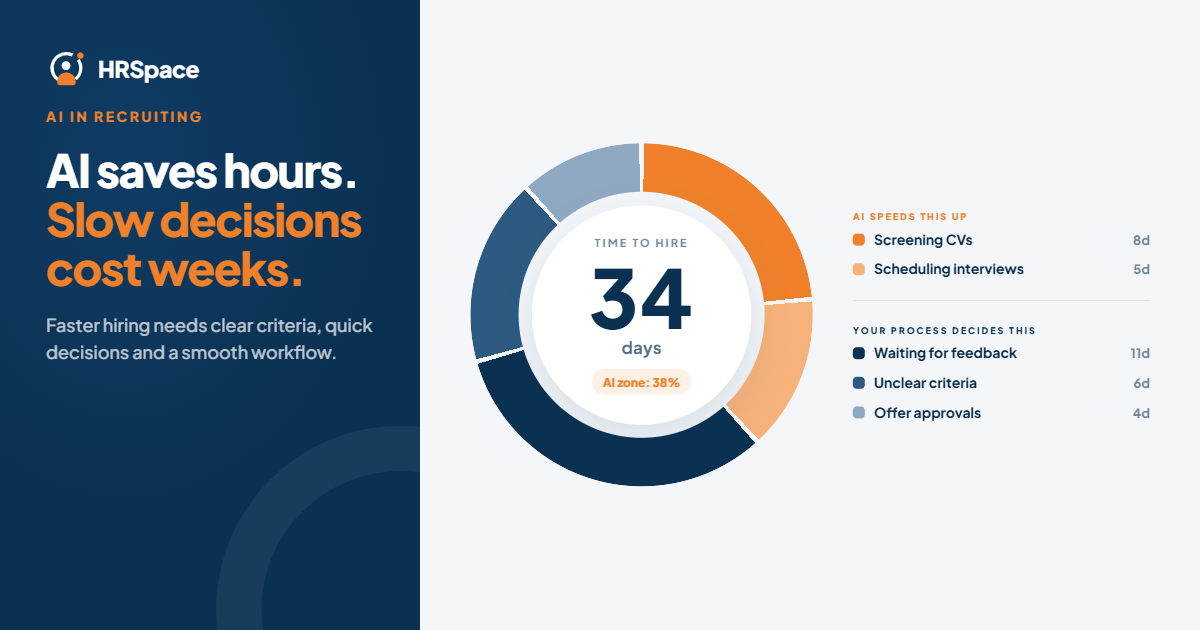
AI recruitment software can reduce time to hire when it helps remove delays from a specific stage of the hiring process. However, it cannot solve every bottleneck. Slow hiring manager decisions, unclear selection criteria, and delayed offer approvals still require process improvements.
For HR teams evaluating recruitment software in 2026, the key question is not how quickly AI generates content. It is whether the software helps candidates move through the hiring process faster without compromising hiring quality.
Key Takeaways
-
AI recruitment software can reduce time to hire when it addresses a genuine bottleneck.
-
Measure elapsed time at each hiring stage, not just task completion speed.
-
Workflow automation and AI assistance solve different problems and may complement each other.
-
Human oversight remains essential for candidate evaluation and final hiring decisions.
-
HRSpace combines AI recruitment with broader HR workflows, including onboarding and employee management.
Can AI Recruitment Software Reduce Time to Hire?
Yes, but the results depend on which part of recruitment the software improves.
Completing a task faster does not necessarily mean filling a position faster. AI may help prepare information or support repetitive recruitment tasks, while workflow automation can help move work between responsible people. Both can be useful, but neither guarantees a shorter hiring cycle.
Before selecting a solution, follow these steps:
-
Define time to hire. Use consistent start and end points, such as the candidate entering the hiring process and accepting the offer.
-
Identify bottlenecks. Track how long candidates spend at each stage and distinguish active work from waiting time.
-
Match features to delays. Evaluate whether the proposed AI or automation capability addresses the problem you identified.
-
Assign responsibility. Ensure every output and handoff has a clear owner.
-
Measure the results. Compare similar roles before and after implementation, accounting for other process changes.
This approach helps distinguish a promising product demonstration from a measurable improvement in recruitment.
AI Assistance vs. Recruitment Workflow Automation
AI assistance and workflow automation serve different purposes. AI can help produce or interpret information, while automation moves work according to defined rules.
| Approach | Best suited for | What to evaluate |
|---|---|---|
| Manual recruitment | Establishing a baseline | Existing tasks, delays, and decision ownership |
| AI-assisted recruitment | Repetitive information-related tasks | Accuracy, relevance, and review effort |
| Workflow automation | Handoffs and repeatable processes | Triggers, ownership, exceptions, and completion tracking |
Choose software based on the problem you need to solve, not simply the presence of AI features.
During a product demonstration, ask the vendor to show what happens after a task is completed. Who receives the output? Who makes the next decision? What happens if information is missing or an approval is delayed?
These questions reveal whether the software supports the complete process or only one isolated task.
Where Recruitment Delays Usually Occur
Before investing in AI recruitment software, examine the stages where candidates are waiting for progress.
-
Application review: Who evaluates applications against the agreed role requirements?
-
Interview coordination: How quickly are interviews arranged and confirmed?
-
Hiring decisions: How long does it take to collect feedback and reach a decision?
-
Offer approval: Which approvals are required before an offer can be sent?
-
Offer acceptance: How much time passes between sending the offer and receiving a response?
These checkpoints help identify where assistance or automation may be useful. They are not a guarantee that every recruitment platform supports every stage.
Ask vendors to demonstrate the relevant capabilities using a realistic hiring scenario. Include exceptions, such as incomplete information, conflicting feedback, or an unavailable decision-maker.
The goal is to identify the actual cause of delays before choosing a feature.
What Determines the Time Saved?
The impact of AI recruitment software depends on several factors.
Recruitment scope. Identify the specific task you want to improve. A broad feature list does not prove that a product supports your particular workflow.
Workflow ownership. Every task needs a responsible person and a clear next step. Faster output will not help if nobody acts on it.
Review requirements. Include the time needed to check and correct AI-generated output. Generation speed alone does not reflect the total effort involved.
Implementation effort. Evaluate the configuration, training, and process changes required before the software becomes useful.
Post-hire processes. Consider how recruitment connects with onboarding, while measuring these activities separately from time to hire.
A useful evaluation should answer three questions: What work will change? What work will remain? How will you measure the difference?
How to Measure Recruitment Efficiency
Time to hire should be measured alongside the effort and quality of the hiring process. Otherwise, faster candidate progression may hide additional review work or weaker decision-making.
| Metric | What it measures | Important limitation |
|---|---|---|
| Time to hire | Elapsed time from candidate entry to accepted offer | Does not prove software caused a change |
| Time in each stage | Where candidates spend time waiting or progressing | Does not explain the cause by itself |
| Preparation and review effort | Work required to produce usable recruitment output | Does not directly measure candidate progress |
| Corrections to AI output | How often assisted output requires changes | Does not establish that uncorrected output is accurate |
| Completed decision records | Whether decisions are documented | Does not prove selection criteria are appropriate |
Compare equivalent roles whenever possible. Different job requirements, interview structures, and approval processes can affect results.
For a pilot, define success criteria before implementation. Decide which stage should improve, what reviewers must check, and what evidence would justify continuing or stopping the test.
This makes it easier to evaluate whether the software contributes to a real improvement rather than simply changing how recruiters work.
Where HRSpace Fits
HRSpace is a cloud-based HR platform for teams evaluating AI recruitment alongside broader employee lifecycle management.
Its stated platform scope includes onboarding, time-off management, performance reviews, goals, recognition, workflow automation, and an internal service desk. The platform uses a modular, per-employee pricing model, with current pricing depending on the selected scope.
This broader coverage may be relevant to growing HR and People Operations teams that want to evaluate recruitment alongside the processes that follow a new hire.
However, platform coverage alone does not establish a reduction in time to hire or prove that specific modules connect automatically. Ask for a demonstration of the recruitment capabilities you need and the handoffs your team wants to improve.
Explore the HRSpace platform to assess whether its available features match your team's requirements.
You can also review the AI recruitment to first-day onboarding workflow to consider how recruitment and onboarding fit into the wider employee lifecycle.
Frequently Asked Questions
Can AI recruitment software reduce time to hire for a small team?
Yes, if it addresses a task or delay that is slowing candidate progression. Start by identifying the bottleneck, then measure whether the software improves that stage after accounting for review effort.
What should I measure before buying AI recruitment software?
Track time to hire, elapsed time in each recruitment stage, and the effort required to prepare and review recruitment output. Use consistent measurement rules before and after implementation.
Is AI recruitment the same as hiring workflow automation?
No. AI assistance helps produce or interpret information, while workflow automation moves work according to defined rules. Some platforms offer both, but their specific capabilities should be verified.
Will AI recruitment software replace hiring managers?
AI should support the recruitment process rather than remove accountability for hiring decisions. Human reviewers should remain responsible for selection criteria, appropriate evaluation, and final decisions.
Can HRSpace support both recruitment and onboarding?
HRSpace's stated platform scope includes AI recruitment and onboarding. Ask the team to demonstrate the specific capabilities and handoffs relevant to your process rather than assuming that every module connects automatically.
How can I verify a vendor's time-saving claims?
Ask which task or stage was measured, how the comparison was conducted, and whether review effort was included. Compare equivalent roles and consider other changes made to the recruitment process.
Should onboarding count toward time to hire?
Not if your chosen definition ends when the candidate accepts the offer. Track onboarding readiness separately so recruitment speed and post-hire preparation remain distinct measures.
Final Thoughts
The best way to evaluate AI recruitment software is to start with the delay that matters most to your team.
Identify where candidates wait, determine whether AI assistance or workflow automation addresses the cause, and define how you will measure the outcome. Keep human oversight in place and evaluate hiring quality alongside speed.
This gives your team a practical basis for deciding whether a recruitment solution improves the hiring process, rather than simply adding another tool.
Related Guides
Ready to make HR the easy part?
Explore modular pricing and start a free 14-day trial.