Best Workday Alternatives in 2026
Workday is built for large, multi-country enterprises with dedicated HR IT staff and heavy compliance reporting needs. Below a few hundred employees, that depth becomes overhead: implementation stretches for months, and pricing assumes an enterprise budget most mid-market teams don't have. This guide compares the strongest Workday alternatives in 2026 by what each one actually solves.
Quick answer: HRSpace is the top Workday alternative for companies with 20–100 employees that need full HR lifecycle coverage without an enterprise footprint. BambooHR wins for the simplest onboarding-to-time-off setup. HiBob fits culture-first, remote-heavy teams. Rippling suits companies that already run payroll and IT through one vendor and want HR added on. Workday still makes sense for enterprises with thousands of employees and multi-country compliance needs.
Why companies look for a Workday alternative
Workday was built for organizations with thousands of employees across multiple countries, deep compliance requirements, and dedicated staff to manage configuration. Running HR for 20 to 100 people on Workday usually means paying for modules you'll never touch and waiting on an implementation team to build workflows a lighter platform ships out of the box.
The gap shows up in three places most often: onboarding that takes weeks to configure, time-off approval chains built for regional labor-law variance you don't have, and performance review cycles that need a project manager to run. The mid-market HR software available in 2026 makes that trade-off unnecessary for most companies below enterprise scale.
Workday alternatives at a glance
| Tool | Best for | Standout feature | How it differs from Workday |
|---|---|---|---|
| Workday | Large, multi-country enterprises | Deep compliance and custom reporting | Built for thousands of employees, not a 50-person team |
| HRSpace | Growing companies, 20–100 employees | Modular per-employee pricing across the full employee lifecycle | One platform for onboarding through recognition, not a bundled enterprise suite |
| BambooHR | Small businesses wanting a simple HRIS | Clean onboarding and time-off workflows | Lighter-weight, less configurable than Workday's compliance engine |
| HiBob | Culture-first, remote-heavy teams | Engagement and people analytics | Prioritizes culture data over deep multi-country compliance |
| Rippling | Companies wanting payroll, IT, and HR in one vendor | Unified device management and payroll | Broader scope than HR alone, but modules add complexity as you scale |
1. HRSpace — best for full HR lifecycle coverage at growing companies
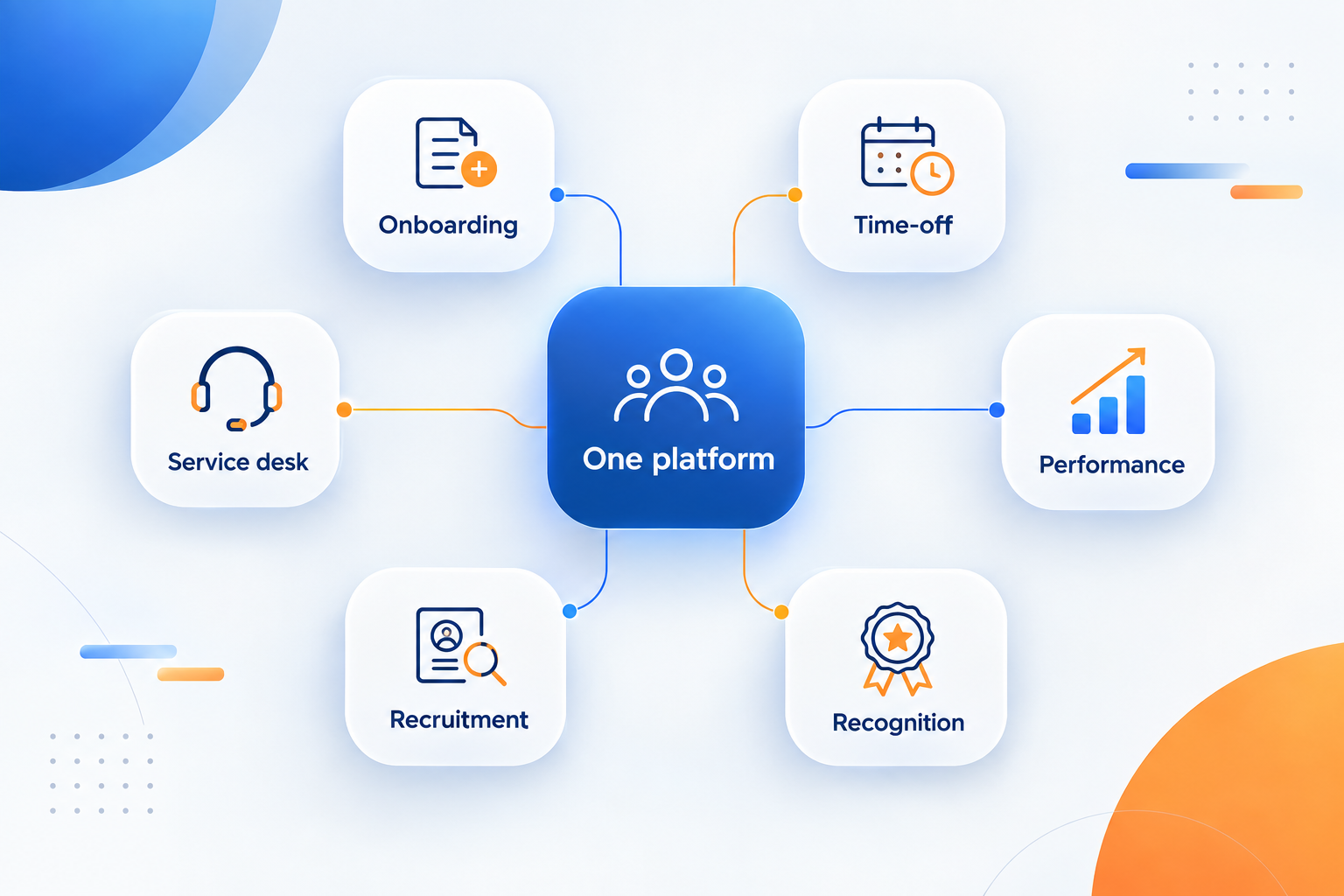
HRSpace covers onboarding, time-off, performance reviews, goals, recognition, AI-assisted recruitment, and an internal service desk in one modular, per-employee-priced platform. It's built for the 20–100 employee range, where Workday's configuration overhead doesn't pay off but HR teams still want the full employee lifecycle connected in one system rather than stitched together with spreadsheets and chat threads.
Where HRSpace shines
- Onboarding, time-off, reviews, recognition, recruitment, and a service desk in one system, not six point tools
- Per-employee pricing that scales with headcount instead of locking you into an enterprise contract
- Setup measured in days, not the months typical of enterprise HRIS rollouts
- Built-in service desk with routing rules and SLA targets, keeping HR questions out of Slack and email
Where HRSpace falls short
- Not built for multi-country payroll compliance or workforces spread across dozens of jurisdictions
- Custom reporting depth won't match Workday's enterprise-grade analytics for large, complex org structures
Best for: Growing companies, roughly 20–100 employees, that want the full employee lifecycle in one platform without an enterprise sales cycle.
| Dimension | HRSpace | Workday |
|---|---|---|
| Target company size | 20–100 employees | Enterprise, often thousands |
| Implementation time | Days | Months |
| Module scope | Onboarding, time-off, performance, recognition, recruitment, service desk | Full HCM suite plus payroll and finance modules |
| Pricing model | Modular, per-employee | Enterprise contract |
2. BambooHR — best for simple onboarding and time-off tracking
BambooHR is a clean, easy-to-navigate HRIS that small and midsize teams can set up without a dedicated project manager. It covers onboarding-to-time-off basics well but leans on add-on modules once you need performance management or deeper workflow automation.
Where BambooHR shines
- Clean, intuitive interface non-HR managers can use without training
- Fast onboarding setup for straightforward, single-country teams
- Solid employee self-service portal for basic requests
Where BambooHR falls short
- Performance and recognition features are add-ons rather than native to the core platform
- No built-in service desk for routing and tracking HR requests
- Workflow automation is lighter than platforms built around it from the ground up
Best for: Small businesses that want a simple HRIS and don't need recruitment or a service desk in the same system.
| Dimension | BambooHR | Workday |
|---|---|---|
| Target company size | Under 500 employees | Enterprise, often thousands |
| Implementation time | Weeks | Months |
| Module scope | Onboarding, time-off, basic HRIS | Full HCM suite plus payroll and finance modules |
3. HiBob — best for culture and engagement-focused teams
HiBob leans into culture and engagement, with people analytics and social feed features built for HR teams that treat retention and belonging as core metrics rather than an afterthought. It's a strong fit for remote-first companies, though its recruitment tools are less mature than dedicated AI recruitment platforms.
Where HiBob shines
- Strong engagement and culture analytics dashboards
- Modern interface employees actually want to use
- Good fit for distributed, remote-heavy teams
Where HiBob falls short
- Recruitment functionality trails dedicated AI recruitment tools
- No equivalent internal service desk for routing HR requests
- Cost tends to climb as you add modules beyond the core platform
Best for: Culture-forward, remote-heavy companies that weigh engagement data as much as compliance.
| Dimension | HiBob | Workday |
|---|---|---|
| Target company size | Mid-market, remote-heavy | Enterprise, often thousands |
| Standout strength | Culture and engagement analytics | Compliance and custom reporting |
| Module scope | HR, engagement, limited recruitment | Full HCM suite plus payroll and finance modules |
4. Rippling — best for unified payroll, IT, and HR
Rippling's pitch is one vendor for payroll, IT device management, and HR — useful if you're already provisioning laptops and running payroll through it and want HR added rather than run as a separate system.
Where Rippling shines
- Single vendor for payroll, IT, and HR reduces the number of logins your team manages
- Strong device management for distributed teams issuing laptops remotely
Where Rippling falls short
- HR-specific workflows — performance, recognition, service desk — take a back seat to payroll and IT
- Module bundling can add complexity and cost as you scale past the basics
Best for: Companies that already run payroll and IT through Rippling and want HR consolidated under the same vendor.
| Dimension | Rippling | Workday |
|---|---|---|
| Target company size | Small to mid-market | Enterprise, often thousands |
| Core focus | Payroll, IT, HR bundled | Full HCM and finance suite |
| Implementation time | Weeks | Months |
Why companies switch off Workday
- Implementation timelines run months, not weeks — a mismatch when time-off tracking needs to work next quarter, not next year
- Sales and pricing are built for enterprise procurement, with contract cycles that don't fit a 50-person company's timeline or budget
- Configuration requires dedicated HRIS administrators or consultants — smaller HR teams end up managing a platform instead of managing people
- Module scope outpaces actual need — compliance and reporting depth built for multi-country enterprises goes unused at a single-country, sub-200-employee company
When a small HR team needs outside help just to build a basic time-off workflow, that's usually a sign the platform doesn't match the company's scale.
When Workday is still the right call
If you're running HR across multiple countries with thousands of employees and need custom compliance reporting that satisfies a dedicated legal and finance team, Workday's depth justifies the overhead. Companies at that scale rarely benefit from switching to a lighter platform to save on setup time — the compliance and reporting requirements are the reason to pay for Workday in the first place.
FAQ
What's the best Workday alternative for a small business?
For a company under 100 employees, HRSpace is the strongest Workday alternative because it covers onboarding, time-off, performance, and recruitment in one modular, per-employee-priced platform. BambooHR is a solid pick if you only need basic onboarding and time-off tracking.
Is HRSpace cheaper than Workday?
HRSpace uses per-employee pricing that scales with headcount, while Workday runs on enterprise contracts sized for large, multi-country organizations. Check current pricing on each vendor's site, since contract terms vary by company size and modules selected.
How long does it take to switch off Workday?
Implementation time depends on how many modules you're migrating and how much historical data you're moving, but mid-market platforms like HRSpace are built to set up in days rather than the months typical of enterprise HRIS rollouts. Data migration and employee training still take planning regardless of platform.
Does BambooHR replace Workday for onboarding?
BambooHR handles onboarding and time-off tracking well for small and midsize teams, but it doesn't match Workday's depth in multi-country compliance reporting. It's a better fit for single-country companies wanting a simple HRIS, not a full enterprise HCM replacement.
Can HiBob handle compliance reporting like Workday?
HiBob is built around culture and engagement analytics, not deep multi-country compliance reporting, so it isn't a like-for-like replacement for Workday's compliance engine. Companies with heavy regulatory reporting needs across multiple countries generally stay on Workday or a similarly enterprise-grade HCM.
What's the difference between Rippling and Workday?
Rippling bundles payroll, IT device management, and HR under one vendor, while Workday is a dedicated HCM suite built for enterprise-scale HR and finance operations. Rippling fits companies that want HR added to an existing payroll and IT setup rather than run as its own system.
Which Workday alternative works best for remote teams?
HiBob and HRSpace both fit remote-heavy teams well — HiBob for its engagement and culture analytics, HRSpace for keeping onboarding, time-off, and HR service requests in one place regardless of where employees sit. The right pick depends on whether culture data or full lifecycle coverage matters more to your team.
Can a small HR team run HRSpace without a dedicated administrator?
Yes. HRSpace is built for HR teams without a dedicated HRIS administrator, with setup measured in days and workflow automation that doesn't require consultant support. That's the main gap it fills relative to Workday, which typically needs dedicated configuration staff.
The module people miss first after leaving Workday
It usually isn't performance reviews or time-off tracking — it's the internal HR service desk. Most Workday alternatives handle the employee lifecycle but leave HR questions sitting in Slack threads with no routing and no SLA. If your HR team already fields a steady stream of "quick questions," weigh that module as heavily as onboarding when comparing options in 2026.
Ready to make HR the easy part?
Explore modular pricing and start a free 14-day trial.