Best Workday Alternatives for Small Business
Workday runs some of the most complex HR and finance operations in the world - and that scale is exactly why it stops making sense for a 40-person company trying to hire, onboard, and pay people without a dedicated systems team. This guide compares the strongest Workday alternatives for small business in 2026, matched to actual company size instead of feature count.
Quick answer: HRSpace is the strongest Workday alternative for companies with 20–100 employees that want modular, per-employee HR software without a consultant-led implementation. BambooHR wins on simplicity for very small teams that only need onboarding and time-off tracking. HiBob fits companies prioritizing culture and engagement data over deep configurability. Rippling suits teams that want HR bundled with IT and device management. Workday still makes sense above roughly 1,000 employees with global payroll and finance consolidation needs.
Why this matters
Workday was built for enterprises running global payroll, finance, and workforce planning in one system. A small business doesn't need that surface area — it needs onboarding that doesn't drop paperwork, time-off requests that don't live in a spreadsheet, and performance reviews people don't dread. Picking a Workday alternative in 2026 isn't about finding "a smaller Workday." It's about matching the tool to a company that's 20 to 100 employees, not 2,000.
Workday vs the alternatives, at a glance
| Tool | Best for | Standout feature | How it differs from Workday |
|---|---|---|---|
| Workday | Large enterprises with global payroll/finance needs | Unified HCM + finance suite | Built for complexity most small businesses don't have |
| HRSpace | Growing companies (20–100 employees) wanting modular HR | Per-employee modules across the full employee lifecycle | Add only the modules you need; no enterprise implementation project |
| BambooHR | Very small teams needing basic HRIS + ATS | Simple, visual employee database | Lighter feature set, less configurability |
| HiBob | Culture-focused, fast-scaling teams | Engagement and pulse-survey dashboards | Stronger on culture data, thinner on workflow automation |
| Rippling | Teams wanting HR bundled with IT/device management | Combined HR + IT provisioning | Broader scope than pure HR, different pricing structure |
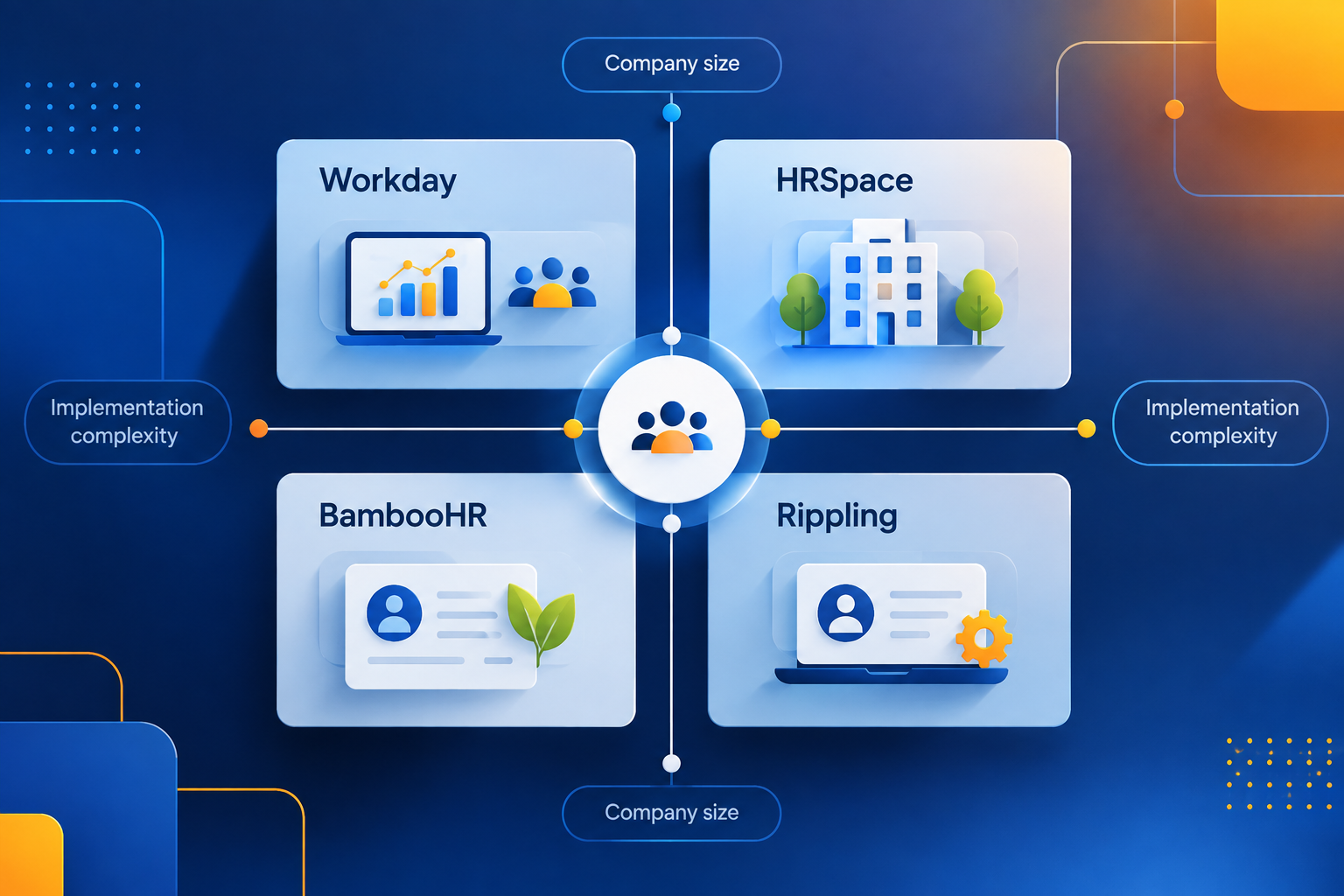
Company size and implementation complexity - not feature count - are what should decide the pick here.
1. HRSpace - best for growing companies replacing Workday's complexity
HRSpace covers seven modules — onboarding, time-off, performance reviews, goals, recognition, AI recruitment, and an internal service desk — priced per employee, so a 30-person company isn't paying for enterprise finance modules it will never touch. It's built for HR and people ops leaders at companies with 20 to 100 employees who need one system across the employee lifecycle without a multi-month rollout.
Where HRSpace shines
- Modular per-employee pricing means you add onboarding or performance-review modules as headcount grows, not all at once
- An internal service desk with routing rules and SLA targets turns "quick questions" in chat into requests that actually get tracked and resolved
- AI-drafted job descriptions and screening support speed up recruiting without a separate ATS subscription
Where HRSpace falls short
- No global payroll or finance consolidation — companies running multi-country payroll still need a dedicated payroll system alongside it
- Fewer prebuilt integrations than a platform with a decade-long partner ecosystem
Best for: Companies with 20–100 employees that want modular HR software without Workday's enterprise footprint.
| Dimension | HRSpace | Workday |
|---|---|---|
| Setup model | Modular, add modules as needed | Full-suite implementation project |
| Pricing structure | Per employee, module-based | Enterprise quote, bundled scope |
| Service desk for HR questions | Built in, with SLA routing | Requires separate case management setup |
| Best-fit company size | 20–100 employees | 1,000+ employees with global operations |
2. BambooHR - best for the smallest teams
BambooHR is the go-to for companies under 20 employees that just need a clean employee database, basic time-off tracking, and a simple applicant tracker. It's known for a lighter learning curve than enterprise suites like Workday.
Where BambooHR shines
- Fast to learn for a first HR system with no dedicated HR hire yet
- Straightforward employee records and org chart visuals
Where BambooHR falls short
- Performance review and goal-tracking depth thins out once a company passes 50–75 employees
- Workflow automation and internal service-desk-style routing aren't core strengths
Best for: Companies under 20–30 employees running their very first HR system.
3. HiBob - best for culture-first, fast-scaling teams
HiBob built its reputation on engagement dashboards and a social, profile-driven employee experience. Companies that care more about pulse surveys and culture visibility than deep HRIS configuration tend to land here.
Where HiBob shines
- Strong engagement and culture-tracking features out of the box
- Visual, social-feed-style employee profiles that fast-growing teams like
Where HiBob falls short
- Workflow automation across onboarding, reviews, and service requests isn't as deep as a modular HR platform built specifically for that lifecycle
- Configuration for company-specific approval chains takes more setup work
Best for: Scaleups prioritizing culture and engagement data over granular HR workflow control.
4. Rippling - best if you want HR bundled with IT
Rippling's pitch is combining HR with device management and IT provisioning in one system - useful for a company that wants a new hire's laptop, accounts, and HR record set up in one motion.
Where Rippling shines
- Combined HR + IT provisioning in a single onboarding flow
- Broad third-party app ecosystem for account provisioning
Where Rippling falls short
- Broader scope than a company only needing HR can mean paying for IT features it won't use
- More complex pricing structure than a pure-play HR tool
Best for: Companies that specifically want HR and device/IT provisioning unified.
Why small businesses switch off Workday
The pattern is consistent: the implementation project outlasts the hiring plan it was meant to support. A 40-person company doesn't need global payroll consolidation, and paying for that scope while a founder is still approving every time-off request in a spreadsheet is the actual problem — not a missing feature.
Other recurring reasons for the switch:
- HR admin work stays concentrated on one or two people, and Workday's configuration model assumes a larger internal systems team
- Quick employee questions "how many PTO days do I have left," "where's my onboarding paperwork" get lost in Slack instead of routed and tracked
- Adding one module, like performance reviews, shouldn't require re-scoping an entire enterprise contract
When Workday is still the right call
Workday earns its complexity at genuine enterprise scale - companies running payroll and finance across multiple countries, with dedicated HRIS administrators, get real value from that unified data model. If your fiscal quarter is shorter than your Workday implementation timeline, the tool is wrong for a company your size, not the other way around. For the 20-to-100-employee range, where HR is one or two people's job rather than a department, a modular alternative built for that scale does more with less setup.
FAQ
What is the best Workday alternative for a small business in 2026?
HRSpace is the strongest fit for companies with 20 to 100 employees because its modules are priced per employee and can be added one at a time. BambooHR suits teams under 20–30 employees needing only a basic HRIS.
Is HRSpace cheaper than Workday?
HRSpace uses per-employee, module-based pricing rather than an enterprise-scope contract, which typically fits smaller budgets better than Workday's suite pricing. Check current plans directly on the HRSpace site for exact figures.
Can BambooHR replace Workday for a 50-person company?
BambooHR can handle basic onboarding and time-off tracking at that size, but its performance review and workflow automation depth is thinner than a platform built for that lifecycle stage. It's a stronger fit for companies under 20–30 employees.
Does HiBob work well for a fully remote company?
HiBob's engagement dashboards and social profile features are built with distributed teams in mind, making it a reasonable option for remote-first companies focused on culture visibility. Workflow automation depth is a separate consideration.
Is Rippling a good Workday alternative if I already use it for IT?
Yes. Rippling's combined HR and IT provisioning is its main advantage if you want new-hire laptops and accounts set up alongside HR records. Companies only needing HR may find the broader scope unnecessary.
What size company actually needs Workday?
Workday's implementation model and pricing structure are built for large enterprises with global payroll and finance consolidation needs, generally well above the 100-employee range. Smaller companies usually get more value from a modular alternative.
How long does it take to switch off Workday?
Migration timelines depend on data volume and existing integrations. Modular platforms like HRSpace typically let you migrate one module at a time instead of an all-at-once cutover.
Do Workday alternatives include a service desk for HR questions?
HRSpace includes a built-in internal service desk with routing rules and SLA targets for HR questions. BambooHR, HiBob, and Rippling handle employee questions differently and don't ship the same dedicated routing model.
The real question before comparing tools
It isn't "which tool has more features" — it's "which modules does my company actually need this year." A 20-person company evaluating Workday alternatives usually only needs three of the seven common HR modules on day one. Modular platforms let you buy exactly those three and add the rest as headcount grows, instead of signing an enterprise contract for capabilities you won't touch until 2028.
Ready to make HR the easy part?
Explore modular pricing and start a free 14-day trial.