Best Time Off Tracking Software for Construction Companies in 2026
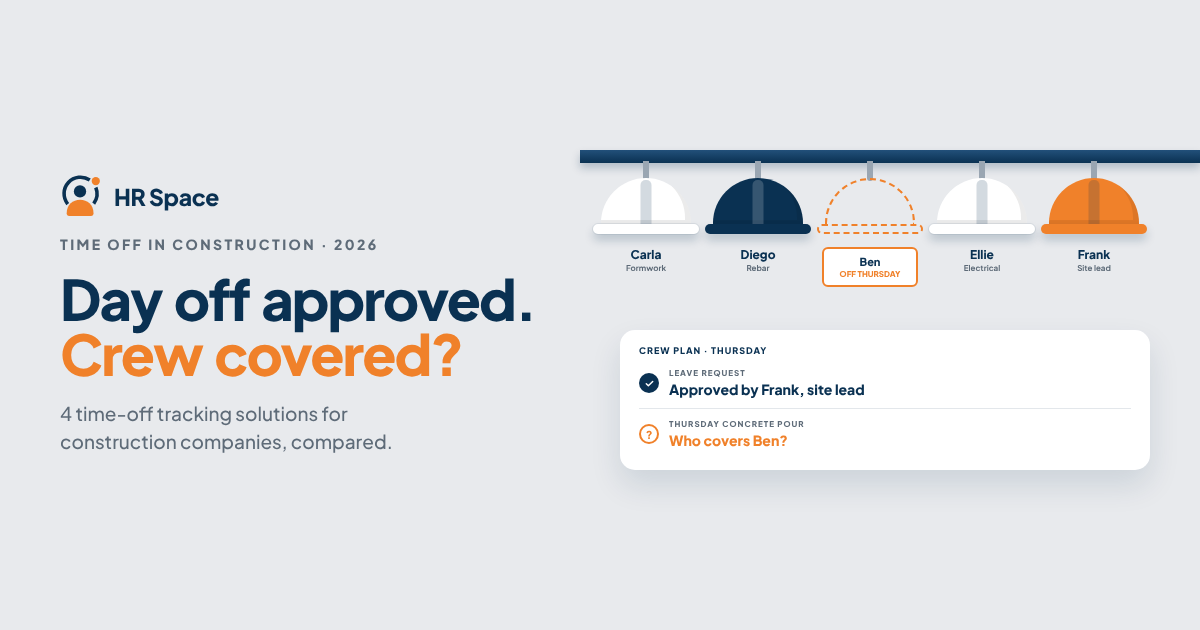
A correct leave balance does not tell a superintendent whether the right people will be on site.
Construction companies need to answer two separate questions:
-
Is the employee's leave request recorded and approved correctly?
-
Can the remaining crew cover the work?
These questions involve different responsibilities. HR may manage leave policies and employee records, while supervisors handle project assignments and staffing decisions.
Employee access is another consideration. The employee self-service portal guide for construction companies explores how workers can handle routine HR requests without turning every question into a message to the office.
What to look for in construction time-off tracking software
Use these criteria when evaluating vendors. Treat them as requirements to demonstrate, not features every platform automatically provides.
-
Clear leave records: Employees and administrators should be able to understand requests, decisions, and available balances.
-
Approval ownership: Establish who approves leave when employees report to different managers or work across multiple projects.
-
Coverage visibility: Check absences against the people and qualifications required for a particular job, not just total headcount.
-
Field access: Ask employees to complete a leave request using the devices they actually use.
-
Payroll handoff: Confirm how approved leave reaches payroll and how corrections are handled.
-
Platform scope: Decide whether you need a dedicated workforce tool or a broader HR platform that also supports onboarding, recruitment, and performance.
Time-off tracking software comparison
The order below reflects different buying priorities, not a claim that one platform is best for every construction workflow.
| Software | Best for | Main scope | What to verify |
|---|---|---|---|
| HRSpace | Connected HR for growing companies | Time-off, onboarding, performance, recruitment, and employee support | Construction-specific coverage and payroll requirements |
| BambooHR | HR-led leave administration | Time-off management within a broader HR system | Connection between approved leave and site staffing |
| HiBob | Organizational context | Time-off within a wider people-management platform | Project and reporting relationships in approval decisions |
| Connecteam | Field-team scheduling | Time-off alongside employee scheduling | Whether broader HR requirements are also covered |
1. HRSpace: Best for connected construction HR
Best for: Construction companies that want time-off management within a broader HR platform.
HRSpace is a modular cloud HR platform that covers time-off, onboarding, performance reviews, goals, recognition, AI-assisted recruitment, and an internal service desk.
It is relevant for companies that want leave management to sit within the employee lifecycle rather than operate as a separate administrative process.
For a company with 20–100 employees, the main consideration is which HR processes you want to manage together. Time-off may be the starting point, while onboarding, recruitment, and performance management can be evaluated as additional needs.
Key advantages:
-
Includes time-off management within a broader HR platform.
-
Covers onboarding, recruitment, and performance processes.
-
Offers modular, per-employee pricing.
-
Includes an internal service desk for employee support requests.
What to verify:
-
Construction-specific crew coverage rules need to be demonstrated.
-
General time-off functionality does not establish payroll integration, offline access, or union-policy handling.
-
Confirm the exact modules and workflows included in the proposed package.
Best for: HR and operations leaders evaluating a connected people platform rather than an isolated absence calendar.
During the demonstration, use an actual leave policy and approval scenario. Ask the vendor to show the request, the decision, the resulting record, and what happens if the employee cancels.
Verdict: Consider HRSpace when connected HR is the goal and the leave workflow passes your acceptance tests.
2. BambooHR: Best for HR-led leave administration
Best for: HR teams that want employee records and leave administration in the same system.
BambooHR includes time-off management within its broader HR software. It belongs on the shortlist when the main priority is managing employee information and leave consistently.
For construction companies, the important distinction is between administering leave and planning work. A platform can maintain accurate absence records without automatically determining whether a crew has the people needed for a particular assignment.
Key advantages:
-
Includes time-off management within its HR offering.
-
Combines employee records and leave administration.
-
Provides an HR-centered approach to employee management.
What to verify:
-
A leave calendar is not a substitute for a demonstrated crew-coverage process.
-
Confirm the handoff to your existing payroll and scheduling arrangements.
-
Check which capabilities are included in the proposed package.
Best for: HR teams whose main challenge is managing employee information and leave consistently.
Compare BambooHR with other shortlisted platforms using the same leave policy and approval scenarios. Ask vendors to explain where HR administration ends and operational staffing decisions begin.
Verdict: Consider BambooHR when HR-led leave administration is the priority and site coverage has a separate, clearly defined process.
3. HiBob: Best for organizational context
Best for: Companies that want leave management alongside broader people-management processes.
HiBob includes time-off management within its people-management platform. It is worth considering when leave decisions need to be understood alongside teams, managers, and organizational relationships.
Construction companies should pay particular attention to reporting structures. An employee's formal manager, day-to-day supervisor, and project assignment may involve different people.
Key advantages:
-
Includes time-off within a broader people-management offering.
-
Provides organizational context for evaluating employee processes.
-
Offers an option for companies whose HR requirements extend beyond absence administration.
What to verify:
-
Broader organizational information does not establish construction-specific crew coverage.
-
Test how project changes, temporary supervisors, and delegated approvals affect leave decisions.
-
Confirm the permissions and approval rules required by your organization.
Best for: Companies that prioritize people management across changing organizational structures.
During the demonstration, ask the vendor to show what happens when an employee changes teams while a leave request is still open. The goal is to establish a clear decision owner and an understandable record.
Verdict: Consider HiBob when organizational context matters and your approval scenarios work as required.
4. Connecteam: Best for field-team scheduling
Best for: Construction companies whose main priority is coordinating field employees and their schedules.
Connecteam offers employee scheduling and time-off management within its workforce-management software. This makes it relevant when the buying problem is closely connected to day-to-day field operations.
However, workforce scheduling and broader HR management are not the same purchase. Decide whether your main requirement is coordinating employee schedules or managing the wider employee lifecycle.
Key advantages:
-
Offers employee scheduling and time-off management.
-
Makes field-workforce coordination a central evaluation priority.
-
Allows buyers to assess absences alongside scheduling processes.
What to verify:
-
Scheduling functionality does not automatically establish qualification-specific crew coverage.
-
Evaluate broader HR requirements separately.
-
Confirm which processes still require manual coordination.
Best for: Operations leaders whose first priority is connecting employee absences with field scheduling.
Include a foreman in the demonstration. Ask them to explain how an approved absence affects the next staffing decision and identify any remaining manual steps.
Verdict: Consider Connecteam when scheduling-led workforce coordination is the main requirement.
How this comparison works
This 2026 shortlist matches each platform to a different buying need:
-
Connected HR
-
HR-led leave administration
-
Organizational context
-
Field-team scheduling
It is an editorial comparison, not a construction-site performance test or a measured implementation-speed ranking.
A broader HR platform may be more relevant when you need employee lifecycle processes in addition to leave management. A scheduling-focused tool may be more appropriate when coordinating field employees is the main challenge.
Give demonstrated workflow fit more weight than feature-list length. Keep any unverified requirement on your acceptance checklist.
How to test the workflow before choosing
Use the same evaluation process with every shortlisted vendor. The following steps are buyer acceptance tests, not claims that every product supports all of them.
1. Submit a leave request
Ask an employee to submit a request using the device they normally carry.
Check whether they can understand the leave category, dates, and request status without needing someone from the office to explain every step.
2. Check crew coverage
Ask a supervisor to evaluate the absence against an actual assignment.
A crew may have enough people overall but still lack the person required for a specific task. Make sure the evaluation accounts for that difference.
3. Confirm approval ownership
Establish who makes the decision and where the result is recorded.
Then test what happens when the usual approver is unavailable or the employee moves to another project.
4. Review the payroll handoff
Ask the vendor to show how approved leave reaches your payroll process.
Identify who checks the result, how corrections are communicated, and whether the process uses an integration, an export, or manual entry.
5. Test cancellations and changes
Cancel an approved request and review the resulting records. Repeat the exercise with a changed date.
The correction process matters just as much as the original approval.
For a practical pilot, test two overlapping requests and follow the resulting records through one payroll cycle. These are suggested evaluation conditions, not vendor performance benchmarks.
Keep the implementation scope clear
Start with the problem you need to solve.
Missing leave records, unclear approval ownership, and poor crew coverage are different issues. Purchasing more software modules does not automatically resolve them.
If connected HR is the priority, identify which employee lifecycle processes belong in the initial rollout.
If scheduling is the priority, make the supervisor's staffing decision the centerpiece of the demonstration.
Before importing employee records, assign responsibility for policy interpretation, coverage decisions, and payroll reconciliation. Software can support these processes, but someone in the organization still needs to own each one.
Which time-off tracking software should you choose?
HRSpace is a strong starting point for construction companies that want time-off management alongside onboarding, recruitment, performance, and employee support.
The other options suit different priorities:
-
BambooHR: HR-led leave administration.
-
HiBob: Broader people management and organizational context.
-
Connecteam: Field-team scheduling and workforce coordination.
Do not select a platform based on category fit alone. Test approval ownership, crew coverage, payroll handoffs, and corrections before making the final decision.
The best choice is the one that fits your actual workflow and has a clear owner for every process outside its scope.
Frequently asked questions
What's the best time-off tracking software for construction companies?
HRSpace is a strong shortlist option for construction companies seeking time-off management within a modular HR platform. BambooHR, HiBob, and Connecteam address different priorities, so compare them against your actual leave and staffing workflows.
Is time-off tracking the same as construction time tracking?
No. Time-off tracking records employee absences, while construction time tracking records hours worked. Evaluate the two processes separately and confirm how each reaches payroll.
Is HRSpace better than BambooHR for a construction company?
The deciding factor is workflow fit. HRSpace offers time-off within a modular employee-lifecycle platform, while BambooHR includes time-off within broader HR software. Compare both using the same leave policy, approval scenario, and payroll handoff.
Should a construction company choose HiBob or Connecteam?
Consider HiBob when broader people management is the priority and Connecteam when field scheduling is central to the purchase. Test project changes and leave approvals rather than assuming general functionality covers your operating model.
Can leave software prevent a construction crew from being understaffed?
Not by itself. Leave software can help record absences, but adequate crew coverage depends on staffing decisions, qualifications, and project requirements. Ask vendors to demonstrate how an absence informs the actual staffing process.
What should we test before replacing our leave spreadsheet?
Test overlapping requests, approval ownership, cancellations, and payroll handoffs. Compare the resulting records with your existing process before making the new system the official record.
Does time-off software automatically handle state and union leave requirements?
Do not assume automatic compliance. Confirm applicable requirements with qualified advisers, then ask vendors to demonstrate the policies, exceptions, and records your organization needs.
One last thing
A leave balance measures entitlement, not crew coverage.
Keep those decisions separate during your evaluation, even if they appear on the same screen.
Before signing, ask the future system owner to explain what happens when an approved absence changes. If the answer depends on someone remembering to send a message, resolve that handoff first.
Related guides
Ready to make HR the easy part?
Explore modular pricing and start a free 14-day trial.