Best Talexa Alternatives in 2026
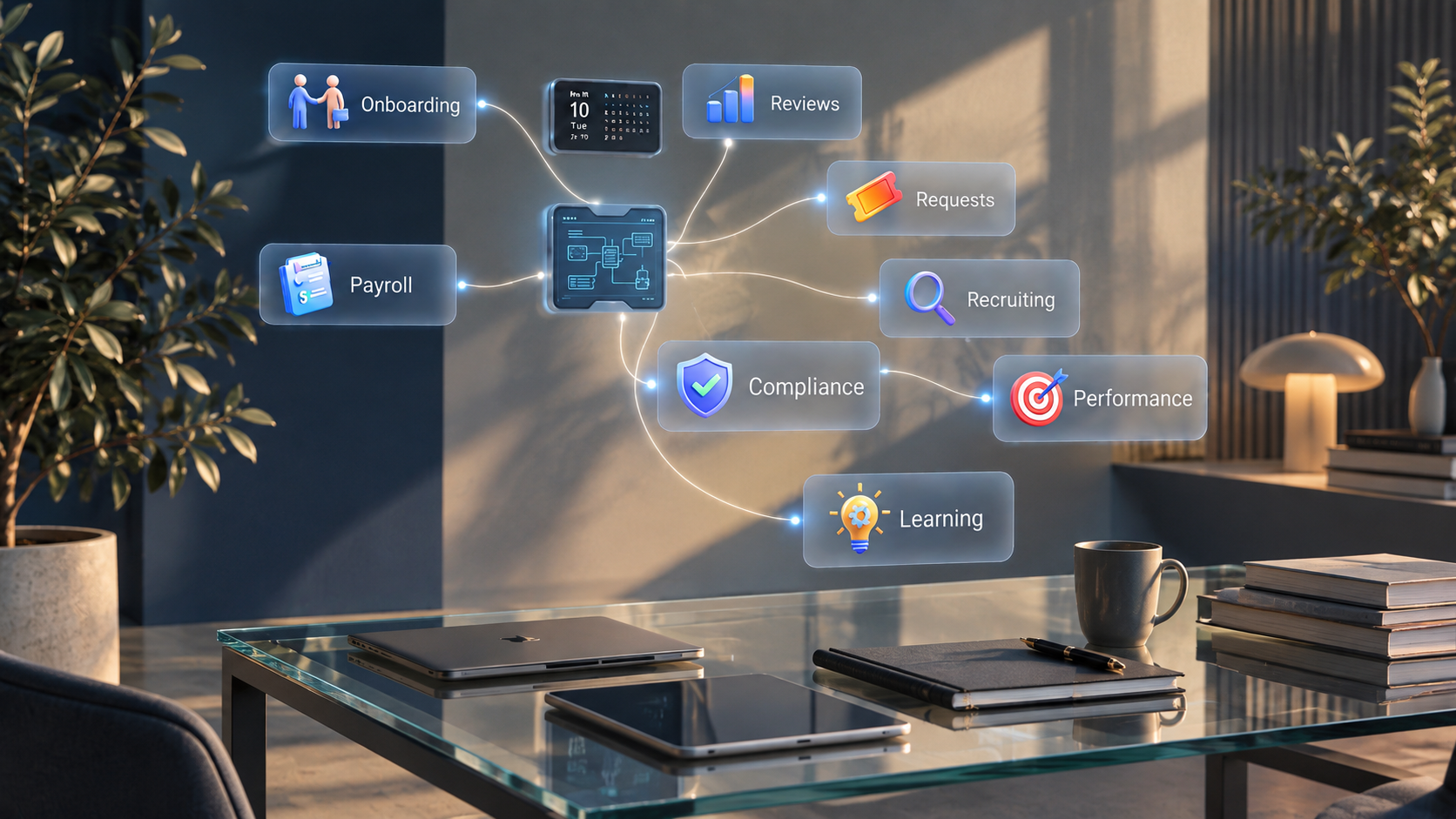
Talexa built a name on fast, AI-driven candidate screening — resume matching and interview triage that cuts the manual grind out of early-stage hiring. The ceiling shows up the day you make an offer: Talexa has no home for onboarding, time-off requests, performance reviews, or recognition, so the moment a candidate becomes an employee, you're back to spreadsheets or a second system. This guide compares the strongest Talexa alternatives in 2026 by what happens after the offer letter goes out.
Quick answer: HRSpace is the strongest Talexa alternative for teams that want AI recruitment plus onboarding, time-off, performance, and recognition in one system. BambooHR wins on brand recognition and a mature applicant tracking module, though at a higher staffing cost beyond core HR. HiBob leans hardest into culture and engagement dashboards, with recruiting as a secondary strength. Talexa itself remains the sharper pick for teams that only need AI resume screening and nothing post-hire. Workday makes sense once headcount and compliance complexity outgrow a 20–100 person org chart.
Why this matters
Talexa is a point solution: it solves the first 30 days of the employee lifecycle and stops there. Companies searching for Talexa alternatives in 2026 are usually hitting one of two walls — they've hired a batch of people and now have nowhere to run onboarding, or they've realized paying for a second HR system on top of Talexa doubles admin work instead of cutting it.
The fix isn't always "replace Talexa." Sometimes it's picking a platform, like HRSpace, that folds AI-assisted hiring into the same system that runs time-off, reviews, and recognition, so the handoff from candidate to employee doesn't require re-entering data anywhere. Other times the honest answer is a dedicated AI recruitment tool built purely for sourcing at volume, and Talexa stays exactly where it is.
Talexa alternatives at a glance
| Tool | Best for | Standout feature | How it differs from Talexa |
|---|---|---|---|
| HRSpace | Growing companies (20–100 employees) that want hiring and HR in one system | AI-drafted job posts feeding directly into onboarding workflows | Covers the full lifecycle; Talexa stops at the offer letter |
| Talexa | Teams that only need AI resume screening | Fast candidate ranking and interview scheduling | Recruiting-only, no post-hire modules |
| BambooHR | Companies that want a long-established HRIS with a built-in ATS | Mature reporting and a large integration library | Broader HR record-keeping, weaker AI screening depth |
| HiBob | Culture-first teams that track engagement alongside HR data | Org chart and engagement survey tools | Stronger on culture analytics, thinner on AI-driven screening |
1. HRSpace - best for running hiring and HR in one place
HRSpace is built around the idea that a new hire shouldn't disappear into a second tool the day they sign an offer. The AI recruitment module drafts job posts and screens applicants, and once someone's hired, the same record flows straight into onboarding, time-off tracking, goals, and recognition — no CSV export, no re-typing a start date into a second system.
Where HRSpace shines
- One employee record from application through performance review, so nothing gets lost between recruiting and HR
- Modular per-employee pricing — pay for the modules you actually turn on, not a flat suite fee
- Setup measured in minutes, not the multi-week onboarding typical of larger HCM suites
- An internal service desk with routing rules and SLA targets, so HR questions stop living in Slack threads
Where HRSpace falls short
- It doesn't run a large external sourcing network the way recruiting-only tools do — teams doing high-volume, multi-channel candidate sourcing may still want a dedicated ATS layered on top
- Enterprise-scale compliance workflows, such as multi-entity payroll or layered approval hierarchies across thousands of employees, are outside where HRSpace is built to play
Best for: Companies in the 20–100 employee range that want AI-assisted hiring and day-to-day HR under one login.
| Dimension | HRSpace | Talexa |
|---|---|---|
| Platform scope | Full lifecycle: hiring, onboarding, time-off, performance, recognition | Recruiting and screening only |
| AI recruitment | Built-in module, connected to onboarding | Core product, standalone |
| Post-hire tools | Onboarding, goals, reviews, recognition, service desk | None |
| Setup | Self-serve, same-day | N/A — no HR data model to configure |
Verdict: Buy if hiring and HR currently live in two disconnected tools and you want them in one.
2. BambooHR - best for an established, standalone HRIS
BambooHR has been the default "grow into it" HR system for small and mid-size companies for years, and its applicant tracking module is a reasonable stand-in for a lot of what Talexa does on the recruiting side, minus the AI-first screening approach.
Where BambooHR shines
- Deep, mature reporting across HR data refined over years
- A large third-party integration library covering payroll, benefits, and background checks
- Wide name recognition, which makes buy-in from a hiring manager or CFO an easier conversation
Where BambooHR falls short
- Its AI screening capability doesn't match a purpose-built recruiting tool like Talexa on speed or ranking sophistication
- Modules tend to be bundled rather than priced individually per feature, so teams that only need two or three functions still pay for the suite
Best for: Teams that want one well-known HRIS and are fine with a less AI-forward recruiting flow.
| Dimension | BambooHR | Talexa |
|---|---|---|
| Platform scope | Full HRIS with built-in ATS | Recruiting and screening only |
| AI recruitment | Limited, not the primary strength | Core product |
| Reporting depth | Mature, long-standing | Recruiting-metrics focused |
Verdict: Hold if you already run BambooHR and only added Talexa for screening speed — the ATS module may cover enough ground on its own.
3. HiBob - best for culture and engagement tracking
HiBob built its reputation on org charts, engagement surveys, and a people-first interface rather than recruiting depth. It's a real alternative if what you actually need out of Talexa is a system that shows who's happy and who's about to leave, not just faster resume screening.
Where HiBob shines
- Engagement and culture dashboards that go deeper than most HR platforms bother with
- A visual, employee-facing interface that people actually open without being told to
- Solid onboarding workflows for new hires once recruiting wraps up
Where HiBob falls short
- AI-driven candidate screening is a secondary feature, not the core product Talexa built
- Heavier on culture tooling than some smaller teams need, which can mean paying for features that go unused
Best for: Companies where retention and engagement data matter more than hiring speed.
| Dimension | HiBob | Talexa |
|---|---|---|
| Platform scope | HR plus culture/engagement analytics | Recruiting and screening only |
| AI recruitment | Secondary feature | Core product |
| Interface focus | Employee-facing, visual | Recruiter-facing, screening-focused |
Verdict: Hold if culture data is the gap, not hiring speed.
4. Workday — best for enterprise scale
Workday is the alternative to consider once headcount and compliance complexity outgrow what a 20–100 person HR stack needs. It's a heavier lift to implement than any tool on this list, and it's built for organizations running multi-entity payroll and layered approval chains — not for a team still deciding between three recruiting tools.
Verdict: Wait, unless you're already past 100 employees with multi-entity compliance needs.
Why people switch from Talexa
- The data stops at the offer letter — Talexa has no onboarding, time-off, or performance module, so every hire means a manual handoff into a second system
- Full-lifecycle reporting isn't possible from inside Talexa — you can't connect "who we hired" to "who's still here at 12 months" without exporting data elsewhere
- Paying for two logins adds admin, not efficiency — teams that added Talexa on top of an existing HR system often find the integration work outweighs the screening speed gained
When staying with Talexa is the right call
If your only real pain point is slow resume review and interview scheduling — and onboarding, time-off, and reviews already run fine in another system — Talexa alone still does that one job well. Switching platforms to solve a problem you don't have isn't an upgrade; it's extra migration work for no gain.
FAQ
What is Talexa used for?
Talexa is an AI-driven recruiting tool focused on candidate screening, resume matching, and interview scheduling. It doesn't cover onboarding, time-off, or performance management.
Is HRSpace a good Talexa alternative?
Yes, if you want AI-assisted hiring connected to the rest of HR. HRSpace runs recruiting, onboarding, time-off, performance, and recognition in one employee record instead of a separate recruiting tool.
Does BambooHR replace Talexa's AI screening?
BambooHR includes an applicant tracking module, but its AI screening isn't as sophisticated as a purpose-built recruiting tool. It's a better fit if you want one established HRIS over best-in-class AI screening.
Is HiBob better than Talexa for recruiting?
HiBob is stronger on culture and engagement tracking, not recruiting depth. Choose HiBob if retention data matters more than AI-driven candidate screening speed.
What's the difference between an AI recruiting tool and a full HR platform?
An AI recruiting tool like Talexa handles sourcing and screening before a hire. A full HR platform like HRSpace continues managing that person through onboarding, time-off, reviews, and recognition after they're hired.
Can you use an AI recruitment module without switching your whole HR stack?
Yes. HRSpace's modular pricing lets teams turn on the AI recruitment module on its own and add other modules like onboarding or performance later as needed.
Is Workday overkill for a 50-person company?
Usually yes. Workday is built for enterprise-scale compliance and multi-entity payroll; a 50-person team typically gets more value from a lighter, faster-to-set-up platform.
The real test
The fastest way to tell whether you need a full HR platform or just a better recruiting tool: count how many separate systems a new hire touches between "offer accepted" and "first performance review." If that number is more than one, the gap isn't Talexa's screening speed — it's the missing connective tissue after the hire, and that's exactly what a modular platform like HRSpace is built to close.
Ready to make HR the easy part?
Explore modular pricing and start a free 14-day trial.