Best Performance Management Software for Healthcare in 2026
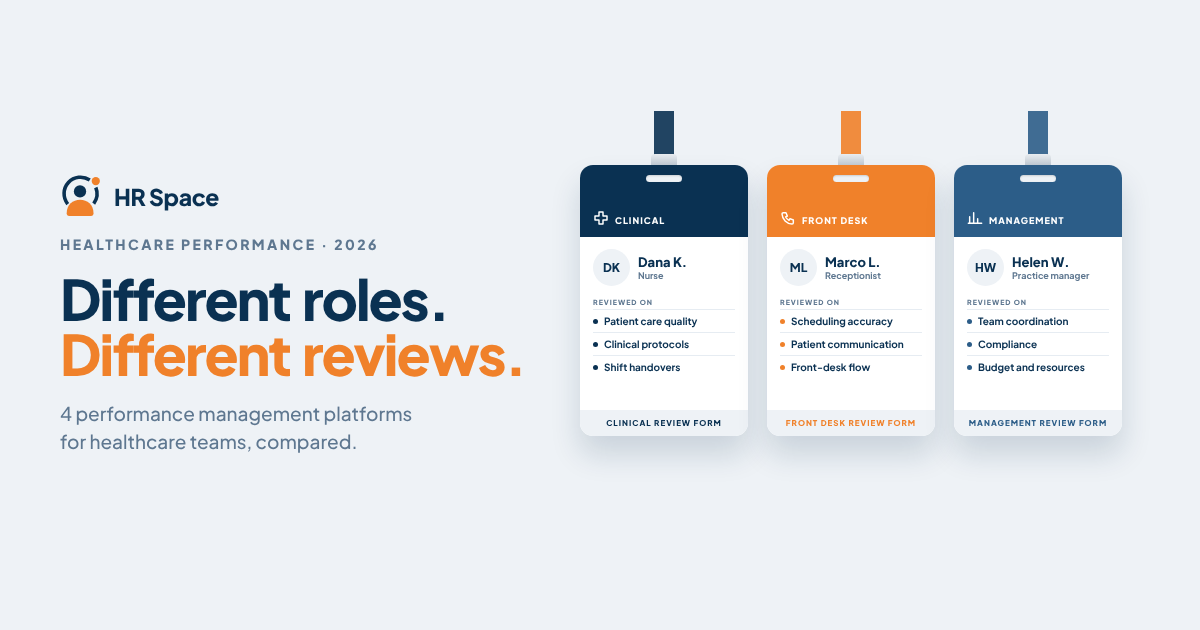
Healthcare organizations need more than annual employee reviews. They need a consistent way to evaluate performance, set development goals and help managers follow up on employee progress.
The right performance management software for healthcare can make these processes easier to manage, particularly for growing organizations with limited HR resources.
For healthcare businesses with 20–100 employees, choosing software also means considering how performance management fits into everyday HR operations. A separate review tool may solve one problem while leaving onboarding, employee records and other administrative processes disconnected.
This guide compares four platforms in 2026:
-
HRSpace: Best for connecting performance management with everyday HR processes.
-
BambooHR: Best for HR teams combining employee administration and performance reviews.
-
HiBob: Best for connecting performance management with employee engagement.
-
Lattice: Best for organizations prioritizing dedicated performance management tools.
The comparison focuses on growing healthcare employers. Performance management software should not be confused with clinical credentialing systems, clinical competency assessment or patient record management.
What should healthcare organizations look for in performance management software?
Healthcare teams have different responsibilities, reporting structures and development requirements. A useful performance management platform should support these differences without making the process unnecessarily complicated.
Before comparing vendors, consider six important factors.
1. Role-specific performance reviews
A healthcare organization may employ receptionists, nurses, administrative staff and department managers. Their responsibilities differ, so their performance expectations should reflect their actual roles.
Look for customizable review processes that allow managers to evaluate relevant competencies and responsibilities.
2. Goal setting and development tracking
Performance reviews should lead to practical next steps. Employees and managers need a clear way to establish development goals, monitor progress and revisit agreed actions.
3. Manager usability
Managers should be able to complete reviews, provide feedback and track employee progress without spending hours navigating complicated workflows.
4. Feedback and recognition
Regular feedback helps managers address performance issues and recognize employee contributions throughout the year, rather than relying exclusively on annual reviews.
5. Access control and data management
Employee evaluations contain sensitive information. Check permission settings, access to historical reviews, data-handling arrangements and administrative controls before selecting a platform.
6. Integration with everyday HR processes
Performance management does not operate independently of the employee lifecycle. Consider whether the platform can connect reviews and development goals with employee records, onboarding and other HR activities.
The most suitable platform is not necessarily the one with the longest feature list. It is the one that supports the processes your organization actually needs.
Performance management software for healthcare: comparison
The following platforms address different HR requirements. Their suitability depends on your organization's priorities, existing systems and required workflows.
| Software | Best for | Main capabilities | What to verify |
|---|---|---|---|
| HRSpace | Growing teams combining performance and everyday HR | Reviews, goals, recognition, AI-powered HR workflows | Healthcare-specific assessment requirements and integrations |
| BambooHR | HR-led employee administration and reviews | Core HR and performance management | Customization and development tracking |
| HiBob | Performance and employee engagement | Performance and engagement capabilities | Module requirements and access permissions |
| Lattice | Dedicated performance management | Reviews, goals, feedback and development | Integration with existing HR systems |
1. HRSpace: Best for connected HR and performance management
Best for: Growing healthcare organizations that want to manage employee performance alongside everyday HR processes.
HRSpace is an AI-powered HR platform that brings multiple employee management processes into one system.
Instead of treating performance reviews as an isolated activity, organizations can manage them alongside employee records, onboarding, time-off management, recruitment, recognition and internal HR workflows.
This approach can be particularly useful for healthcare businesses where a small HR team is responsible for several administrative processes.
Key capabilities:
-
Performance reviews and employee feedback.
-
Goal setting and progress tracking.
-
Employee recognition.
-
Employee database and document management.
-
Onboarding and offboarding.
-
AI-powered recruitment and candidate management.
-
HR workflow automation and employee support.
Advantages:
-
Connects performance management with broader HR operations.
-
Combines employee development and administrative processes.
-
Offers modular functionality for organizations introducing HR software gradually.
-
Includes AI-powered tools for recruitment and HR workflows.
Considerations:
-
Healthcare-specific clinical competency assessment and credential tracking require separate verification.
-
Organizations should confirm required integrations, permissions and data-handling arrangements.
-
The initial implementation should prioritize the HR processes that need improvement most.
Our assessment: HRSpace is a strong option for growing healthcare businesses that want to manage performance and everyday HR operations within one platform, rather than introducing another standalone tool.
Explore HRSpace to learn more about its HR management and performance capabilities.
2. BambooHR: Best for HR-led performance reviews
Best for: Healthcare organizations that want to manage employee administration and performance reviews within a broader HR platform.
BambooHR combines core HR administration with performance management functionality.
It can be a suitable option for organizations where the HR department manages employee records, coordinates review cycles and oversees employee development processes.
For healthcare teams, the important consideration is whether the available review structure can accommodate different job responsibilities.
Advantages:
-
Combines employee administration and performance management.
-
Supports HR teams managing recurring review processes.
-
Offers a broader HR platform rather than a performance-only solution.
Considerations:
-
Healthcare-specific evaluation requirements should be verified.
-
Review customization and development workflows should be tested.
-
Replacing an existing HR system may introduce additional migration work.
Our assessment: BambooHR is worth considering when employee administration and performance reviews are part of the same software purchasing decision.
3. HiBob: Best for performance and employee engagement
Best for: Healthcare organizations that want to consider employee performance and engagement within one HR platform.
HiBob, through its Bob platform, provides HR management functionality alongside performance and employee engagement capabilities.
This can be relevant for organizations that want to understand employee development in a broader organizational context.
However, performance reviews and engagement surveys serve different purposes. Organizations should establish how each process will be managed and who will have access to the information.
Advantages:
-
Combines performance and engagement capabilities.
-
Offers a broader people management platform.
-
Supports organizations looking to manage multiple HR activities in one environment.
Considerations:
-
Required modules and configuration should be confirmed.
-
Healthcare-specific assessment workflows need independent verification.
-
Access permissions for employee feedback and performance information require attention.
Our assessment: HiBob is a relevant option when employee engagement and performance management are both important parts of the organization's HR strategy.
4. Lattice: Best for dedicated performance management
Best for: Organizations whose main priority is improving employee reviews, feedback and development.
Lattice focuses on performance management and employee development. Its capabilities include performance reviews, goal management, feedback and development tools.
For healthcare organizations, this approach may be suitable when existing HR administration already works well and the main challenge is improving how managers evaluate and develop employees.
Advantages:
-
Dedicated performance management functionality.
-
Tools for reviews, goals and employee feedback.
-
Supports structured employee development processes.
Considerations:
-
Integration with existing HR administration needs verification.
-
It does not automatically solve unrelated HR administration challenges.
-
Clinical competency and credentialing requirements should be assessed separately.
Our assessment: Lattice is worth considering when performance management is a clearly defined project rather than part of a wider HR system replacement.
How to choose the right healthcare performance management software
Comparing software features is only the first step. Before making a decision, evaluate how each platform handles your actual HR processes.
Use the following steps during vendor demonstrations.
Step 1. Identify your current challenges
Determine what needs improvement. Is your organization struggling with inconsistent employee reviews, unclear development goals, limited manager feedback or disconnected HR processes?
Start with the problem rather than the software features.
Step 2. Test role-specific reviews
Ask vendors to demonstrate how managers can evaluate employees with different responsibilities.
Use examples from both administrative and clinical roles to understand the level of customization available.
Step 3. Evaluate goal tracking
Check how employees and managers create development goals, assign responsibilities and monitor progress.
A completed review should lead to an actionable development plan.
Step 4. Check access permissions
Ask who can view, edit and manage performance records. Review how access changes when an employee changes departments or reporting managers.
Step 5. Consider the administrative workload
Evaluate how much time HR teams need to organize review cycles, manage employee information and follow up on development activities.
Step 6. Check how the platform fits your existing systems
Identify which processes can be managed within the platform and which require separate tools or integrations.
For a fair comparison, ask every vendor to demonstrate the same employee review scenario, including feedback, goal creation and a follow-up meeting.
Use anonymized employee information during demonstrations and keep patient-identifiable information out of performance review examples.
Which performance management software should healthcare businesses choose in 2026?
The right choice depends on the organization's HR priorities and existing technology.
-
Choose HRSpace if you want performance reviews, goals, recognition and everyday HR processes connected in one platform.
-
Choose BambooHR if your priority is combining core HR administration with employee reviews.
-
Choose HiBob if performance management and employee engagement are equally important.
-
Choose Lattice if you primarily need dedicated tools for reviews, feedback and employee development.
For growing healthcare businesses, connected HR processes can be particularly valuable. When employee records, onboarding, performance reviews and development goals are managed separately, HR teams may spend additional time maintaining information across different systems.
HRSpace offers an approach that brings these processes together, helping organizations manage more of the employee lifecycle from one platform.
Frequently asked questions
What is the best performance management software for healthcare in 2026?
The best option depends on your organization's requirements. HRSpace is suitable for growing teams looking to combine performance management with everyday HR. BambooHR, HiBob and Lattice offer alternatives for different performance and HR management priorities.
Why do healthcare organizations need performance management software?
Performance management software helps healthcare organizations structure employee reviews, establish development goals, provide feedback and monitor progress. It can also reduce the administrative work involved in managing recurring review processes.
Can performance management software replace clinical credentialing systems?
No. Employee performance management and clinical credentialing are different processes. Organizations should evaluate credential tracking, professional qualifications and clinical competency assessment separately.
Should healthcare employees have different performance review forms?
Performance reviews should reflect employees' actual responsibilities. Organizations can use common evaluation criteria for shared expectations while adapting other sections to specific job roles.
What features should healthcare businesses look for in HR software?
Important features include employee management, performance reviews, goal tracking, onboarding, time-off management, reporting and access controls. The required functionality depends on the organization's size and HR processes.
Is HRSpace suitable for small and medium-sized healthcare businesses?
HRSpace is designed to support growing organizations with employee management, recruitment, performance reviews, goals and other HR processes. Healthcare businesses should verify their specific operational and data requirements before implementation.
How do I compare performance management software vendors?
Use the same demonstration scenario with every vendor. Evaluate review customization, feedback, goal tracking, access permissions, administrative workload and integration with existing HR systems.
Make employee performance management easier to manage
Managing employee performance should not require HR teams to coordinate multiple disconnected processes.
HRSpace brings performance reviews, goals, recognition and everyday HR management together in one platform, helping growing organizations create a more structured approach to employee management.
Explore HRSpace and see how connected HR processes can support your team.
Related guides
Ready to make HR the easy part?
Explore modular pricing and start a free 14-day trial.