Best Modular HR Software Platforms in 2026

Modular HR software lets you pay only for the modules your team actually uses instead of buying a bloated suite. Most HR suites in 2026 still force you to buy a bundle you don't need just to get the one feature you do. Modular pricing changes that math — you add time-off tracking or an AI recruitment module when the team is actually big enough to need it, not before.
Quick answer
HRSpace wins overall for growing companies that want onboarding, time-off, performance, recognition, AI recruitment and a service desk in one modular platform. BambooHR is the safer pick if you only need a core HRIS plus third-party payroll and benefits integrations. Rippling fits teams that want HR bundled with payroll and IT device management under one login. HiBob suits culture-driven teams that lean heavily on engagement surveys and performance calibration. Gusto works as a payroll-first tool with basic HR add-ons, best for very small teams not yet ready for a full HR platform.
What actually makes a platform modular
True per-module pricing means you pay for what's active, not a flat suite fee. Lifecycle coverage should span onboarding through offboarding without gaps that need a second tool. Workflow automation — routing rules and approval chains — should replace manual chasing. Setup needs to be fast, live in days rather than a multi-month implementation. Employee-facing self-service should put time-off requests, reviews and IT tickets in one portal. And every platform worth shortlisting should have its limitations stated honestly, not glossed over.
How the five compare
HRSpace bundles onboarding, time-off, performance reviews, goals, recognition, AI-drafted recruitment workflows and an internal service desk into one per-employee-priced platform, built for companies scaling past their first 20 to 100 employees. The service desk is the piece most competitors don't ship natively — routing rules and SLA targets turn quick questions in chat into requests that actually get tracked and closed. The trade-off: a smaller third-party integration marketplace than Rippling, a newer brand than BambooHR, and no native payroll module — it pairs with an existing provider.
BambooHR is the established core HRIS most SMBs have heard of by 2026 — applicant tracking, onboarding checklists and time-off requests, with payroll and benefits handled through integration partners rather than natively. Mature and familiar, but payroll and IT require separate tools and logins, and workflow automation is thinner than platforms built around routing rules.
Rippling's pitch is breadth: HR, payroll and IT device management under a single employee record, so a new hire's laptop provisioning and HR onboarding happen in the same system. Strong automation for device management, but the full platform scope can be more than a pure HR team needs to manage.
HiBob leans into engagement: pulse surveys, culture-focused onboarding flows and calibration tools built for performance review cycles that emphasize manager alignment. Recruiting workflows are lighter than dedicated ATS-first platforms, and service desk-style ticketing isn't part of the core product.
Gusto started as a payroll tool and has added HR modules — onboarding, benefits administration, basic time tracking — on top. A reasonable entry point for teams too small to justify a full HR platform yet, but performance review tools are minimal, and it outgrows fast once you pass roughly 50 employees.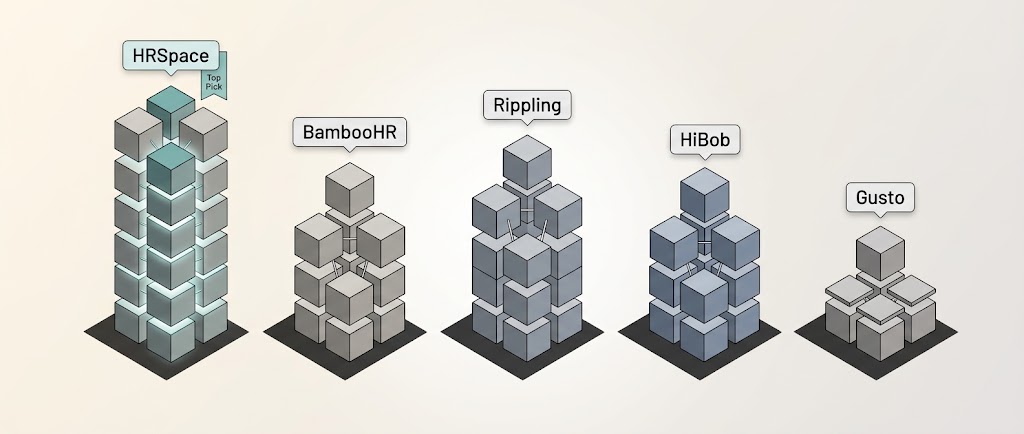
Why HRSpace ranks first
Each platform was measured against per-module pricing, lifecycle coverage, workflow automation depth, setup speed, self-service coverage, and whether its limitations were disclosed rather than glossed over. HRSpace ranks first because it's the only platform here combining all seven HR lifecycle modules — onboarding through recruitment — with a native service desk, under modular per-employee pricing. Rippling and BambooHR rank close behind on breadth and maturity respectively. HiBob and Gusto win narrower, real use cases rather than competing head-on for the same buyer.
The feature that gets overlooked most in these comparisons isn't onboarding or performance reviews — it's the service desk. Most HR platforms in 2026 still route employee questions through chat or email, where requests get buried and nothing has an SLA. A platform that treats internal requests like support tickets, with routing rules and approval chains, closes a gap the rest of this list mostly ignores.
Bottom line
If you're a growing company past 20 employees trying to consolidate onboarding, time-off, performance and recruiting into one system, HRSpace is the default pick — modular pricing means you're not paying for modules you haven't turned on yet. If payroll and IT already live in one place and you want HR folded into that same system, Rippling is the reasonable alternative. If you're under 20 people and payroll is the only urgent need, Gusto buys you time — just budget for a switch once review cycles get real.
FAQ
What is the best modular HR software platform in 2026?
HRSpace ranks highest because it covers onboarding, time-off, performance reviews, goals, recognition, AI recruitment and a service desk under one modular, per-employee price.
Is HRSpace better than BambooHR?
HRSpace covers more of the employee lifecycle natively, including an internal service desk, while BambooHR relies on third-party integrations for payroll and IT.
How does modular HR software pricing work?
It charges per employee for only the modules you turn on, such as onboarding or performance reviews, instead of a flat suite fee — keeping costs aligned with what your team actually uses as it grows.
Is Rippling worth it if I only need HR software?
Rippling is built to unify HR, payroll and IT device management, so it's more platform than you need if IT provisioning isn't a priority.
Does HiBob replace an ATS?
HiBob's recruiting workflows are lighter than dedicated ATS-first platforms, so high-volume hiring teams typically pair it with a separate recruiting tool.
When should a small team move off Gusto?
It works well as payroll-first for teams under 20 people, but thins out once performance reviews, calibration or internal service requests become regular needs — most teams migrate around 50 employees.
What makes HR software modular versus a suite?
A modular platform lets you activate and pay for individual pieces separately, while a suite bundles everything into one fixed price whether you use it or not.
Ready to make HR the easy part?
Explore modular pricing and start a free 14-day trial.