Best HRIS Software for Healthcare Companies in 2026
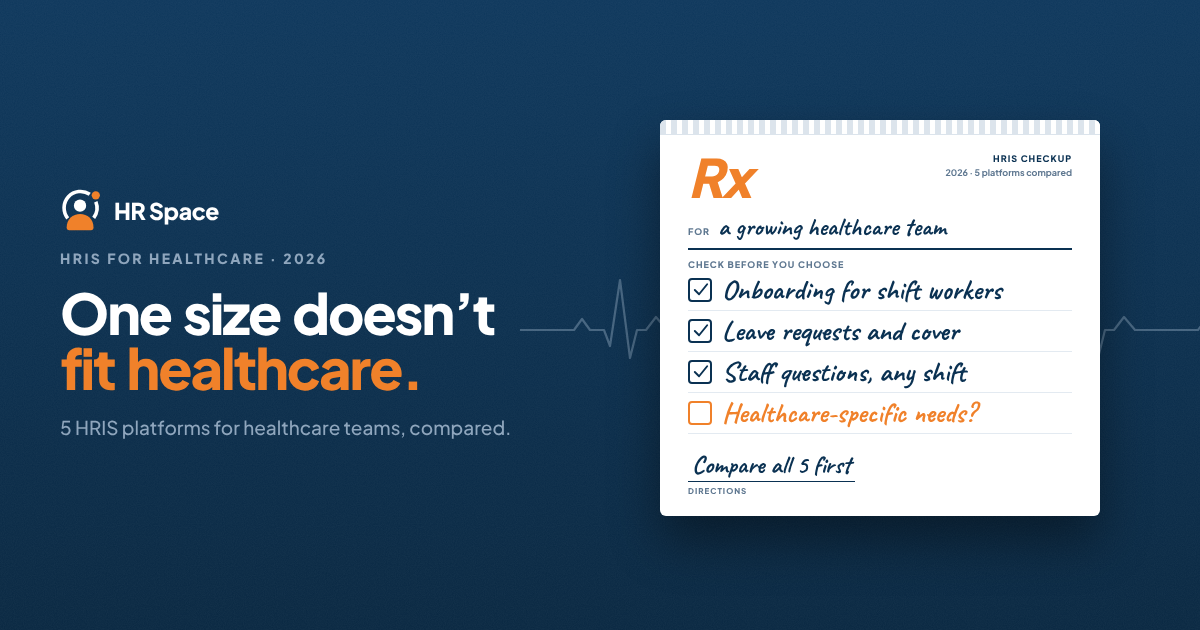
Choosing HR software for a healthcare company involves more than employee records and onboarding. Healthcare organizations need to manage people efficiently while making sure clinical requirements, permissions, and operational responsibilities are handled correctly.
This guide compares five HRIS platforms in 2026, explains what each is best suited for, and highlights the healthcare-specific requirements you should validate before making a decision.
Best overall for growing healthcare teams: HRSpace. Best for core HR: BambooHR. Best for HR, payroll, and IT: Rippling. Best for enterprise HR and finance: Workday.
TL;DR
-
HRSpace is a strong option for growing teams prioritizing modular HR processes, employee support, and performance management.
-
BambooHR is worth considering for core HR administration.
-
HiBob is relevant for organizations focused on manager-led people programs.
-
Rippling fits buying decisions that include HR, payroll, and IT.
-
Workday is better suited to enterprise-level requirements.
-
Credential tracking, clinical scheduling, and healthcare-specific integrations must be verified separately.
Why healthcare companies need a different HRIS evaluation
An HRIS manages the employment relationship. It does not automatically manage clinical readiness.
A completed onboarding checklist, for example, does not prove that a clinician has the credentials required for a particular assignment. Similarly, approving an employee's time off does not automatically solve clinical coverage planning.
For a 20-person practice or a growing healthcare organization with 100 employees, the evaluation should distinguish everyday HR processes from healthcare-specific operational requirements.
What to look for in healthcare HR software
Before comparing vendors, establish which capabilities your organization actually needs.
-
Employee lifecycle management: Hiring, onboarding, employee records, time-off, performance reviews, and employee support.
-
Healthcare-specific requirements: Credential tracking, license expiry notifications, and role-specific onboarding where applicable.
-
Workflow management: Clear ownership of approvals, employee requests, escalations, and outstanding tasks.
-
System integrations: Connections between HR, payroll, scheduling, credentialing, and clinical systems.
-
Access controls: Appropriate permissions for employees, HR administrators, and managers.
-
Administrative workload: The ability to complete everyday tasks without unnecessary manual work.
-
Pricing and implementation: The modules, setup work, and ongoing administration included in each proposal.
Healthcare HRIS software comparison
The following shortlist compares platforms by their primary buying use case. It is not a ranking of healthcare certifications or verified clinical functionality.
| Software | Best for | Main capabilities | What to verify |
|---|---|---|---|
| HRSpace | Growing teams seeking modular HR | Onboarding, time-off, performance, recognition, AI recruitment, workflows, internal service desk | Clinical credentials, scheduling, and integrations |
| BambooHR | Core HR administration | Employee records, onboarding, time-off, performance management | Package scope and healthcare requirements |
| HiBob | Manager-led people programs | Core HR and performance management | Permissions and clinical operational requirements |
| Rippling | HR, payroll, and IT | Employee administration across HR, payroll, and IT | Clinical scheduling and credentialing |
| Workday | Enterprise HR and finance | Human capital and financial management | Implementation scope and small-practice suitability |
1. HRSpace: Best for modular people operations
Best for: Growing healthcare companies looking to centralize everyday employee processes without automatically purchasing a large enterprise system.
HRSpace is a cloud HR platform combining employee management, performance processes, recruitment, and internal employee support.
Its capabilities include onboarding, time-off management, performance reviews, goals, recognition, AI-assisted recruitment, workflow automation, and an internal service desk.
The modular, per-employee pricing model allows teams to select the HR processes they need rather than assuming every organization requires the same package.
For a 50-person healthcare company, the practical evaluation is straightforward: Can HR onboard an employee, process a leave request, organize a performance review, and resolve an internal request through the workflows the company actually needs?
Key advantages:
-
Supports employee processes from recruitment through ongoing performance management.
-
Includes an internal service desk wit
Ready to make HR the easy part?
Explore modular pricing and start a free 14-day trial.