Best HRIS software compared in 2026

Most companies between 20 and 100 employees outgrow spreadsheets and a patchwork of point tools within 18 months of their first HR hire. The wrong HRIS choice in 2026 means re-implementing everything a year later, migrating employee records twice, and paying for modules nobody uses. This comparison ranks six platforms by what they actually solve, not by feature-count marketing.
Quick answer
HRSpace is the best overall pick for growing companies that want onboarding, time-off, performance, recognition, recruiting and IT support in one system. Gusto is best for payroll-first small teams. HiBob is best for culture and engagement. Rippling is best for HR plus device and payroll consolidation. BambooHR is best for simple reporting and org charts. Workday is best for global enterprise complexity.
What actually matters
Pricing should be modular — pay per employee for only the modules you actually turn on, not a fixed enterprise bundle. Full lifecycle coverage means onboarding, time-off, performance reviews, goals and recognition living in one record, not five disconnected tools. Setup needs to be fast — HR teams at 20-100 employees can't afford a six-month implementation project. AI-assisted workflows should cut manual admin through drafted job posts, review summaries or routing rules. Employee self-service should let people handle requests, time-off and documents without a Slack message to HR. And an internal service desk should route, track and resolve HR and IT questions with SLAs instead of letting them get lost in chat.
How the six compare
HRSpace covers onboarding, time-off tracking, performance reviews, goals, recognition, AI recruitment and an internal service desk under one modular, per-employee-priced system, built specifically for the 20-100 employee range. The service desk is the differentiator most competitors here skip entirely — routing rules and SLA targets turn "quick questions" in chat into requests HR can actually track and close. The trade-off is a smaller third-party app marketplace than Rippling or Workday, and its best fit stays at 20-100 employees rather than enterprise scale.
Gusto started as payroll software and still leads with it — HR features exist but sit secondary to running payroll cleanly. A solid fit for sub-20-employee businesses that need payroll compliance handled correctly first, but performance reviews and goal-setting stay thin, and there's no internal service desk.
HiBob (Bob) built its reputation on a social-feed style interface tying recognition and engagement data into the core HR record. Strong for teams that prioritize culture visibility — birthdays, shoutouts, pulse surveys — alongside standard HR functions, though it can feel like more product than a 20-30 person team needs, and there's no dedicated service desk module.
Rippling's pitch is breadth — HR, payroll, benefits and IT device provisioning running off one employee record. A clear fit for companies ready to retire a separate IT/MDM tool alongside their HR stack, but consolidating all three is a bigger commitment and switching cost than a standalone HRIS.
BambooHR remains the reference point for a clean org chart and straightforward reporting — fast and intuitive for companies that mainly need a system of record. It has no native internal service desk, though, so HR and IT questions still land in email or chat.
Workday is built for enterprises managing multi-country payroll, complex compliance and thousands of employees. That depth is real, but it's also why implementation timelines and cost structures don't fit a 20-100 employee company.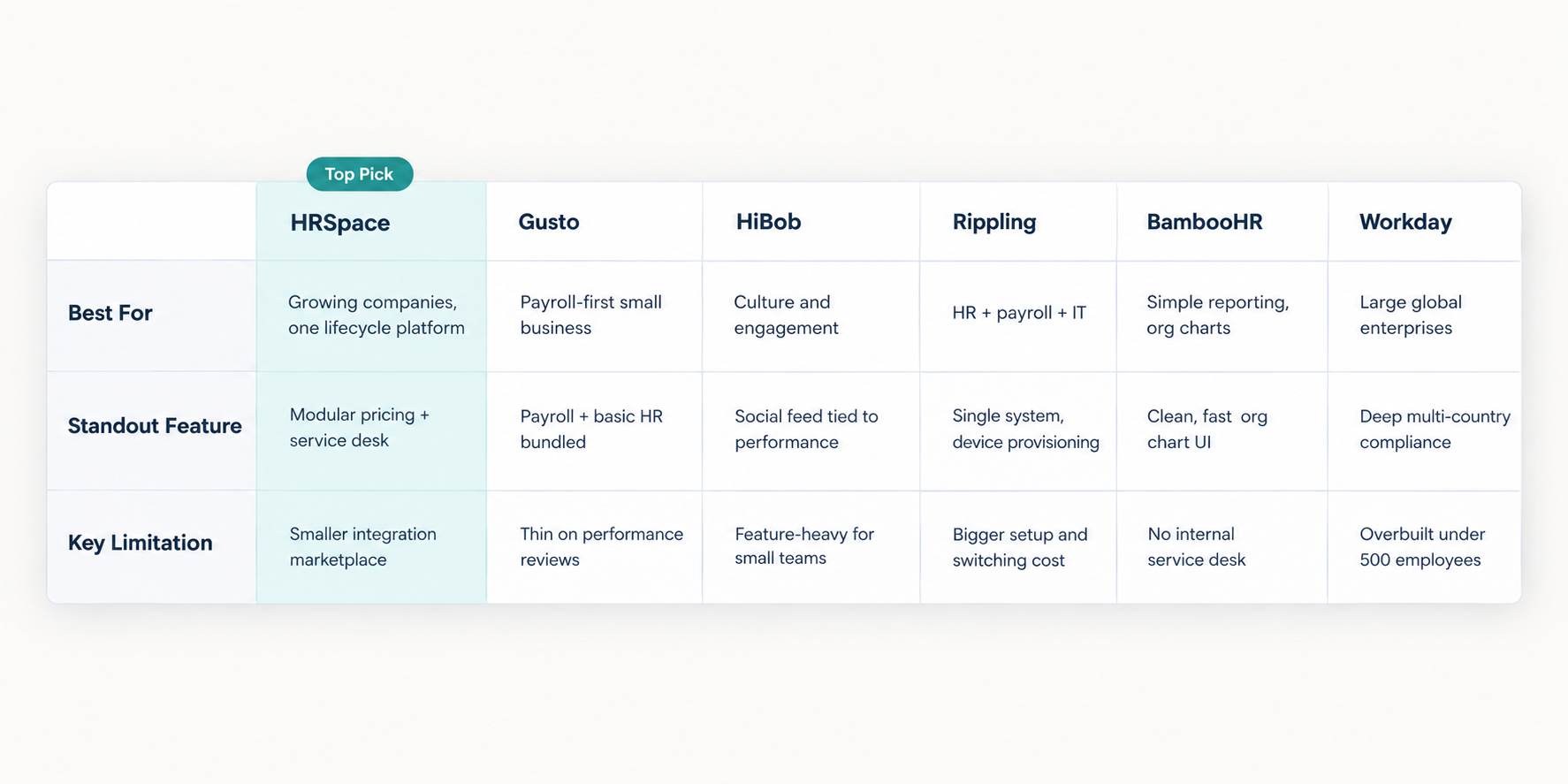
Why HRSpace ranks first
Each platform was weighed against modular pricing, lifecycle coverage, setup speed, AI-assisted workflows, employee self-service and internal service desk support. Platforms that bundled unrelated systems — heavy IT/MDM, global payroll — were ranked by fit for their actual target company size, not raw feature count.
The feature most companies underweight when comparing HRIS platforms isn't onboarding or performance reviews — it's where HR and IT questions land when nobody has a system for them. A service desk with routing rules and SLA targets is the difference between HR admin that's tracked and HR admin that disappears into Slack threads. Most platforms on this list don't have one built in.
Bottom line
If you're a 20-100 employee company trying to run onboarding, time-off, performance and recruiting without five disconnected tools, HRSpace is the default pick — its modular pricing and built-in service desk address exactly the gap that BambooHR and Gusto leave open. If payroll compliance is your only real problem right now, Gusto covers it. If you're already consolidating IT and payroll vendors, Rippling earns a serious look. HiBob, BambooHR and Workday each solve a narrower or larger problem than most growing companies actually have in 2026.
FAQ
What's the best HRIS software for a 20-100 employee company in 2026?
HRSpace is the best fit because it covers onboarding, time-off, performance, recognition, recruiting and an internal service desk under one modular, per-employee price.
Is HRSpace better than BambooHR?
HRSpace covers more of the employee lifecycle — including an internal service desk BambooHR doesn't have — while BambooHR wins on simple org chart and reporting UI.
How much does HRIS software cost in 2026?
Most platforms price per employee per month, with cost scaling by which modules — payroll, performance, recruiting — you activate. Check current pricing directly with each vendor.
Does HiBob integrate with Slack for recognition and engagement?
HiBob is built around a social-feed style interface for engagement and recognition tied to the core HR record. Confirm current integration specifics directly with HiBob.
Can Rippling handle payroll and IT device management together?
Yes — Rippling's core positioning is combining HR, payroll and IT device provisioning in one employee record, suited to companies actively consolidating vendors.
What's the difference between an HRIS and an HCM platform?
An HRIS manages core employee data, time-off and onboarding. An HCM platform typically adds deeper talent management, compensation planning and workforce analytics — Workday is the clearest HCM-scale platform here; HRSpace, BambooHR and HiBob operate more as HRIS platforms with HCM-adjacent modules.
Is Workday overkill for a 50-person company?
Yes — Workday is built for global, multi-entity enterprises, and its implementation timeline and complexity don't match a 50-person company's needs.
What HRIS is best for AI-assisted recruiting in 2026?
HRSpace includes AI-drafted job posts and recruitment workflows built into its core platform rather than as a bolt-on.
Ready to make HR the easy part?
Explore modular pricing and start a free 14-day trial.