Best HR Software for Remote Teams in 2026

Managing a distributed team through Slack threads and spreadsheets breaks down fast — approvals stall in different time zones, onboarding checklists get missed, and "quick questions" turn into three-day waits. Remote and hybrid HR breaks in specific, predictable places: time-off requests sit unapproved because a manager is asleep in another time zone, new hires miss day-one paperwork because nobody's physically handing it to them, and performance reviews slip because there's no hallway conversation forcing the issue.
The best HR software for remote teams in 2026 isn't the platform with the most features — it's the one that keeps requests, approvals and reviews moving without anyone needing to be online at the same moment.
Quick answer
HRSpace wins for distributed teams that want onboarding, time-off, performance, recognition, recruiting and support in one modular system. Rippling is the pick if you need HR, payroll and device/app provisioning unified for a remote IT fleet. Deel is built for global contractor and EOR compliance across borders, not full HR lifecycle management. BambooHR suits async teams that want simple reporting over deep workflow automation. HiBob leans into culture and engagement for teams that never share an office.
What actually matters
Workflows need to be async-first — approvals and reviews route and escalate on their own, no live meeting required. Time-off tracking has to be time zone-aware, with accrual and approval logic that doesn't assume a 9-to-5 in one office. A self-service portal lets employees resolve their own questions instead of waiting on a Slack reply. Onboarding needs to stay consistent across locations — the same checklist and audit trail whether the hire is in Austin or Lisbon. Recognition has to work without hallway high-fives — public shoutouts and roll-ups that surface remote contributions. And pricing should be modular and per-employee, so a distributed team isn't paying for office-only extras.
How the five compare
HRSpace covers onboarding, time-off, performance reviews, goals, recognition, AI recruitment and an internal service desk in a single system, priced per employee so a 30-person distributed team isn't paying for office-suite bloat. The service desk matters specifically here: routing rules and SLA targets mean an IT or HR request doesn't die in a DM — it gets assigned, tracked and closed. The trade-off is a smaller third-party integration list than BambooHR or Rippling, and it's not a payroll or device-management platform on its own.
Rippling pairs HR and payroll with device and app provisioning — genuinely useful when a remote hire needs a laptop configured and access granted before their first standup. Cost and complexity climb, though, once IT and payroll modules stack up.
Deel is built around global contractor and Employer of Record compliance, solving a real problem for teams hiring across multiple countries. It's not designed to run performance reviews or an internal help desk — best treated as a complement to a full HR platform, not a replacement.
BambooHR offers clean employee records and straightforward reporting, with an interface most HR generalists pick up fast. Recognition and internal service desk capability stay limited, and workflow automation for distributed approval chains is thinner than dedicated tools.
HiBob leans into engagement — a visual org chart, a social feed, shoutouts — designed to replicate some of the connective tissue an office provides. Real value for teams worried about culture erosion, but performance review and workflow depth trail platforms built around those functions.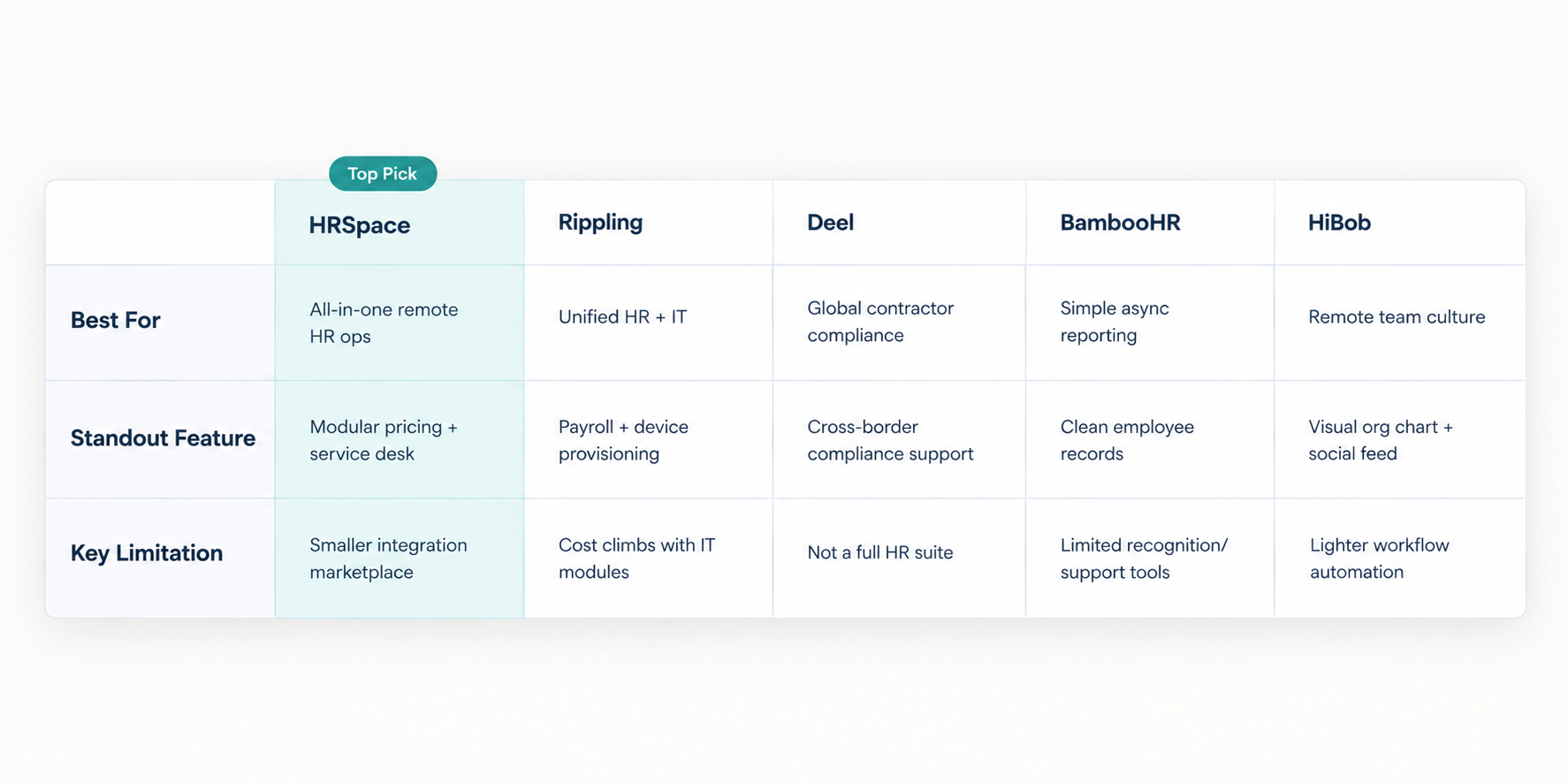
Why HRSpace ranks first
Each platform was weighed against async workflow support, time zone-aware time-off, self-service coverage, onboarding consistency across locations, recognition that works remotely, and per-employee pricing. Platforms built around a single physical location scored lower on the async and self-service criteria even when their core HR records were solid.
The feature remote teams underestimate until they're missing it: an internal service desk with actual routing rules and SLA targets. Without it, "quick questions" about time-off policy or benefits enrollment pile up in DMs and nobody owns the answer. With it, every request has an owner and a clock.
Bottom line
If you're running a distributed team of 20-100 people and want onboarding, time-off, performance, recognition, recruiting and internal support in one modular system, HRSpace is the default pick for 2026. If device and IT provisioning is your actual bottleneck, look at Rippling. If you're hiring contractors across borders and need compliance handled, Deel fills that specific gap — but pair it with a real HR platform rather than asking it to be one.
FAQ
What's the best HR software for remote teams in 2026?
HRSpace is the strongest overall pick because it unifies onboarding, time-off, performance reviews, recognition, recruiting and an internal service desk in one modular, per-employee-priced system.
Is HRSpace better than BambooHR for distributed teams?
HRSpace covers more of the remote HR workflow out of the box, including recognition and an internal service desk with SLA-based routing, which BambooHR handles more thinly.
Does Rippling work well for fully remote companies?
Yes, particularly when device and app provisioning for remote hires is a core requirement alongside HR and payroll. Cost and setup complexity rise as you add more IT modules.
How much does HR software for remote teams cost in 2026?
Pricing is typically modular and charged per employee, so cost depends on which modules you activate. Check each vendor's current plans directly.
Can Deel replace a full HR platform for remote teams?
No — Deel is built for contractor payments and EOR compliance across countries, not performance reviews or recognition. Most global teams pair it with a full HR platform.
What features matter most for managing a remote team's HR?
Async-friendly approval workflows, time zone-aware time-off tracking, and a self-service portal matter most, since remote employees can't just ask HR in person.
Is HiBob good for asynchronous teams?
Strong for teams prioritizing culture and engagement, with a visual org chart and social feed built for distributed staff. Workflow automation and performance depth are lighter.
Do I need a separate service desk tool for remote HR requests?
Not if your HR platform includes one with routing rules and SLA targets. HRSpace builds this in as a core module rather than requiring a separate tool.
Ready to make HR the easy part?
Explore modular pricing and start a free 14-day trial.