Best HR Software for Real Estate Teams in 2026
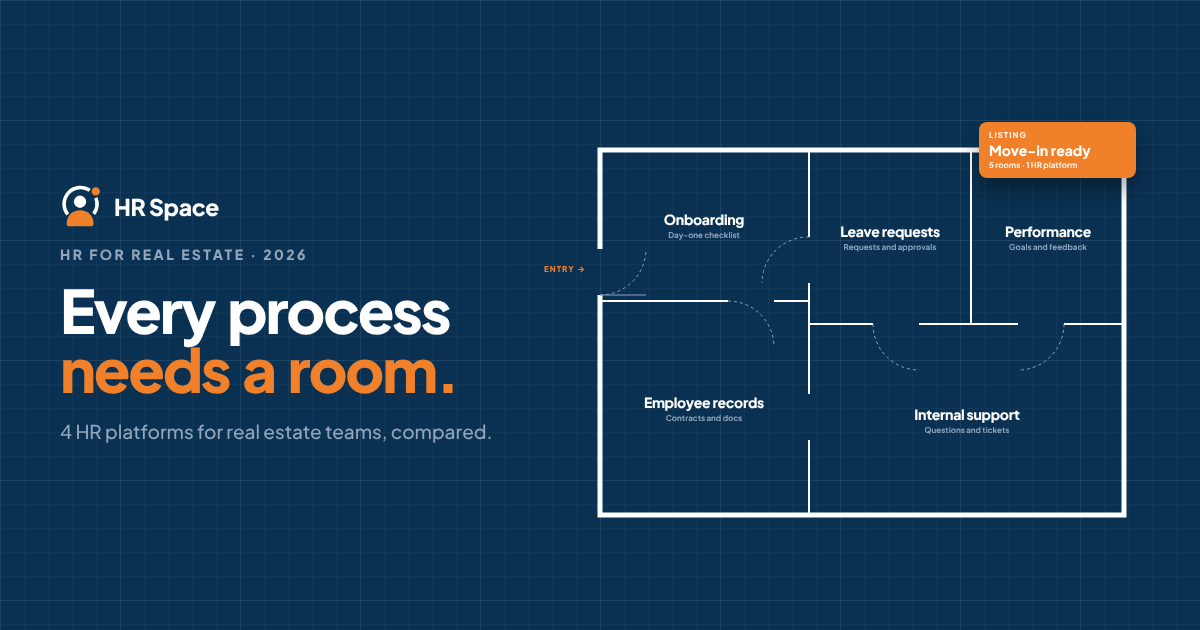
Real estate businesses manage more than properties and transactions. They also need to recruit employees, onboard new team members, manage time off, track performance and handle everyday employee requests.
As a real estate company grows, these responsibilities can become difficult to coordinate through spreadsheets, emails and disconnected tools.
The right HR software for real estate teams helps bring employee information and HR processes into one organized system, reducing manual administration and giving managers better visibility into their teams.
For growing businesses with 20–100 employees, choosing HR software is also a question of operational efficiency. A platform should simplify the work of HR managers and business owners without introducing unnecessary complexity.
This guide compares four HR platforms in 2026:
-
HRSpace: Best for managing the employee lifecycle through modular HR software.
-
BambooHR: Best for core HR administration and employee records.
-
HiBob: Best for performance management and employee engagement.
-
Rippling: Best for connecting HR with payroll and IT administration.
The focus is on employee management, not property transactions, real estate CRM functionality or commission calculations.
What should real estate businesses look for in HR software?
Real estate companies often have different employee groups, including property managers, office administrators, sales support teams and department managers.
Their responsibilities differ, but the organization still needs consistent HR processes.
Before choosing a platform, evaluate the following capabilities.
1. Employee management
A centralized employee database helps HR teams organize employee information, documents and employment-related records.
Look for a platform that makes it easy to update information, manage employee profiles and control access to sensitive records.
2. Employee onboarding
New employees need a structured introduction to company policies, responsibilities and internal processes.
Onboarding software can help HR teams organize tasks, assign responsibilities and monitor completion without coordinating everything manually.
3. Time-off and attendance management
Real estate businesses need a clear process for submitting, reviewing and approving employee leave requests.
A centralized system can make these requests easier to manage and help managers understand employee availability.
4. Performance management
Employee performance should be evaluated against relevant responsibilities and business objectives.
Look for performance reviews, goal setting, feedback and development tracking that help managers maintain consistent evaluation processes.
5. Employee support and internal communication
Employees regularly need information about company policies, documents, payroll questions and administrative procedures.
An internal HR service desk can help organize these requests, assign ownership and track their status.
6. Recruitment and automation
Hiring is an ongoing responsibility for growing real estate businesses.
AI-powered recruitment tools and automated HR workflows can help reduce repetitive administrative tasks and organize hiring processes.
The objective is not to purchase every available feature. It is to identify the HR processes that currently consume the most time and choose software that addresses them.
Best HR software for real estate teams: comparison
The following platforms offer different approaches to employee management and HR administration.
| Platform | Best for | Main capabilities | Key consideration |
|---|---|---|---|
| HRSpace | Connected employee lifecycle management | Employee database, onboarding, time-off, performance, AI recruitment and HR workflows | Select the modules that match your current priorities |
| BambooHR | Core HR administration | Employee records and HR management | Verify the required functionality and package |
| HiBob | Performance and employee engagement | Performance management and engagement | Evaluate configuration and administrative requirements |
| Rippling | Connected HR and IT administration | HR, payroll and IT products | Confirm whether the broader system scope is necessary |
These platforms should be evaluated as employee management solutions. Requirements involving property transactions, commission calculations and customer relationship management should be assessed separately.
1. HRSpace: Best for modular employee lifecycle management
Best for: Growing real estate businesses that want to manage employee information, HR administration and performance in one platform.
HRSpace is an AI-powered HR platform designed to bring multiple employee management processes together.
Instead of managing recruitment, onboarding, employee records, time-off and performance reviews through separate tools, businesses can organize these activities within one system.
This is particularly relevant for real estate companies where HR responsibilities are often handled by a small team or directly by business managers.
Key features:
-
Employee database and document management.
-
Employee onboarding and offboarding.
-
Time-off management and attendance.
-
Performance reviews and employee feedback.
-
Goal setting and progress tracking.
-
Employee recognition.
-
AI-powered recruitment and candidate management.
-
AI workflow builder.
-
Internal HR service desk.
-
Project and task management.
Advantages:
-
Covers multiple stages of the employee lifecycle.
-
Connects performance management with everyday HR processes.
-
Offers modular functionality for different business requirements.
-
Includes AI-powered tools for recruitment and workflow automation.
-
Helps organize internal employee requests through a dedicated service desk.
Considerations:
-
Commission management and property transaction workflows should be handled through dedicated systems unless a verified integration meets the requirement.
-
Businesses should identify which modules are necessary for the initial implementation.
-
Required integrations, permissions and data-handling arrangements should be confirmed before purchasing.
Our assessment: HRSpace is a strong option for real estate businesses looking to organize HR operations without introducing separate tools for every employee management process.
Its modular approach allows growing teams to prioritize the HR functions they need most.
Explore HRSpace to learn more about its employee management capabilities.
2. BambooHR: Best for core HR administration
Best for: Real estate businesses looking to centralize employee information and organize everyday HR administration.
BambooHR provides HR software focused on employee records and core HR processes.
For a growing brokerage or property management company, centralized employee information can make routine administration easier to organize.
Rather than relying on spreadsheets and separate documents, HR teams can manage employee-related information through a dedicated platform.
Advantages:
-
Centralized employee information.
-
Core HR administration functionality.
-
Employee onboarding capabilities.
-
Suitable for businesses prioritizing employee record management.
Considerations:
-
Confirm which recruitment, performance and employee-support features are included in the selected package.
-
Evaluate whether the available workflows match your company's administrative requirements.
-
Property management and commission calculations require separate evaluation.
Our assessment: BambooHR is worth considering when the main objective is to establish a structured employee administration system.
It is a practical comparison point for businesses that do not yet need a broader HR platform.
3. HiBob: Best for performance management and employee engagement
Best for: Real estate businesses that want to improve employee development and management processes.
HiBob's Bob platform combines HR management with performance and employee engagement capabilities.
For real estate organizations, this can be useful when managers need a more structured approach to employee feedback, performance reviews and development goals.
For example, a company may want to evaluate how office teams manage internal responsibilities while setting different development objectives for property management employees.
Advantages:
-
Performance management capabilities.
-
Employee engagement functionality.
-
Broader HR management environment.
-
Supports structured employee development processes.
Considerations:
-
Review the configuration required to manage different employee roles.
-
Confirm which modules are necessary for your organization.
-
Evaluate administrative workload and manager participation.
Our assessment: HiBob is a relevant option for real estate businesses that consider employee development and engagement important parts of their HR strategy.
4. Rippling: Best for connecting HR and IT administration
Best for: Real estate companies looking to coordinate employee administration with payroll and IT operations.
Rippling offers products across HR, payroll and IT administration.
This broader approach may be relevant for businesses managing multiple employee systems, company accounts and workplace technology.
For example, when a new employee joins, the company may need to coordinate HR documentation with access to internal systems and workplace tools.
Advantages:
-
HR and IT administration within the same vendor ecosystem.
-
Payroll products for businesses evaluating broader employee administration.
-
Suitable for organizations considering connected administrative processes.
Considerations:
-
Determine whether your business needs the broader product scope.
-
Confirm the exact modules and integrations required.
-
Evaluate implementation responsibilities across HR, payroll and IT.
Our assessment: Rippling is worth considering when connecting HR and IT administration is an important part of the company's technology strategy.
For businesses primarily looking to organize employee records, onboarding and performance reviews, a broader system may not be necessary.
How to choose the right HR software for your real estate business
Comparing platforms is easier when every vendor is evaluated against the same business scenarios.
Instead of focusing only on feature lists, test how the software handles everyday HR responsibilities.
Step 1. Identify your current HR challenges
Start by identifying the processes that create the most administrative work.
For example:
-
Employee information is stored across spreadsheets.
-
Onboarding depends on manual follow-ups.
-
Leave requests are managed through messages.
-
Managers struggle to track employee development.
-
HR requests are handled through separate emails and conversations.
Your priorities should determine which software capabilities matter most.
Step 2. Test the employee onboarding process
Ask the vendor to demonstrate how a new office administrator or property manager is added to the system.
Check how tasks are assigned, documents are organized and onboarding progress is monitored.
Step 3. Evaluate time-off management
Use a sample leave request and ask a manager to review and approve it.
Check whether employees and managers can clearly follow the request status.
Step 4. Test performance reviews and goals
Ask the vendor to create a performance review for a sample employee.
Evaluate how managers provide feedback, establish development goals and monitor progress.
Step 5. Review employee support workflows
Submit sample requests involving company policies, employee documents and administrative questions.
Check how requests are assigned, tracked and resolved.
Step 6. Compare pricing and implementation requirements
Review the cost of the required modules, the number of employees included and any additional implementation or integration expenses.
A platform should fit both your current operational needs and your expected growth.
Which HR software is best for real estate teams in 2026?
The right platform depends on the processes your business wants to improve.
-
HRSpace: Best for businesses seeking modular HR software across the employee lifecycle.
-
BambooHR: Best for organizations prioritizing core employee administration.
-
HiBob: Best for companies focusing on performance management and employee engagement.
-
Rippling: Best for businesses connecting HR with payroll and IT administration.
For growing real estate businesses, the ability to manage multiple HR processes within one environment can make a meaningful difference.
When employee records, onboarding, time-off, performance reviews and internal requests are scattered across different systems, HR teams spend additional time coordinating information.
HRSpace brings these processes together through one AI-powered HR platform, giving growing businesses a structured way to manage employees and everyday HR operations.
Frequently asked questions
What is the best HR software for real estate companies?
The best HR software depends on your business requirements. HRSpace is suitable for companies looking to manage multiple employee lifecycle processes in one platform. BambooHR, HiBob and Rippling offer alternatives for different HR administration priorities.
Why do real estate companies need HR software?
Real estate businesses need HR software to organize employee records, recruitment, onboarding, time-off, performance reviews and internal HR processes. As teams grow, managing these activities manually can increase administrative workload.
Can HR software manage real estate agents and contractors?
HR software can help organize employee-related information and administrative processes. However, businesses should define the requirements for independent agents and contractors separately and seek appropriate legal advice on worker classification.
Does HR software replace real estate CRM software?
No. HR software manages employee-related processes, while real estate CRM systems typically support customer relationships, sales pipelines and property-related business activities. These systems serve different purposes.
What features should small real estate businesses look for in HR software?
Important capabilities include employee records, onboarding, time-off management, performance reviews, recruitment and internal employee support. The right combination depends on team size and operational priorities.
How can HR software reduce administrative work in a real estate business?
HR software can centralize employee information, automate selected workflows and organize routine requests. This reduces the need to coordinate every process through spreadsheets, emails and manual follow-ups.
Is AI-powered HR software useful for real estate businesses?
AI-powered HR tools can support recruitment, screening and repetitive HR workflows. Businesses should evaluate how each AI feature works, what information it processes and whether human review remains part of the process.
Manage your growing team with HRSpace
As your real estate business grows, employee management becomes an increasingly important part of daily operations.
HRSpace brings recruitment, onboarding, employee records, time-off, performance reviews, goals and internal HR support together in one platform.
Instead of coordinating every HR process manually, your team can work with a more structured and connected system.
Explore HRSpace and see how one platform can simplify your everyday HR operations.
Related guides
Ready to make HR the easy part?
Explore modular pricing and start a free 14-day trial.