Best HR software for healthcare companies in 2026

Healthcare HR runs on three-shift schedules, license renewals that can't lapse, and turnover that outpaces most industries. Generic HR software wasn't built for any of that. This guide ranks six platforms by the specific problem each one solves, not by a single overall score — because a 60-employee clinic and a multi-site hospital system aren't shopping for the same thing.
Quick answer: HRSpace is the strongest fit for growing healthcare practices (20–100 employees) that want onboarding, time-off, and HR requests consolidated on one modular, per-employee-priced platform. UKG is the right call for large hospital systems running 24/7, three-shift scheduling. BambooHR fits organizations where compliance-heavy hiring documentation is the bigger risk than shift complexity. Rippling suits healthcare orgs that want HR, IT device provisioning, and payroll under one login.
Why healthcare HR is a different buying decision
Most HR software is designed for office staff working one shift on one pay structure. Healthcare doesn't work that way: nurses and techs rotate across three shifts, certifications expire if no one is tracking renewal dates, and a single question — "where's my W-2," "can I swap this shift" — can flood an HR inbox during flu season.
The right platform depends on which specific gap you're closing, not which vendor has the longest feature list. A 40-bed clinic with 60 employees has different priorities than a hospital system coordinating a dozen units around the clock, and picking the wrong tool either leaves a compliance gap or buries you in an implementation you didn't need.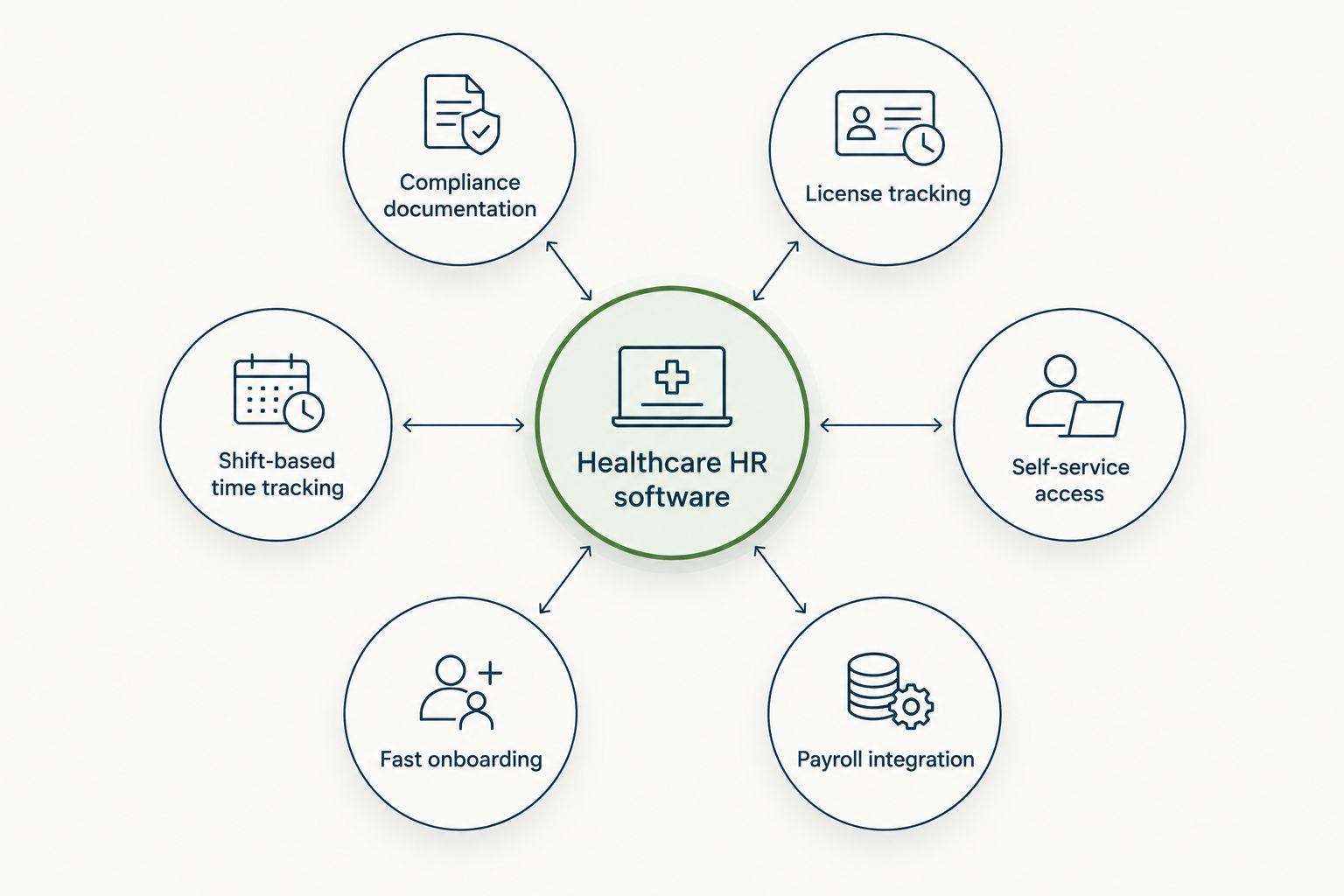
What to evaluate in healthcare HR software
Six criteria separate the platforms below. No single vendor wins on all six — that's the reason this guide is organized by use case rather than a composite score.
- Compliance documentation that holds up to an audit, not a folder of scanned PDFs
- License and certification tracking, or a workaround that flags renewals before they lapse
- Shift-based time tracking that handles rotating and overnight schedules correctly
- Employee self-service for shift swaps, pay stubs, and time-off requests without a phone call to HR
- Fast onboarding built for roles with above-average turnover
- Payroll and benefits integration that doesn't require re-entering the same data twice
HR software for healthcare at a glance
| Software | Best for | Standout feature | Key limitation |
|---|---|---|---|
| HRSpace | Growing healthcare orgs consolidating HR into one platform | Modular per-employee pricing across onboarding, time-off, reviews, and a service desk | No native payroll processing or built-in license-expiry tracking |
| BambooHR | Compliance-heavy hiring and documentation | Applicant tracking system built into the core HRIS | Less depth for complex, rotating-shift time tracking |
| Rippling | HR, IT, and payroll in one login | Device and app provisioning tied to the employee record | Bigger platform, longer setup for a small clinic |
| UKG | Large hospital systems with 24/7 shift scheduling | Enterprise-grade workforce scheduling and time tracking | Built and priced for large enterprise deployments |
| Paycor | Mid-market payroll-first healthcare orgs | Payroll and compliance reporting in one workflow | Onboarding and engagement tools are thinner than HR-first platforms |
| HiBob | Culture and engagement across clinical and non-clinical staff | Strong recognition and engagement workflows | Less built for compliance-heavy, audit-driven environments |
1. HRSpace — best for healthcare orgs consolidating onboarding, time-off, and HR requests
HRSpace is a modular, per-employee-priced HR platform covering onboarding, time-off, performance reviews, goals, recognition, AI-assisted recruitment, and an internal service desk. For a healthcare practice in the 20–100 employee range, that means new hires, shift-swap questions, PTO requests, and reviews live in one system instead of three separate tools and a Slack channel.
The onboarding module matters most here because turnover in clinical-adjacent and support roles runs high, and every rehire means resetting paperwork, training assignments, and system access. The built-in service desk routes recurring questions — benefits, pay, scheduling — into tickets with SLA targets instead of letting them get lost in chat.
Pros
- Modular per-employee pricing — pay for the modules your HR team actually uses
- Onboarding, time-off, performance, and recognition on one employee record
- Built-in service desk with routing rules and SLA targets
- Faster setup than larger enterprise suites
Cons
- No native payroll processing — pairs with an existing payroll provider
- No built-in license or certification expiry tracking for clinical staff
- Not built for the scale of a multi-site hospital system
Pricing: Modular, per-employee. Check current plan details on the HRSpace site.
Best for: Healthcare practices and clinics between 20 and 100 employees that want one platform instead of five.
Verdict — Buy. For growing healthcare orgs, HRSpace covers more of the employee lifecycle out of the gate than BambooHR or HiBob.
2. BambooHR — best for compliance-heavy healthcare hiring
BambooHR is a core HRIS with an applicant tracking system built in, aimed at small and mid-size companies that need clean employee records and a documented hiring process. Healthcare organizations hiring continuously for licensed roles use it to keep candidate and compliance paperwork organized in one place.
Pros
- Applicant tracking system included, not bolted on
- Clean, well-documented employee records for audits
- Established platform with a large customer base
Cons
- Shift-based and rotating time tracking is less developed than dedicated workforce tools
- Service desk and internal ticketing aren't part of the core product
Best for: Healthcare employers whose biggest HR headache is hiring documentation, not shift scheduling.
Verdict — Buy. If compliance paperwork during hiring is your top risk in 2026, BambooHR handles it well.
3. Rippling — best for combining HR, IT, and payroll
Rippling connects HR, IT device management, and payroll under a single employee record. For a healthcare org managing laptops, EHR system access, and payroll for the same person, that consolidation removes a step every time someone joins or leaves.
Pros
- HR, IT, and payroll tied to one employee profile
- Automatic app and device provisioning on hire
- Scales to more complex, multi-system organizations
Cons
- More platform than a small clinic typically needs
- Longer implementation than a single-purpose HR tool
Best for: Healthcare organizations that also need to manage devices and system access, not just HR records.
Verdict — Hold. Worth evaluating only if you're consolidating IT and payroll at the same time.
4. UKG — best for large hospital systems with 24/7 scheduling
UKG (Ultimate Kronos Group) is built for enterprise workforce management, including the complex, three-shift, 24/7 scheduling common in hospital systems. It's the platform most large health systems already run their time and attendance through.
Pros
- Enterprise-grade shift scheduling and time tracking
- Built to handle large, multi-site workforces
- Deep reporting for labor cost and compliance
Cons
- Priced and built for enterprise scale, not a 50-person clinic
- Implementation is a bigger project than a mid-market HR platform
Best for: Hospital systems and large healthcare networks running around-the-clock shift coverage.
Verdict — Buy. For large, shift-heavy operations, nothing on this list matches its scheduling depth.
5. Paycor — best for mid-market healthcare payroll and compliance
Paycor is a payroll-first HR platform with compliance reporting built around it, popular with mid-market employers that want payroll and HR compliance handled by the same vendor.
Pros
- Payroll and compliance reporting in one workflow
- Solid fit for mid-market headcounts
Cons
- Onboarding, recognition, and engagement tools are thinner than HR-first platforms
- Less flexible for orgs that want to select modules individually
Best for: Healthcare employers where payroll accuracy and compliance reporting outrank onboarding or engagement features.
Verdict — Hold. A solid fit only if payroll is the primary pain point, not the full employee lifecycle.
6. HiBob — best for culture and engagement across healthcare staff
HiBob focuses on employee engagement and culture, with recognition and feedback workflows aimed at improving retention among clinical and non-clinical staff alike.
Pros
- Strong recognition and engagement features
- Modern, easy-to-use interface for employee self-service
Cons
- Less built for audit-heavy compliance documentation
- Not designed around complex, rotating shift schedules
Best for: Healthcare employers prioritizing culture and retention over compliance depth.
Verdict — Buy for culture-first teams; skip if compliance is your main gap.
How we ranked these platforms
Each platform was measured against the six criteria above: compliance documentation, license and certification tracking, shift-based time tracking, self-service, onboarding speed, and payroll integration. No platform wins on all six, which is why this guide is organized by use case rather than a single composite score. A hospital system and a 40-person clinic are both searching for "best HR software for healthcare companies" in 2026, but they need different answers.
Which HR software should you choose in 2026?
- 20–100 employees, consolidating onboarding, time-off, and HR requests: HRSpace
- Hospital system, three-shift, 24/7 staffing: UKG
- Compliance documentation during hiring is your top risk: BambooHR
- Managing HR, IT devices, and payroll together: Rippling
FAQ
What's the best HR software for healthcare companies in 2026?
HRSpace is the strongest overall pick for healthcare practices between 20 and 100 employees because it covers onboarding, time-off, reviews, and HR support requests on one modular platform. Larger hospital systems with complex 24/7 shift scheduling are better served by UKG.Is HRSpace better than BambooHR for healthcare hiring?
HRSpace covers more of the employee lifecycle in one platform, including a built-in service desk, while BambooHR's applicant tracking system is more developed for compliance-heavy hiring documentation. The right pick depends on whether hiring paperwork or day-to-day HR requests are the bigger headache.Does healthcare HR software need to track staff licenses and certifications?
Yes. Most healthcare roles require active licenses or certifications, and a missed renewal creates real compliance risk. Not every platform on this list has license tracking built in, so confirm that specifically before committing.What HR software handles 24/7 shift scheduling for hospitals?
UKG is built for enterprise workforce management, including three-shift, 24/7 scheduling common in large hospital systems. Smaller clinics rarely need that level of scheduling complexity.How much does HR software cost for a healthcare company?
Pricing varies by platform and module selection. HRSpace uses modular, per-employee pricing, so cost scales with the modules a healthcare org actually turns on. Check current plan details directly with each vendor before comparing.Can one HR platform handle both HR and IT for a healthcare org?
Rippling combines HR, IT device provisioning, and payroll under one employee record, which suits healthcare orgs managing both system access and HR from the same team. It's a bigger platform than most small clinics need.Is HiBob good for healthcare companies?
HiBob works well for healthcare employers focused on culture and engagement across clinical and non-clinical staff, but it's less built for the compliance documentation that regulated hiring requires.The real test before you sign
The platforms that struggle hardest in healthcare aren't the ones missing a feature — they're the ones designed around a single 9-to-5 shift. Before signing a contract in 2026, ask how the platform actually behaves with a rotating three-shift schedule, not just whether "time tracking" appears on the feature list.
Ready to make HR the easy part?
Explore modular pricing and start a free 14-day trial.