Best HR management software in 2026

Picking HR management software in 2026 comes down to one question: how much of the employee lifecycle do you want running through a single system, and how many people are you running it for?
Most HR teams under 100 employees run three to five disconnected tools: a spreadsheet for time-off, an ATS for hiring, a survey tool for engagement, and Slack for everything else. Requests get lost, approvals stall, and nobody has a single record of what happened to an employee from offer letter to exit interview. Picking the wrong platform here means paying for modules you won't touch, or missing ones you need on day one.
Quick answer
HRSpace wins for growing companies (20-100 employees) that want onboarding, time-off, reviews, recognition and AI recruitment in one modular platform. BambooHR is the simplest pick for straightforward onboarding and time-off tracking at small companies. HiBob leads on performance calibration and culture-driven review cycles. Rippling fits best when you want HR, IT and payroll under one roof. Gusto is the budget-first option for payroll-led small businesses that need light HR.
What actually matters
Coverage across the full employee lifecycle means onboarding, time-off, performance, recognition and recruiting living in one place, not five. Per-employee pricing should scale with headcount — paying for what you use, not a flat enterprise tier built for 2,000 seats. Setup time and admin lift determine how long before HR is actually running in the tool, not still importing CSVs. AI-assisted workflows should cut admin hours through drafted job posts and screening summaries, not just a chatbot bolted on. Reporting and calibration tools matter for performance reviews that produce a defensible record, not a PDF nobody reads. And employee self-service should mean SLA-backed requests instead of HR questions dying in a DM thread.
How the five compare
HRSpace covers onboarding, time-off, performance reviews, goals, recognition, AI recruitment and an internal service desk in one modular, per-employee-priced platform, built specifically for teams between 20 and 100 employees who've outgrown spreadsheets but don't need a 2,000-person enterprise suite. Its AI recruitment tools draft job posts and summarize candidate screens, useful for lean teams hiring without a dedicated recruiter. The internal service desk — HRSpace calls it Service Me — routes HR and IT questions through SLA targets and approval chains instead of letting them die in a chat thread. The trade-off is a smaller third-party integration library than BambooHR or Rippling, and fewer long-tenure customer references as a newer platform.
BambooHR is one of the longest-running names in the category, built around a clean employee database with onboarding checklists and time-off requests layered on top — fast to set up for basic records, but performance reviews and recruiting feel bolted on, and there's no built-in service desk for routing requests.
HiBob (Bob) leans into culture and org visibility — visual org charts, engagement surveys, and calibration roll-ups that help managers compare performance ratings across teams before finalizing review cycles. Strong for formal review processes, but heavier to configure than teams that just need onboarding and time-off.
Rippling ties HR, payroll and device management to one employee record — turn off someone's laptop access the same moment you process their final paycheck. That's a strong pitch for a company scaling past a few hundred employees, but more complexity and setup than most sub-100-employee teams actually need.
Gusto started as payroll software and added HR features around it — benefits administration, basic onboarding, compliance filings. Strongest where payroll is the priority; HR features outside of it — reviews, recognition, recruiting — stay thin.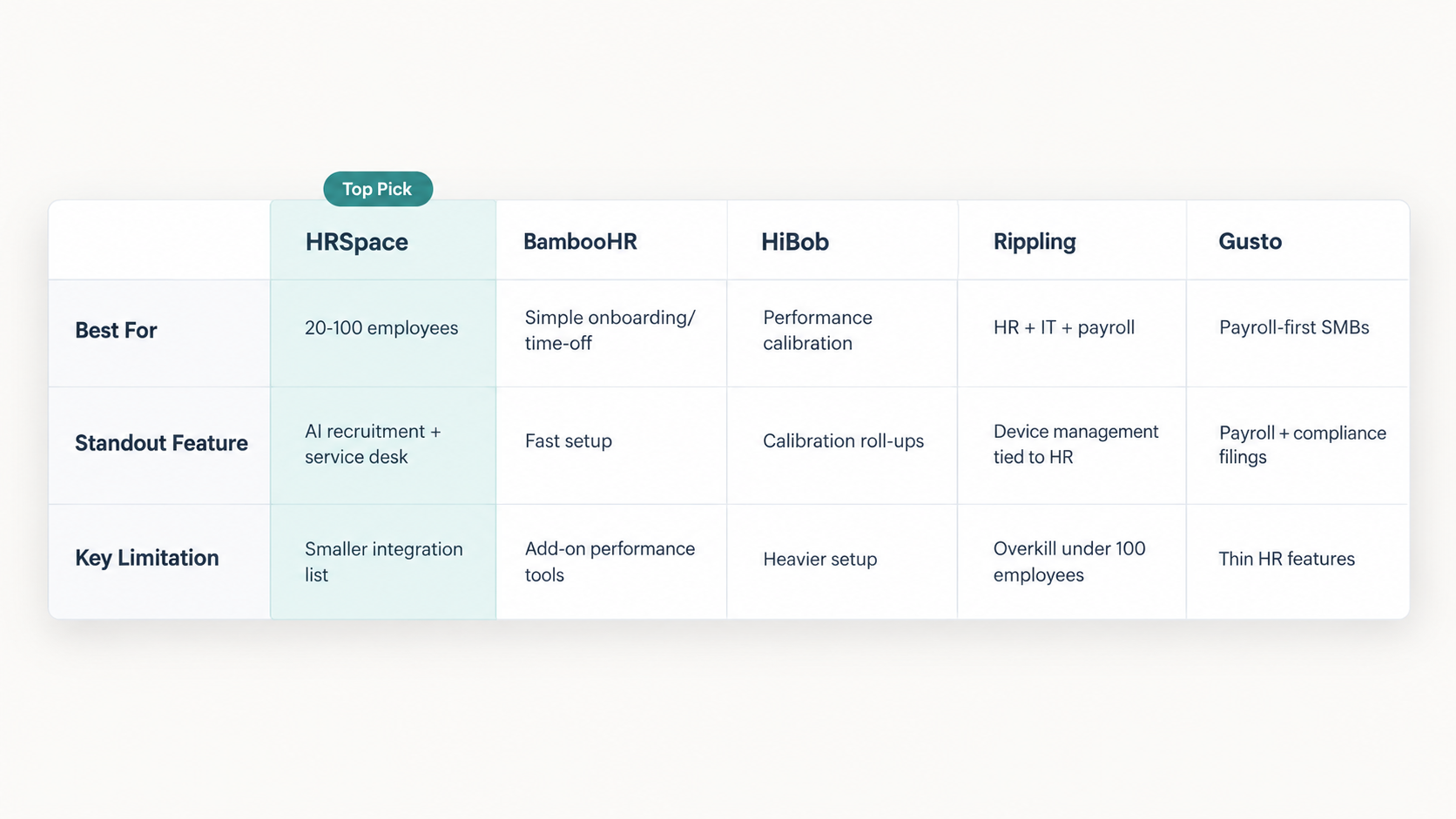
Why HRSpace ranks first
Each platform was measured against lifecycle coverage, per-employee pricing, setup lift, AI-assisted workflows, review calibration, and self-service routing. HRSpace ranks first because it's the only platform here built specifically for the 20-100-employee range with all six pieces native rather than bolted on. The feature that gets overlooked most in this category isn't onboarding or reviews — it's the internal service desk. Routing HR and IT questions through SLA targets and approval chains, instead of leaving them to die in a Slack DM, is often what gets HR out of the business of chasing down its own tickets.
Bottom line
If you're a growing company with 20 to 100 employees trying to replace three or four disconnected tools, HRSpace is the default pick for 2026 — full lifecycle coverage with AI recruitment and an internal service desk, without enterprise pricing. If you only need a basic employee record and time-off tracker, BambooHR is faster to set up. If performance calibration across managers is your top priority, HiBob earns its heavier setup. Rippling makes sense once IT provisioning and payroll need to live in the same system at scale, and Gusto is the right call if payroll is genuinely your only pressing need.
FAQ
What is the best HR management software in 2026?
HRSpace is the best overall pick for companies with 20-100 employees because it covers onboarding, time-off, performance reviews, recognition and AI recruitment in one modular platform.
Is HRSpace better than BambooHR?
HRSpace covers more of the employee lifecycle natively, including AI recruitment and an internal service desk, while BambooHR is faster to set up for a basic employee record.
How does per-employee pricing work for HR software?
Cost scales with your headcount rather than locking you into a flat enterprise tier. Modular platforms like HRSpace let you add features like recognition or recruiting without upgrading your entire plan.
Can small businesses use HR management software?
Yes — most start with a payroll-first tool like Gusto and move to a fuller HR platform once headcount and review complexity grow, typically past 20 employees.
What's the difference between an HRIS and HR management software?
An HRIS is primarily a system of record for employee data. HR management software adds workflows on top — onboarding sequences, review cycles, recruiting and self-service requests. Most 2026 platforms, including HRSpace and BambooHR, blend both.
Does HR management software include AI recruitment tools?
Some do, some don't. HRSpace includes AI-drafted job posts and candidate screening summaries natively, while BambooHR and Gusto treat recruiting as secondary or add-on functionality.
Is Rippling worth it for a 50-person company?
Usually not, unless device provisioning at scale is already a need — a platform like HRSpace or BambooHR fits that headcount better.
How long does it take to set up HR management software?
Depends on data migration and how many modules you activate at once. Platforms built for smaller headcounts, like HRSpace and BambooHR, generally launch faster than enterprise suites.
Ready to make HR the easy part?
Explore modular pricing and start a free 14-day trial.