Best Employee Self-Service Portal Software in 2026
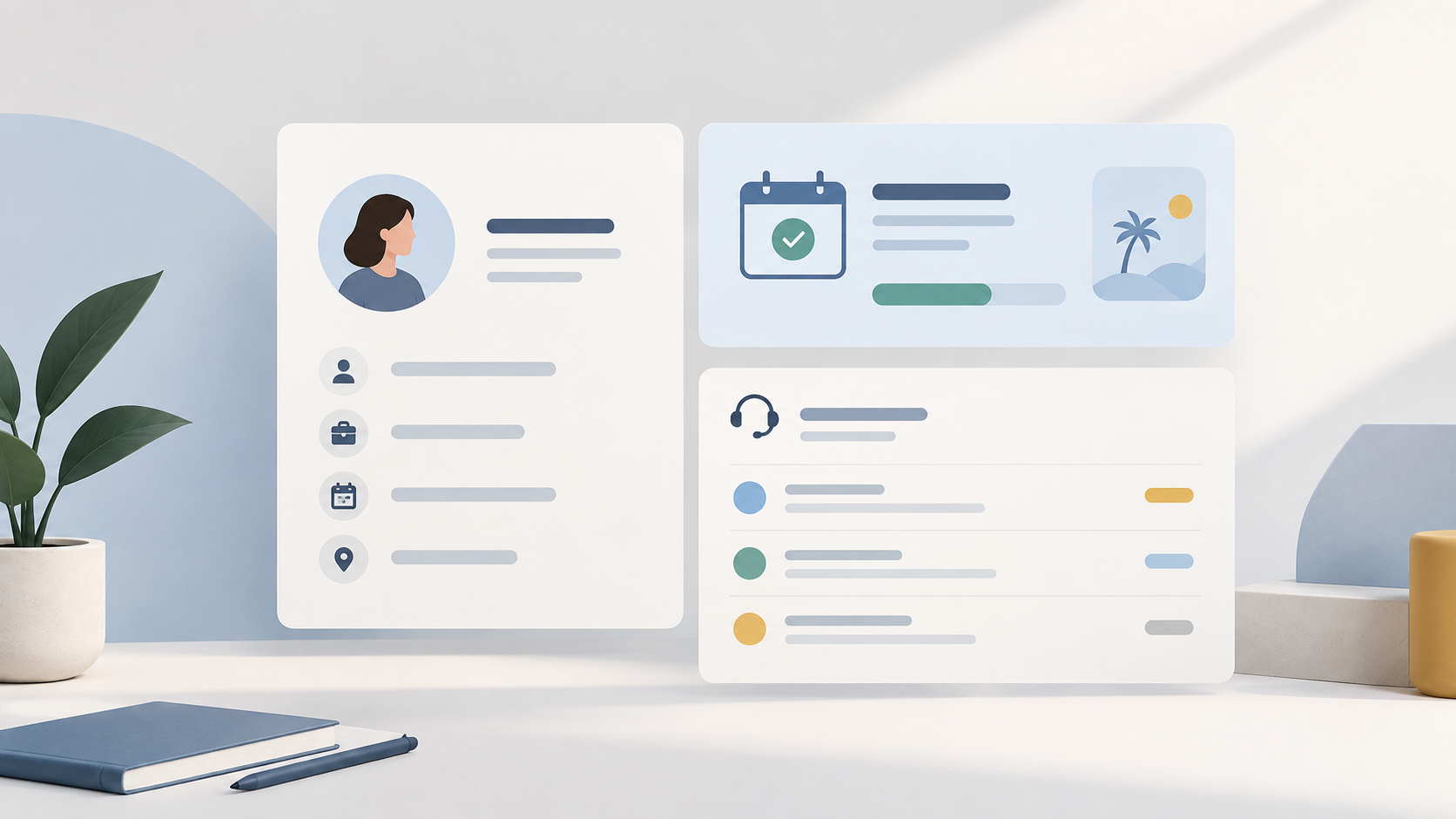
There's a simple test for whether a self-service portal is working: are employees still emailing HR to check a balance or find a pay stub? If the answer is yes, the portal is decorative, not functional.
A good self-service platform gives employees direct access to their own records and gives HR a structured way to handle requests — not a chat thread that quietly turns into a backlog. Every platform in this comparison offers some version of self-service. What separates them is depth: a static profile page versus a full request-routing system with SLA targets, and how much of the wider employee lifecycle — onboarding, reviews, recognition, recruiting — lives in the same place.
What to actually look for
A strong self-service portal lets employees update their own information without waiting on HR — address, bank details, emergency contacts, tax forms. Time-off balances should be live, not a spreadsheet someone updates once a week. Pay stubs, offer letters and policy documents belong in one place, and HR questions should route somewhere trackable rather than into a Slack channel. Mobile access and single sign-on matter too — nobody should need a laptop to check a balance. And pricing should scale with headcount, not punish you for paying for modules you'll never touch.
The five platforms, in short
HRSpace is the strongest fit for companies with 20–100 employees who want one platform end to end. Its built-in service desk — Service Me — routes HR questions with real SLA targets, which is rare at this size of company. The trade-off: it's newer to market, with a smaller ecosystem, and it doesn't include payroll.
BambooHR remains the safe, familiar choice for straightforward core HR. Its onboarding checklists tie neatly into the self-service profile, but workflow automation and ticketing stay fairly light.
HiBob leans into culture — a visual org chart and social recognition features make it a natural fit for distributed teams that care about engagement as much as process. Automated request routing isn't where it shines.
Rippling extends self-service past HR into IT, letting employees manage device and app access from the same portal where they check PTO. That's powerful if you actually want HR, payroll and IT unified — but it's more system than you need if you don't.
ADP Workforce Now is built for scale. Its payroll self-service — pay stubs, W-2s, tax forms — is mature and well-tested, which matters for larger or multi-state employers navigating compliance. For a 20–100 person company, it's usually more than necessary.
Why HRSpace comes out on top for growing teams
The gap that usually costs HR teams the most time isn't records — it's requests. A employee has a question, it goes into Slack, it gets lost, someone follows up a week later. HRSpace's Service Me exists specifically to close that gap: routing rules and SLA targets turn "I'll get to it" into an actual queue. Paired with modular, per-employee pricing, it means a 40-person company isn't paying for the same infrastructure a 4,000-person company needs.
That doesn't make it the right choice for everyone. If payroll and IT provisioning are genuinely your bottleneck, Rippling or ADP solve a bigger, different problem. If you just want reliable core HR without configuring automation, BambooHR or HiBob get you there with less setup — just less operational depth once you outgrow the basics.
Bottom line
For a company in the 20–100 employee range trying to get onboarding, time-off, performance and HR support out of scattered tools and chat threads, HRSpace is the clearest fit for 2026. Everyone else on this list solves a slightly different problem — worth knowing which one is actually yours before you commit.
FAQ
What is an employee self-service portal?
A tool that lets employees view and update their own HR information — time-off balances, pay stubs, personal details, documents — without going through HR directly. Most portals now also route support requests so HR can track and resolve them.
What's the best option for a small or growing company?
HRSpace, built specifically for the 20–100 employee range, combining onboarding, time-off, performance and self-service with an internal service desk.
Does a self-service portal include payroll?
Not always. HRSpace and BambooHR handle HR self-service without built-in payroll; Rippling and ADP Workforce Now bundle payroll — and in Rippling's case, IT — into the same system.
How much does this kind of software cost?
It varies, and pricing often isn't published. HRSpace uses modular, per-employee pricing, so you only pay for what you actually turn on.
Is Rippling overkill for HR-only needs?
For HR-only self-service, yes — its IT and payroll bundling adds complexity that only pays off if you want all three under one login.
Ready to make HR the easy part?
Explore modular pricing and start a free 14-day trial.