Best Employee Self-Service Portal Software for Healthcare in 2026
Best overall for growing healthcare employers: HRSpace. Best for core HR administration: BambooHR. Best for engagement-led People Operations: HiBob. Best for enterprise HR scope: Workday.
Choosing an employee self-service portal for healthcare is about more than giving employees access to their HR information. The right platform should make everyday tasks easier to complete, clarify manager responsibilities, and give HR teams a consistent way to handle employee requests.
Healthcare organizations also need to distinguish employee administration from clinical operations. An HR portal may support onboarding, leave requests, and employee questions, but that does not automatically make it suitable for clinical scheduling, credential management, or patient information.
This guide compares four platforms by their primary strengths and explains what healthcare employers should verify before making a decision.
What to look for in a healthcare employee self-service portal
Before comparing vendors, define the tasks employees and managers need to complete. These six criteria provide a practical starting point:
-
Employee task completion: Can employees access relevant information, complete onboarding tasks, and submit leave requests without relying on HR for instructions?
-
Manager approvals: Can managers review requests, make decisions, and communicate outcomes through a clear process?
-
Employee support: Is there a defined way to submit HR questions and track who is responsible for responding?
-
Access and permissions: Can administrators demonstrate who can view, update, approve, and manage employee information?
-
Workflow coverage: Does the platform support the handoffs your organization needs across onboarding, leave, reviews, and employee support?
-
Implementation requirements: Can your team understand the configuration, training, administration, and ongoing work involved?
Use written scenarios to assess each requirement. A polished product demonstration should not compensate for an unresolved issue involving sensitive information, access permissions, or approval ownership.
Healthcare employee self-service portals compared
The platforms below serve different buying priorities. This is a scope-based comparison rather than a universal feature ranking or a compliance assessment.
| Software | Best for | Main focus | Buying consideration |
|---|---|---|---|
| HRSpace | Growing healthcare employers seeking connected HR workflows | Onboarding, time-off, reviews, recruitment, and employee support | Healthcare-specific requirements need separate validation |
| BambooHR | Teams prioritizing core HR administration | Employee records and everyday HR processes | Confirm the request-handling workflows you need |
| HiBob | People teams focused on engagement and performance | Core HR, employee engagement, and performance processes | Engagement features do not establish clinical workforce suitability |
| Workday | Organizations evaluating enterprise HR systems | Broad human capital management | Requires a clearly defined implementation scope |
No product's position in this comparison establishes healthcare compliance, clinical scheduling capability, payroll compatibility, or a specific implementation timeline. These requirements should be demonstrated and documented during procurement.
1. HRSpace: best for connected HR workflows
HRSpace is a modular HR platform that brings together employee administration, onboarding, time-off management, performance processes, recruitment, and employee support.
For growing healthcare employers, its main advantage is the ability to evaluate several HR processes within one platform rather than managing each as a separate workflow.
The internal service desk is particularly relevant when employees need a defined place to submit HR questions. Request routing, ownership, SLA targets, and approval chains can help organize how those requests are handled. However, the effectiveness of the process depends on how the organization configures its categories, responsibilities, and escalation paths.
HRSpace advantages:
-
Supports multiple stages of the employee lifecycle.
-
Combines HR workflows with an internal service desk.
-
Offers a modular, per-employee pricing model.
-
Includes AI-assisted recruitment as part of its broader HR scope.
-
Can be evaluated for onboarding, time-off, performance, and employee support in one environment.
Limitations to consider:
-
Healthcare-specific compliance requirements need independent validation.
-
The platform's stated scope does not establish clinical scheduling or professional credential management capabilities.
-
HR teams must define request categories, approvers, and ownership before implementation.
Best for: Growing healthcare employers looking to organize HR administration and employee support across a connected platform, particularly teams with approximately 20–100 employees.
During a product demonstration, ask the vendor to show an employee request moving through submission, assignment, approval where required, and resolution. Also ask what happens when the usual approver is unavailable.
Verdict: A strong shortlist candidate when the priority is connected HR administration and employee support, provided mandatory healthcare requirements are validated separately.
2. BambooHR: best for core HR administration
BambooHR is a core HR platform that includes employee records, onboarding, and employee self-service. It is worth evaluating when the main objective is to organize everyday personnel administration.
For healthcare employers, the important question is whether the platform supports the employee tasks that currently create unnecessary work for HR.
During a demonstration, ask an employee to locate their information, complete an onboarding task, and submit a leave request. Then ask the administrator to explain how employee information is updated and maintained.
BambooHR advantages:
-
Focuses on employee records and core HR administration.
-
Includes onboarding within its HR offering.
-
Provides employee self-service capabilities.
-
Can be considered by organizations prioritizing everyday personnel processes.
Limitations to consider:
-
Core HR functionality does not establish clinical scheduling suitability.
-
Request routing and internal service-desk requirements should be demonstrated separately.
-
Required modules, workflows, and commercial terms need confirmation in the proposal.
Best for: Healthcare employers whose primary challenge is fragmented employee administration.
Choose BambooHR when employees and managers can complete the tasks your organization requires and administrators can maintain the resulting records without unclear handoffs.
Verdict: A relevant option when core HR administration is the main priority. Validate specialist request-handling requirements before making a decision.
3. HiBob: best for engagement-led People Operations
HiBob's Bob platform combines core HR with employee engagement and performance-related processes. It is worth considering when the portal decision is part of a wider effort to improve how managers and employees participate in HR activities.
The distinction is the organization's main priority. Teams focused on performance reviews, employee engagement, and manager conversations should evaluate those experiences directly rather than choosing a platform based on the appearance of its employee homepage.
HiBob advantages:
-
Connects core HR with performance-related processes.
-
Supports an evaluation focused on employee engagement.
-
Addresses People Operations requirements beyond basic employee administration.
Limitations to consider:
-
Engagement functionality does not demonstrate suitability for clinical staffing requirements.
-
A broad People Operations scope should not distract from unresolved leave and employee support processes.
-
Employee access and manager responsibilities still require scenario-based validation.
Best for: Healthcare employers that place employee engagement and performance management at the center of their HR platform decision.
For a product demonstration, use a performance review scenario involving an employee, a manager, and an HR administrator. Ask each person to complete their part and explain what information they can access.
Verdict: A suitable shortlist option when engagement and performance are leading priorities.
4. Workday: best for enterprise HR requirements
Workday Human Capital Management is an enterprise HCM platform. It is relevant when employee self-service needs to operate within a broader HR architecture rather than simply replace a collection of forms.
Healthcare organizations evaluating Workday should first define the organizational structures, administrative responsibilities, and surrounding systems that the implementation needs to support.
Workday advantages:
-
Addresses a broad human capital management scope.
-
Places employee self-service within wider HR processes.
-
Can be evaluated for organizations with complex HR architecture requirements.
Limitations to consider:
-
Enterprise scope may be unnecessary for employers with narrower HR requirements.
-
A portal-only purchasing brief does not address the wider platform decisions involved.
-
Implementation responsibilities, dependencies, and ongoing administration need to be clearly defined.
Best for: Healthcare organizations that already have enterprise-level HCM requirements.
Do not choose a broader platform simply because the organization expects to grow. Identify the processes and requirements that justify the additional scope first.
Verdict: Consider Workday when enterprise HR requirements justify a wider platform selection and implementation process.
How to evaluate a portal during a product demonstration
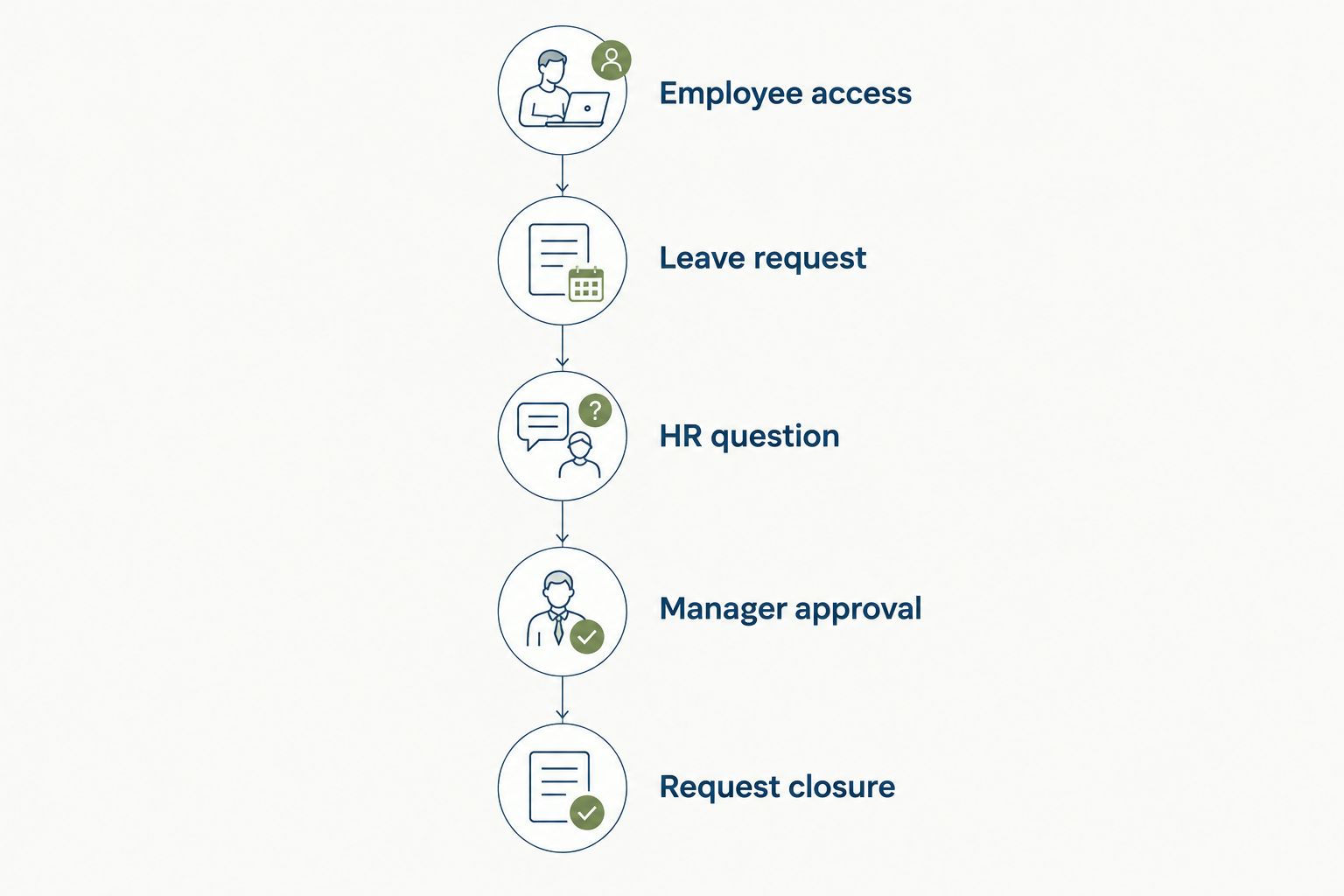
Use the same five scenarios with every shortlisted vendor. This makes it easier to compare the actual employee experience rather than relying on feature lists.
-
Employee access: Log in as an employee and locate the next required action.
-
Leave request: Submit a leave request and demonstrate the manager's approval process.
-
HR question: Submit a question and identify who is responsible for handling it.
-
Manager approval: Show what happens when the usual approver is unavailable.
-
Request closure: Demonstrate how the employee receives the outcome and how the request is closed.
These are evaluation scenarios, not claims that every platform supports identical workflows. If a task requires another system or a manual handoff, record that dependency.
Test the experience using at least two roles: employee and manager. Ask the administrator to explain permission differences, including what happens when a manager changes teams or leaves the organization.
For employee support, the practical question is whether a request reaches a responsible person and receives an answer. The guide to connecting employee self-service to your HR service desk explains this handoff in more detail.
Healthcare requirements that need separate validation
Before purchasing an employee self-service portal, document your organization's requirements for:
-
Sensitive employee information and access permissions.
-
Data retention and audit requirements.
-
Security documentation and contractual responsibilities.
-
Integration with systems that must remain in place.
-
Internal policies and approval responsibilities.
Involve the relevant security, legal, and operational stakeholders in reviewing the vendor's documentation.
A general security statement should not be treated as proof of healthcare compliance. Similarly, an approved leave request does not establish that a department has adequate staffing coverage.
Keep the boundaries clear: employee administration belongs in the HR platform evaluation. Patient records, clinical scheduling, and professional credential requirements need their own explicit assessment.
How this ranking was determined
This comparison groups four platforms by their primary buying priorities:
-
Connected HR workflows and employee support.
-
Core HR administration.
-
Engagement-led People Operations.
-
Enterprise human capital management.
It is a scope-based shortlist, not a hands-on performance benchmark or compliance certification.
The same evaluation criteria apply to every platform: task completion, manager approvals, request ownership, access permissions, workflow fit, and implementation requirements. Mandatory organizational requirements should always take priority over the order of this comparison.
Which healthcare employee self-service portal should you choose?
For a growing healthcare employer looking to organize employee administration and HR support together, HRSpace is a strong starting point for the shortlist.
BambooHR is worth evaluating when core HR administration is the main priority. HiBob is more relevant when engagement and performance lead the decision. Workday belongs on the shortlist when the organization needs enterprise-level HCM capabilities.
Before choosing, identify the first employee task you want to improve and ask every vendor to demonstrate it from beginning to end. If the process still depends on unclear ownership or manual handoffs, continue evaluating.
FAQ
What's the best employee self-service portal for healthcare?
HRSpace is a strong option for growing healthcare employers seeking modular HR workflows and an internal service desk in one platform. Healthcare-specific requirements should be validated before selection.
Is BambooHR better than HiBob for a healthcare employer?
They serve different priorities. BambooHR is relevant for core HR administration, while HiBob is worth evaluating for engagement and performance-led People Operations. Compare both against the same employee scenarios.
Can an employee self-service portal replace clinical scheduling?
Not automatically. Employee leave administration and clinical staffing coverage are different requirements. Organizations should evaluate clinical scheduling separately.
Does choosing healthcare HR software establish HIPAA compliance?
No. A healthcare-related use case or product description does not establish HIPAA compliance. Responsible stakeholders should review the intended data use, vendor documentation, contractual requirements, and applicable safeguards.
What should employees be able to do in the portal?
Start with the tasks your organization needs employees to complete, such as onboarding, leave requests, accessing relevant employee information, and submitting HR questions. Ask vendors to demonstrate the complete process for each task.
How should we compare employee portal costs?
Compare proposals using the same employee count, required modules, implementation scope, and support requirements. Separate recurring costs from implementation work and optional services. Do not assume vendors include the same capabilities in their base packages.
Should a small healthcare employer choose Workday?
Workday is primarily relevant when enterprise HCM requirements justify its broader scope. Smaller employers with narrower HR administration needs should first assess whether they need that level of platform capability.
One final evaluation step
Ask each vendor to demonstrate what happens when an employee submits a request and their manager is unavailable.
Who takes responsibility? What does the employee see? How does the request reach a decision and get closed?
The answers will tell you more about the practical value of the portal than a feature checklist alone.
Related guides
Ready to make HR the easy part?
Explore modular pricing and start a free 14-day trial.