AI Written CVs and the Evidence Your Hiring Decision Needs
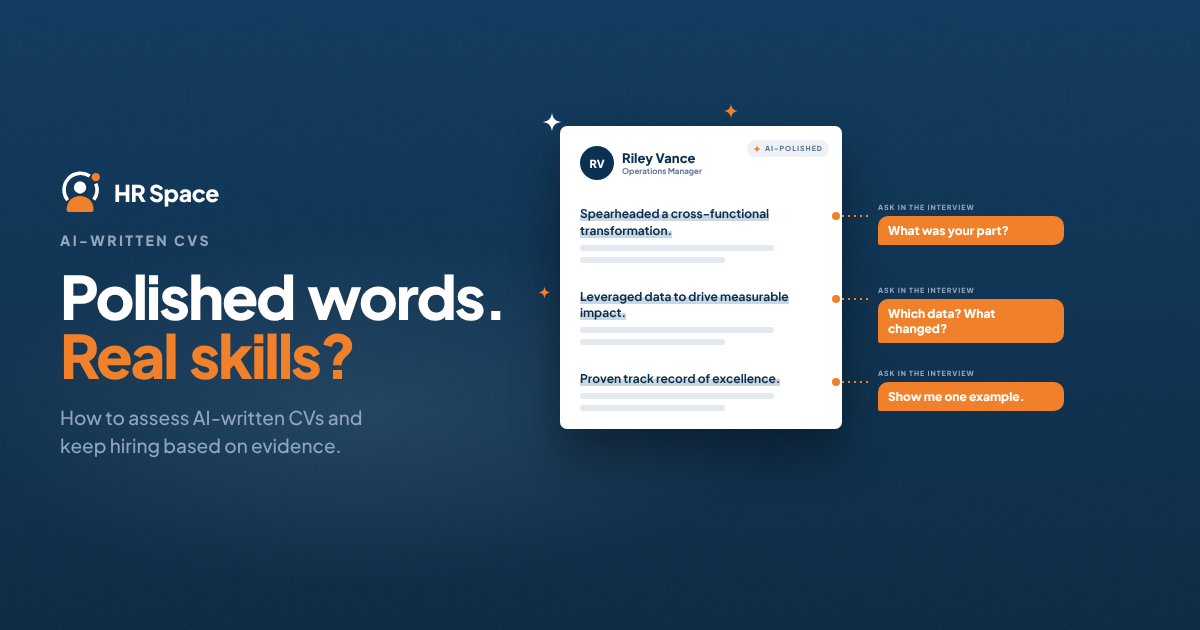
Separate writing assistance from the claim being made
A person may use a tool to organize a CV, edit grammar, or describe experience more clearly. The important hiring question is whether the account accurately represents their work.
Identify the claims that matter to the role. If the CV says the candidate led a project, ask what they owned, what others contributed, and which decisions they made. If it describes an outcome, explore the starting point and the evidence behind it.
Greenhouse's published AI principles emphasize structured hiring, observable information, and human ownership of decisions. That provides a useful basis for reviewing an application: agree on what needs to be demonstrated and keep someone responsible for interpreting it.
Avoid turning an impression about style into a recorded finding about honesty. If a material claim needs verification, name that claim and assess it directly.
Ask questions that reveal the candidate's own contribution
Choose one relevant example and explore it in detail. Ask how the work began, what constraints mattered, and why the candidate chose a particular approach.
Then change one condition in the scenario. Ask how they would adapt if the deadline shortened, the customer need changed, or a dependency failed. Keep the variation appropriate to the role and consistent with your assessment criteria.
These questions help the reviewer understand reasoning. They should not become an adversarial attempt to catch someone using an unfamiliar phrase.
Give the person time to clarify. An incomplete answer may need a better question, especially when the original example involved shared work or information they cannot disclose.
Review important claims through a consistent process
|
Application claim |
Follow-up to explore |
Evidence to record |
|
Led a project |
What did you personally own |
Decisions and scope of contribution |
|
Improved an outcome |
What changed and how was it measured |
Context and supported result |
|
Used a specialist skill |
How did you apply it to a problem |
Relevant explanation or work sample |
|
Worked across teams |
How were responsibilities agreed |
Specific collaboration example |
|
Solved a difficult issue |
Which options did you consider |
Reasoning and tradeoffs |
Use the same standard for similarly situated candidates. The purpose is to understand the work, rather than reward one document style or penalize another without relevant evidence.
Publish assessment rules before the task
If the process includes an exercise, explain which resources and AI tools are permitted. Distinguish what the candidate may use during preparation from what you expect them to demonstrate in the assessment.
Design the rule around the capability you need to understand. If the job normally involves using tools, a discussion of choices and verification may be relevant. If the assessment requires independent performance of a particular task, explain that requirement clearly.
Ask reviewers to apply the stated rules. Avoid introducing a new restriction after someone submits work and then judging them against an instruction they never received.
If a concern arises, follow the organization's assessment process and give the authorized owner the relevant information. Keep an observation, an unresolved question, and a confirmed breach distinct in the record.
Check generated hiring summaries as carefully as applications
Recruiters may also use AI to summarize answers or organize application information. Review those outputs against the underlying material before relying on an important claim.
Ask whether a summary preserves the person's contribution, the conditions attached to a result, and any uncertainty. A concise sentence can lose a distinction that matters to the role.
HRSpace Recruiting describes AI evaluations with reasons linked to answers and a human hiring decision. If that is part of your proposed workflow, ask a reviewer to inspect a response alongside its evaluation and identify what needs clarification.
The same evidence standard should apply on both sides of the process. A fluent application and a fluent generated summary both need a connection to the underlying work.
Leave a decision another reviewer can understand
Record the relevant claim, what the candidate demonstrated, and any important question that remains. Avoid notes that simply say “sounds AI-generated” without explaining what that means for the role.
If the candidate meets the requirements, describe the evidence. If a requirement is not demonstrated, name it and explain the basis of the assessment. If more information is needed, assign a focused follow-up.
This gives the team something useful to discuss and keeps the decision connected to the capability it set out to assess.
FAQs
Does an AI-assisted CV prove the candidate lacks the skills
The writing method alone does not answer the role-specific question. Examine the accuracy of relevant claims and ask the candidate to demonstrate the capabilities the job requires through an explained, consistent assessment process.
What should we ask about a polished project example
Explore the person's contribution, decisions, constraints, and supported results. Ask a relevant follow-up about how their approach would change under another condition. Preserve the context in the review notes.
Should candidates be told the rules for AI tools
Yes. Explain the permitted resources and what the assessment is intended to demonstrate before participation. Apply those rules consistently and use the organization's process to handle concerns about compliance with them.
What if our own team uses AI summaries
Check important statements against the original answers or records. Keep a human owner for the decision and note questions that require clarification. A summary should help review the evidence while preserving the context that matters.
Review one claim beyond the wording
Choose a relevant achievement and ask what the person actually decided and delivered. Explore HRSpace Recruiting with a sample answer and ask to see how the reviewer checks its evaluation before taking the next step.
Further reading
Ready to make HR the easy part?
Explore modular pricing and start a free 14-day trial.